Image courtesy of Scryfall.com
Strategic Breakdown: Tatsunari, Toad Rider and Enchantment Synergy
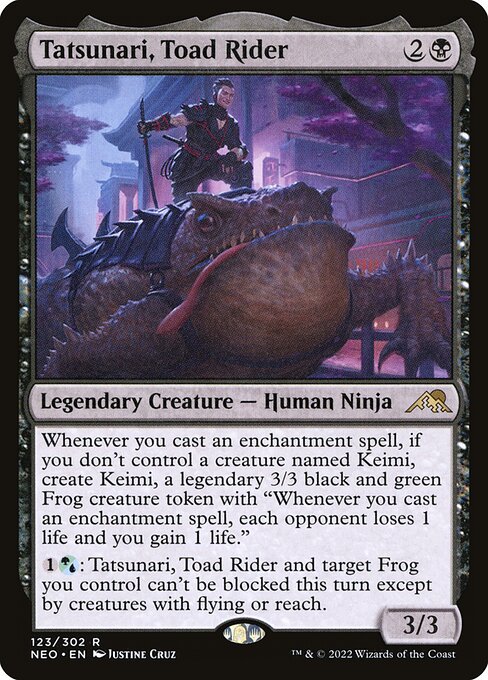
When you mix a cunning ninja with a toad-formed engine, you don’t just win games—you craft stories. Tatsunari, Toad Rider is a rare creature from Kamigawa: Neon Dynasty that invites a very particular kind of synergy: enchantment-centric boards that turn life totals and blockers into your advantage 🧙🔥. Priced with a modest three-mana bill in black (and allied with green and blue through its color identity), Tatsunari sits at a crossroads of aggression, token production, and clever disruption. The result is a playable, flavorful engine that rewards patient planning and precise timing, especially in Historic, Modern, or Commander tables where enchantment-heavy decks have room to breathe ⚔️.
At the core, Tatsunari’s two-part text creates a dynamic dance between enchantment spells and Frog tokens. The first clause, “Whenever you cast an enchantment spell, if you don't control a creature named Keimi, create Keimi, a legendary 3/3 black and green Frog creature token with ‘Whenever you cast an enchantment spell, each opponent loses 1 life and you gain 1 life,’” establishes a token-generating feedback loop. Keimi isn’t just a cute frog; it’s a lifegain-and-drain engine that scales with your spell repertoire. The second clause, “{1}{G/U}: Tatsunari and target Frog you control can’t be blocked this turn except by creatures with flying or reach,” adds the tempo punch—turning your tokens into unblockable threats that can force damage through boards clogged with x/1s or heavy blockers. The interplay between these two abilities makes Tatsunari a natural fit for enchantment-heavy lists that want both inevitability and reach 🧙🔥.
Why Enchantment Focus Looks Right for Tatsunari
- Token economy from Keimi: Each cast of an enchantment can seed a 3/3 Frog that pressures life totals and fuels more enchantment triggers. This fosters a self-sustaining loop where casting a single aura, charm, or artifact enchantment can yield multiple value lines: life swing, additional bodies, and more enchantments to cast later.
- Tempo via unblocked attacks: The {1}{G/U} activation gives you a temporary boost in combat math, letting you push damage while opponents scramble to answer the board. Unblocked Frogs are a scalpel, not a hammer.
- Color identity diversity: The G/U component in Tatsunari’s cost is not merely ornamental. It broadens your spell selection to include versatile green and blue enchantments, including value-driven draw, counterplay, and utility that supports a longer game while still leaning into black's disruption and reach.
In practice, this means you’re not locked into a single path. You can race if your hand is full of cheap enchants and cheap evasions; you can grind out value with recursion and lockdowns; or you can pivot toward a midrange beatdown plan if your opponents overcommit. The synergy is flexible, and that’s the beauty of Tatsunari’s design—an artificer’s toolkit wrapped in a ninja’s silhouette 🧙🔥🎨.
Core Engine: Keimi and the Frog-Friend Meta
Keimi is the literal engine starter and a curious nexus for deck-building decisions. Built around the enchantment theme, Keimi rewards you for every enchantment you cast by granting a life swing for each opponent. That means in a multiplayer game, you’re not just trading damage with a single player; you’re multiplying life drain with every cast—one life sap per opponent per enchantment cast. It’s a neat calibration between “I want to cast more enchantments” and “I want to pressure the table.” And because Tatsunari can tutor a blocking-free window for a Frog you control, you can sequence attacks to maximize both board presence and life swing without giving opponents a clean blocker to retire your threats later on 💎⚔️.
As a practical matter, you’ll want to think in terms of cast-order clarity. Start with a low-cost enchantment or two that establishes card advantage or removal, then follow with Keimi-producing plays. As soon as Keimi lands, your life totals start to move with every enchantment cast. The more you cast, the more lives swing, and the more your opponents will contemplate their own trajectory against a looming chorus of Frog tokens in the skies. The synergy scales nicely in games that feature a steady diet of enchantments—removal, auras, planeswalkers that lean into enchantment themes, and other pump effects that don’t overshadow Tatsunari’s tempo push 🧙🔥.
Deck-Building notes: Practical Staples and Planeswalkers
- Enchantment suite: Prioritize a mix of efficient, value-rich enchantments—ones that draw cards, filter lands, or deter disruption. Think of enchantments that can recur or be recast, so you never stall on cards you want to cast.
- Protection and recursion: Cards that protect Tatsunari and Keimi or fetch them back from the graveyard extend the engine’s lifespan. A few resilient combos let you stabilize early game pressure and pivot into a longer late game.
- Frog-token synergy: Keimi isn’t the only potential Frog on the battlefield; other Frog tokens or Frog-labeled creatures can amplify the unblocked-attack window and create a broader board-state that keeps pressure on the table.
- Finishing touches: When the board slows, you’ll want to leverage the unblockability window for Tatsunari or your Frogs to push the final points of damage. That pressure compounds with every enchantment cast, turning a tempo plan into a game-ending sequence.
From a design perspective, Tatsunari’s toolkit is a thoughtful nod to Neon Dynasty’s emphasis on hybrid mana and cross-color synergy. The rarity cap fits well for casual and competitive play alike, inviting players to explore a hybrid experience that is flavorful, interactive, and occasionally hilariously punny—Frogs, ninjas, and enchantments all colliding in one elegant package 🧙🔥🎲.
“If you’re building around Tatsunari, think tempo with staying power—the kind of deck that rewards you for committing to a plan and then exploiting every enchantment-cast moment.”
For those who enjoy the broader ecosystem, Tatsunari pairs nicely with broader Kamigawa-themed decks and can slot into Historic or Pioneer enchantment-based strategies with the right supporting cast. The card’s lore-drenched flavor—Toad Rider and eternal flame of the enchantment sparks—fits the neon-lit streets of Neon Dynasty, where art, strategy, and storytelling fuse into a single, mesmerizing play. As AI-assisted models begin to predict synergy more accurately, Tatsunari stands as a delightful case study: a single card whose value emerges from the interplay of tokens, blockers, and the tempo of each enchantment you cast. It’s not just about winning—it’s about weaving a smarter plan, one cast at a time 🧙🔥💎🎨.
Curious minds and deckbuilders alike can dive deeper into the wave of synergy modeling and practical playtesting, and if you’re chasing some real-world inspiration, check out the associated product below to level up your everyday carry—and yes, it pairs surprisingly well with late-night gaming sessions where you’re balancing budget-friendly builds with big ideas.