Image courtesy of Scryfall.com
Art Ignites Gameplay Flavor
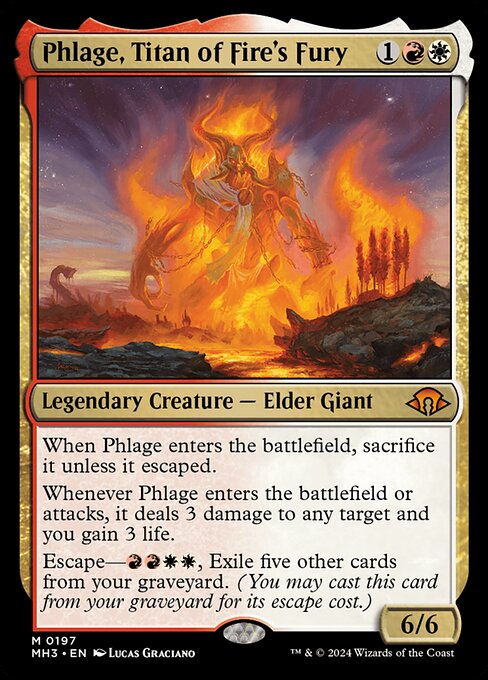
In the hands of a patient red and white commander, the art on Phlage—Titan of Fire's Fury—does more than decorate a card. It sets the battlefield on fire with a story you can feel in your bones. Lucas Graciano’s fiery titan bursts into frame with molten energy weaving through crimson and ivory—colors that tell a story of courage, risk, and heroic upheaval. When you draw Phlage, you don’t just see a stat line; you sense a dare: push the lava-lit tempo, or watch the titan slip back into the void via its own escape. That tension between blazing assault and calculated retreat is the art translating into play, a rare synergy that makes a game feel cinematic 🧙♂️🔥💎.
The creature’s two-tone identity—mana cost {1}{R}{W}—isn’t just a mana curve; it’s a cue that you’re about to blend aggression with lifegain, a dance that painters and players have chased since the dawn of red and white in tandem. The moment Phlage steps onto the battlefield, the artwork cues you to a moment of reckoning: a towering elder giant ready to unleash its fury, yet bound by a sacrifice unless it has escaped. That visual throughline—fiery might tempered by a narrow path to revival—helps players remember why you’d pay the red-white tax to see this titan smash in with a grin 🧙♂️⚔️.
Design and Mechanics in Concert
Phlage’s behavior on the stack mirrors the drama of its frame. When it enters, you must sacrifice it unless it escaped, a flavor-driven mechanic that echoes the perilous, sacrificial flame of its own legend. This isn’t just flavor text; it’s a design choice that rewards forethought about graveyard recursion and timing. If you’ve planned properly, Phlage can return from exile via Escape—{R}{R}{W}{W}, Exile five other cards from your graveyard—giving you a second—or even third—crack at a devastating blow. The Escape mechanic makes the card feel like a phoenix of red and white: dangerous to commit, thrilling to resurrect, and relentless in its second act 🔥🎨.
Beyond its entrance, Phlage’s enter-the-battlefield and attack trigger is where the tactical flavor really shines. Whenever this titan enters or attacks, it deals 3 damage to any target and you gain 3 life. That dual-output—directing damage while siphoning life back to you—creates an emotional swing: you can push through a weary opponent’s defenses, or you can weather a counterattack with a steady stream of life to keep you in the fight. It’s a card that begs you to think not just about finishing the game in one swing, but about pressing your advantage across multiple turns, ensuring every attack is a story beat rather than a one-note strike 🧙♂️⚔️.
“When a card’s art and its rules speak the same language, you feel your decisions echo in the color of the flames.”
Roles in the Playing Field: Limited, Commander, and Beyond
Limited play
In draft and sealed formats, Phlage delivers a palpable battlefield tempo shift. The red-white color pairing supports removal, anthem effects, and reach, making Phlage a tempo finisher that can tilt a mid-game board into your favor. Its 3/6/6 profile—glossy with enough power to demand respect—means it can trade with many midrange threats, and its life-gain adds a defensive buffer when the table is going wide with weenies or value engines. The Escape clause nudges you toward card advantage in longer drafts, encouraging you to value graveyard interactions even in a limited environment 🧙♂️🎲.
Commander/EDH and multi-player
In a Commander table, Phlage’s status as a legendary Elder Giant with a multifaceted ability set makes it a natural centerpiece for red-white strategies—think of it as a spicy cornerstone for theme builds that enjoy aggressive starts with late-game resilience. The Escape mechanic invites graveyard-synergy plays, which pair nicely with commanders that leverage exile, recursion, or wheel effects. Its triggers scale with your board state: more targets to ping, more opportunities to gain life, and more chances to escape and re-enter the fray for another burst of fury. And yes, the card plays well with other big red spells and white protection—you’ll often see it shining in a deck that blends temp control, burn, and resilient life gain, all while keeping players on their toes ⚔️💎.
Flavorful Lore and Collector Pulse
The Modern Horizons 3 set, a draft-innovation line, is a playground for ambitious card design, and Phlage embodies that spirit. Its mythic rarity signals the card’s big-play potential, not just in power but in story-telling capability. The artwork—by Lucas Graciano—captures a moment of cataclysmic potential, a monster’s gaze that says, “This scene could decide the war, but only if you brave the risk.” Collectors appreciate the card for its compelling silhouette and its playability in multiple formats where Escape redefines late-game access to the battlefield. If you’re tracking price threads, you’ll notice values in the single-digit range for non-foil copies and a modest premium for foils, with European markets showing similar enthusiasm. The card sits in a comfortable tier for mythics that aren’t just one-trick ponies; they’re a narrative engine that breathes life into your games 🧙♂️💎.
From a design perspective, Phlage demonstrates how flavor can guide mechanical decisions without sacrificing gameplay clarity. The red-white synthesis isn’t merely cosmetic; it’s a compass for deck-building philosophy: strike hard, heal, and if you must, awaken the titan again from the ashes. It’s a reminder that the art on a card can be more than a pretty picture; it can be a concrete sense of what you’re about to do on the battlefield, a shared language that players instinctively understand as they plan their next move 🎨⚔️.
Practical Play, But Make It Thematic
If you want to lean into Phlage’s flavor-driven potential, here are quick tips:
- Pair with efficient removal and life-gain engines so that your early aggression doesn’t backfire when Phlage hits the yard.
- Build around graveyard interactions—Escape becomes a second arrival, not a one-and-done moment.
- Favor cards that amplify damage output to maximize the “3 damage, 3 life” rhythm on ETB and attack.
- Use red-white disruption to protect your board state as you tempo-finish the table with this titan’s second act.
- In Commander, consider a deck that embraces recursion, value trades, and strategic attacks that keep opponents guessing about what you’ll do next.
In the end, the art is the spark, and the card’s text is the flame. Phlage invites you to lean into the warmth of risk—the kind that makes every game feel like a story you’re writing with a spark of danger and a splash of triumph 🧙♂️🔥💎.