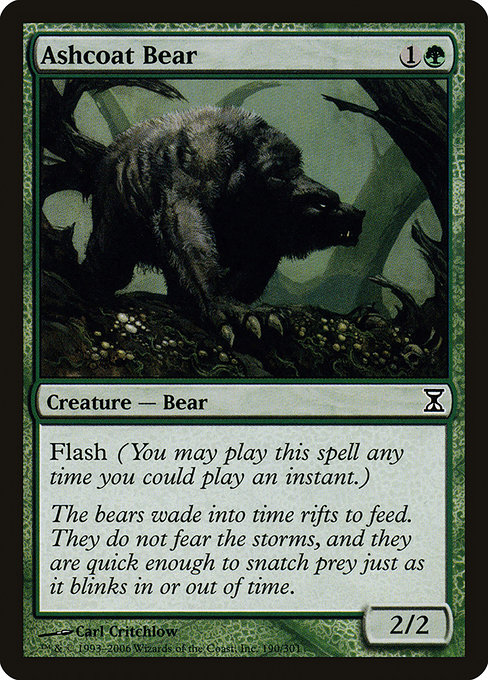
Image courtesy of Scryfall.com
Time-Threaded Beasts: Ashcoat Bear and the Glue of MTG Communities
If you’ve ever wandered into a thread about cards that don’t win every game in a flash of fireworks, you’ve probably stumbled upon something quietly magnetic: the lore surrounding a simple green bear with a very simple trick. Ashcoat Bear—low on mana, high on mischief, and dripping with Time Spiral-era flavor—has earned a surprising niche in MTG communities that collect stories, strategies, and shared memories around cards that aren’t the obvious marquee legends. This is the kind of card that, while seemingly modest on the battlefield, becomes a cultural pivot for fans who love the flavor of time-shifts, the tactile joy of a well-timed trick, and the art that makes a fantasy universe feel tangible 🧙♂️🔥.
From a gameplay perspective, Ashcoat Bear is a quintessential green tempo card: a 2/2 for {1}{G} with Flash. That single keyword unlocks a universe of possibilities, especially in formats that reward surprise and tempo. You can drop it on your opponent’s end step to field a 2/2 with smash-on-curve pressure, or you can weave it into a larger plan where you cast it during opponent combat to maximize surprise blocks. The simplicity of its stats and cost belies a design that invites players to think creatively about timing, value, and how a little denial of tempo can pivot a game’s narrative. And yes, we’re talking about a common, not a glossy mythic, which makes the card feel both accessible and endlessly reinterpretive for new players and veterans alike ⚔️.
The Time Spiral set itself is a fan favorite precisely because it invites retellings of the MTG multiverse’s narrative through a clockwork lens. Ashcoat Bear’s flavor text—“The bears wade into time rifts to feed. They do not fear the storms, and they are quick enough to snatch prey just as it blinks in or out of time.”—reads like a mini fable that fans can annotate, remix, and embed in their own lore. The bear isn’t just a creature on the battlefield; it’s a symbol of the way space and time bend for those who keep building, trading, and debating in the margins of a card game’s endless timeline. Community threads often braid this flavor into fan fiction, rule-of-thumb tips on tempo strategies, and even goofy memes about bears leaping through time rifts to steal your opponent’s next draw 🔥🎨.
The bears wade into time rifts to feed. They do not fear the storms, and they are quick enough to snatch prey just as it blinks in or out of time.
That flavor unlocks a cultural phenomenon: a shared vocabulary that fans use to talk about plays, not just cards. In EDH/Commander circles, players often invoke Ashcoat Bear as a playful reminder that tempo and surprise are still potent in longer games. In legacy and modern-adjacent chats, you’ll see debates about how a Flash creature with solid stats can enable edgy combat tricks, or how a well-timed Ashcoat Bear blurs the line between “value” and “story power” in a deck that cares as much about narrative momentum as it does about hitting dropped spells on curve 🧙♂️. The card’s relatively approachable rarity—common—with foil options in older printings invites collectors and thrifty players to share their finds, trade foil variants, and tell stories about the card’s trips through the mail and the kitchen-table meta of years past 🔎💎.
From an art perspective, Carl Critchlow’s illustration gives Ashcoat Bear a personality that fans can rally around. The bear’s expression—a mix of wry determination and arctic calm—pairs with Time Spiral’s clockwork motifs to evoke a sense of ancient woods meeting temporal rifts. Art becomes a talking point in online galleries, card-spotlight videos, and local game-store displays, and this visual cohesion helps a relatively modest card become a touchstone for groups that celebrate the aesthetics of magic as much as the mechanics. The art, the flavor text, and the clever timing of Flash all feed into fan discussions about what a card represents beyond numbers—about a shared mythos that makes every match feel like a chapter in a longer, collaborative campaign 📖🎲.
For players who love the collecting side, Ashcoat Bear’s pricing notes are a reminder that a card can be both approachable and storied. The data set lists a USD price around 0.35 for nonfoil and around 5.50 for foil, with foil printing typically catching the eye of players who want that extra shimmer while they narrate their bear’s time-bending escapades. In a modern context where many players build mono-green or ramp-adjacent tempo lists, a well-timed Ashcoat Bear can anchor a deck’s early game and provide a memorable moment that your table will quote in future games. The shared joy of discovering a card that’s both a reliable play and a storytelling prompt is one reason fans keep returning to old sets and new reprints alike 🧙♂️💎.
Strategic threads that weave lore and play
Communities often treat Ashcoat Bear as a symbol of clever, offbeat tempo. In practical deck-building terms, you’ll see discussions about how Flash allows you to surprise opponents during lifecycle events like opponents casting big initiates or creature-swarm turns. Players may pair the bear with spells that benefit from surprise entry or exit, or with other flash enablers that turn the battlefield into a chessboard of unexpected tempo swings. While it’s a modest creature, its footprint in a team’s storytelling arc can be outsized—the moment you cast it on an opponent’s end step, you not only threaten defense; you also prompt your playgroup to narrate what “the bear that blinked through time” might do next turn. The enduring appeal is that these conversations aren’t just about winning; they’re about building a shared world where a single card becomes a memory, a talking point, and a fan-made legend 🧙♂️🔥.
Where the community meets real life
Multiplayer formats, fan articles, and even custom-store mini-events often use Ashcoat Bear as a case study in how lore can elevate play experiences. The card’s Time Spiral lineage invites discussions about time manipulation, time travel tropes, and how a seemingly humble 2/2 with Flash can anchor a story-heavy strategy. Collectors and new players alike can appreciate the card’s place in MTG history, its thematic resonance with green’s adaptability, and its value as a storytelling anchor at casual meets and competitive discussions. If you’re looking to celebrate this thread in real life, pairing your MTG hobby with a tactile accessory—like a neon mouse pad that keeps pace with late-night deckbuilding sessions—can be a playful nod to the artful blend of fantasy, nostalgia, and modern play that Ashcoat Bear represents 🧙♂️🎨.
To keep the vibe rolling beyond the table, consider exploring product pairings that fit your hobby mood. The Neon Mouse Pad linked below is a practical way to boost late-night drafting marathons, while the card’s lore continues to spark conversations in your favorite MTG communities. It’s all part of the same ecosystem: a shared love of cards, stories, and the thrill of a perfectly timed surprise that makes every session feel legendary 🔥💎.