Image courtesy of Scryfall.com
Axegrinder Giant: Digital pricing in MTG markets vs paper market realities
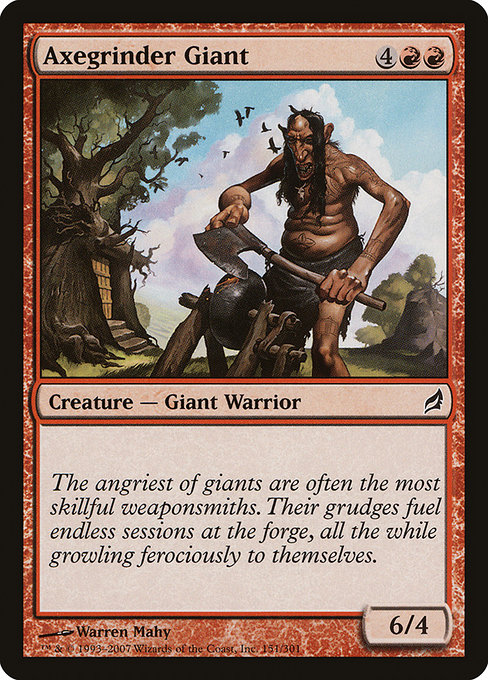
If you’ve ever chased a card across both screens and deck boxes, you’ve felt the tug between digital price signals and the stubborn inertia of the paper market. Axegrinder Giant, a red-hot target from Lorwyn’s bustling forge of giants and goblins, serves as a perfect case study. It’s a chunky 6/4 for four mana plus two red mana, a hungry beater with no tricks on the card text—yet the market still buzzes around it in surprising ways. 🧙🔥💎 The journey from pixels to paper is not always a straight line, and Axegrinder Giant makes a clean example of why that happens in MTG today. ⚔️
Profile in brief: what the card actually is
- Name: Axegrinder Giant
- Mana cost: {4}{R}{R}
- Type: Creature — Giant Warrior
- Power/Toughness: 6 / 4
- Rarity: Common
- Set: Lorwyn (LRW), released 2007-10-12
- Artwork: Warren Mahy
- Flavor text: “The angriest of giants are often the most skillful weaponsmiths. Their grudges fuel endless sessions at the forge, all the while growling ferociously to themselves.”
- Oracle text: None (pure stat-stick with no triggered abilities)
In the online mint, Axegrinder Giant sits in the commons but carries the bravado of a classic red beater. Its foil version is a touch rarer, and that rarity shows in price signals that diverge from the nonfoil market. In Lorwyn’s evergreen world, this card is a reminder that rarity in a card’s print run doesn’t always align with its impact on the board. The card’s artistry and flavor text also give it a nostalgic sheen that players and collectors love to chase, especially when walking the line between casual cube drafting and more competitive Modern- or Legacy-focused decks. 🎨🎲
Digital price signals: what the data are saying
On the digital side, the numbers tell a precise, often merciless story. According to the card data, Axegrinder Giant carries a current USD price of about $0.08 for nonfoil and around $0.25 for foil. In euros, you’ll see roughly €0.06 nonfoil and €0.23 foil. The TIX price hovers near $0.03. These figures reflect a few key digital-market realities:
- The digital market rewards accessibility and instant liquidity. A common from a decade-old set remains a quick add to a Modern or Legacy deck in MTGO or MTG Arena, where the card pool is vast and reprint anxieties are less pronounced than in paper. 🧙🔥
- Foil copies command a premium, showing up as a ~3x factor in some cases due to foil supply dynamics and collector interest. For Axegrinder Giant, the foil price is notably higher than nonfoil, signaling that even everyday cards can carry evergreen appeal for foil enthusiasts. 💎
- Prices in digital formats often reflect deck-building trends in Modern and Eternal formats where a single card can enable a surprising number of slot-fill options. When a red creature lands a role in a midrange or big-spell strategy, you’ll see the digitals respond with brisk price activity. ⚔️
In short, digital pricing tends to be direct, data-driven, and reactive to build-drafting trends. The scarcity of a digital card isn’t about physical stock; it’s about how often players reach for it in decks, and how comfortable the platform is with the card in a given meta. Axegrinder Giant’s digital numbers mirror a healthy, low-cost option for players who want a big body on a budget, with foil magic adding a small premium for aesthetics and collectibility. 🧙🔥
Paper market realities: where the real-world value lives
Now, let’s glance at the cardboard world. The Lorwyn-era commons like Axegrinder Giant were printed in abundance, and the paper market often follows the script of supply over time. The price signal in paper is less about immediate deck viability and more about inventory on shelves, local shop dynamics, and the ebb and flow of casual play. In the real world, the nonfoil version sits at a few dimes, while foil copies—when found in a well-loved show or foil-boosted EDH night—tend to carry a higher premium again due to foil scarcity and collector interest. The gap between digital and paper pricing isn’t about one being right and the other wrong; it’s about two ecosystems operating with different constraints and incentives. Paper cards also live in a culture of condition, grading, and real-world play wear, which can nudge prices in unpredictable directions. 🎲
It’s worth noting that Axegrinder Giant’s status as a common in Lorwyn means it’s less likely to command the stratospheric prices you see for rares and mythics. Yet, the value isn’t entirely absent: collectors prize a clean foil for shelf appeal, and grinders value a sturdy, well-loved copy for cube or casual deckbuilding. The result is a moderately priced staple that remains accessible in most local games shops, even as digital channels continue to flex price momentum with modern decklists and online tournaments. ⚔️
Why the price gap persists: drivers behind digital vs paper divergence
- Format demand: Axegrinder Giant is legal in Modern and Legacy, two formats that keep red beater archetypes relevant, which sustains digital demand even when Standard rotates. 🧙🔥
- Print history and reprints: The card’s Lorwyn printing is older, and while there have been no recent Lorwyn reprints indicated in the data, the absence of frequent reprints can limit new supply in paper while digital markets can adapt quickly. 💎
- Condition and availability: Paper copies flow through shop stock and online marketplaces with varying condition, which can push prices up or down independently of digital supply. In contrast, digital copies are less dependent on physical wear and shelf space. 🎨
- Collector psychology: Foils carry appeal for display and nostalgia, often creating a higher premium on both sides of the market, although the price delta can be modest for a common. 🧙🔥
- Platform economics: Digital marketplaces use automated pricing, instant buy/sell, and TIX-based economies that can dampen or amplify price swings far more quickly than paper. 💎
Practical guidance for players and collectors
For players, Axegrinder Giant is a straightforward board presence: a big body at a reasonable cost that can swing momentum and deter ranged removal. In a red-centric strategy, it fills the role of an early-to-mid-game threat, providing raw power without requiring complex trickery. For budget-conscious builders, the nonfoil option is a solid choice, with foil as a nice-to-have for those chasing a showy collection piece. For collectors, the foil version offers a longer-term upside if Lorwyn nostalgia continues to trend and collectors chase pristine copies. 🎲
If you’re mapping your collection strategy, consider how digital prices might guide your purchasing decisions in MTGO or MTG Arena: a cheap nonfoil adds immediate play value, while a foil variant can act as a small investment that rewards care and storage quality. And if you’re exploring the broader MTG ecosystem, remember that the paper market still matters—your local store’s stock, the condition and grading market, and the joy of sharing a table with friends all contribute to a vibrant community beyond the numbers. 🧙⚡
On a lighter note, as you plan your next game night or a casual drafting session, you can pair the strategic focus of your decks with something equally stylish off the table—the Neon Slim Phone Case for iPhone 16 with a glossy Lexan finish. It’s a cheeky nod to the glossy shine of foil cards and the neon spark that keeps MTG nights memorable. If you’re curious, the product below is a fun, unobtrusive partner for your gear as you dive into the multiverse. 🎨