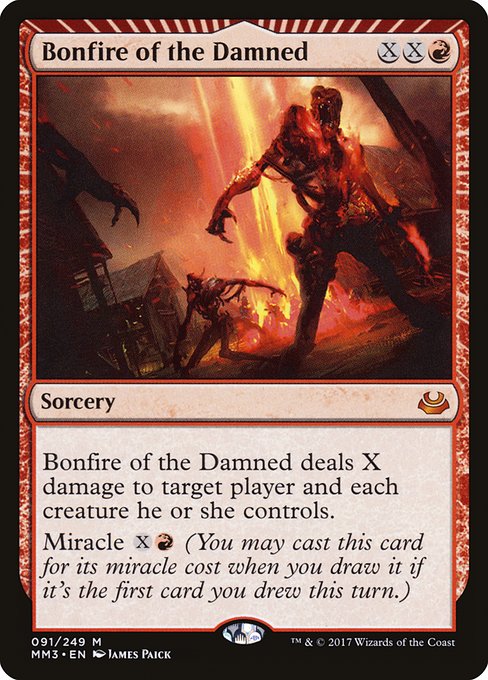
Image courtesy of Scryfall.com
The evolution of enchantment design
Enchantments have always served as the slow-burn engines of a deck—permanent effects that quietly reshape the battlefield as turns tick by. From the early days of Auras that attached to creatures to the modern era’s more modular, self-contained effects, enchantment design has chased a core idea: make lasting influence feel meaningful without becoming rigid or oppressive. The lineage is rich with experiments, and one card from Modern Masters 2017 offers a revealing lens into how designers flirt with power, timing, and risk. 🧙🔥
Consider the red spell Bonfire of the Damned. It’s a sorcery, not an enchantment, but it sits at a pivotal moment in MTG’s design arc where “boom, you lose” effects could be massed into a single, scalable event. With a miracle trigger and a flexible X cost, the card embodies a design philosophy that rewards players for reading the game state and choosing the right moment to strike. The set Modern Masters 2017 (MM3) reprint plane gave this card a new home in a Modern-legal environment, reinforcing red’s identity as the color of explosive punishments and dramatic reversals. ⚔️
Miracle as a bridge between permanent tempo and instantaneous impact
Miracle is a keyword that sits at the intersection of enchantment-style inevitability and spell-for-the-moment relief. Bonfire’s miracle cost is {X}{R}, allowing the player to unleash a scaled, high-impact blast at the moment it’s drawn, provided it’s the first card drawn that turn. This creates a delightful tension: you might cast Bonfire early for a manageable X, or you might hold it until you draw it and then unleash a board-clearing inferno. The Miracle mechanic effectively turns the top of your deck into a secret accelerator for your strategy, mirroring how enchantments often stack incremental value over time, only here that value can explode in a single, satisfying flash. 🧙🔥
From a design standpoint, this approach marked a shift: rather than forcing players to invest steadily in a long-tail advantage, designers increasingly experimented with conditional, immediate effects that scale with your draw and your board. Bonfire demonstrates how a red spell can borrow an enchantment’s long-game aura—persistent threat, lasting impact—while delivering a dramatic, game-changing moment that feels almost enchantment-like in its memorable weight. The card’s ability to pair a devastating X-damage sweep with a Miracle option během the draw step is a microcosm of how modern enchantment-inspired design often travels: permanent influence with the possibility of sudden, game-turning bursts. 🪄💥
Design highlights from Bonfire of the Damned
- Dynamic scaling: The X in the mana cost means the spell can scale to the moment, letting you choose a level of devastation that fits the board and your hand. This is a rare form of volatility that enchantment-focused minds love—power without rigidity. 💎
- Mass removal with a twist: Dealing damage to a target player or planeswalker and all creatures they control is a textbook board wipe, but the inclusion of Miracle adds a high-stakes, high-reward flavor not always associated with traditional mass-removal effects. ⚔️
- Color commitment: As a red card, it embodies red’s penchant for explosive power and dramatic plays—where timing, not just effect, shapes victory. The color identity reinforces a design story about how red can pivot from direct burn to wholesale battlefield reshaping when the moments align. 🧙🔥
- Rarity and reprint dynamics: MM3’s mythic rarity for this card, along with foil and nonfoil options, underscores the collector culture around high-impact spells that reward savvy players who chase both power and aesthetic. The card’s value profile on Scryfall—roughly a couple dollars in nonfoil, with foil enjoying a premium—speaks to how iconic moments continue to find homes in modern collections. 💎
“The thrill of Miracle is a design beacon: it teases that a surprising, game-shifting moment can be hiding in the very card you drew, ready to bloom the moment you cast it.”
Playing Bonfire in the shadow of enchantment design
In practical terms, Bonfire rewards a gambler’s approach to tempo. You’re incentivized to maximize early draws to unlock miracle casts, while also acknowledging that you’re playing with a flexible X that demands careful resource management. When you actually resolve Bonfire, the damage is not merely to a single target—it’s a statement: a red engine that says, “I’m going to reset your battlefield and leave you staring at a crater of at least one of your boards.” For players who savor the “play the long game” philosophy of enchantments, this card is an exhilarating reminder that red, too, can craft enduring implications—just with a boom instead of a bloom. 🎲
Design-wise, the evolution here is clear: enchantments traditionally emphasize permanence and continued influence, but modern iterations leverage dynamic costs and conditional triggers to bend permanence toward dramatic, one-shot reversals. The miracle condition—first drawn card of the turn—brings a tactile, deck-thickening tension to the front lines, letting red’s raw power be deployed at the most cinematic moment. It’s a micro-lesson in how enchantment design can borrow from bold spellcraft to produce lasting memories on the battlefield. 🧙🔥
Value, craft, and collector’s flavor
Bonfire of the Damned is a card that finds a home among players who value both memory and potential payoff. Its mythic rarity places it among the more dramatic pull from MM3, a set celebrated for reprinting and preserving a certain “Masters” vibe—where power is clear, and play is loud. In casual circles, folks talk about price points and foil premiums, but in the long arc of enchantment design, the card remains memorable because it showcases a rare moment when red’s immediacy collides with the enchantment’s aura of inevitability. For those who adore the cross-pollination of past and present design, Bonfire is a reminder that the most agile enchantment-inspired concepts often come wrapped in a spell’s appetite for control. 🧙🔥💎
Collectors and players who chase the MM3 line often track not only playability but the story behind how a card’s mechanics evolved. The Miracle mechanic’s presence in a red mass-damage spell is a perfect illustration of the era’s appetite for hybrid design: a single card can feel like an old-school board wipe and a new-school surprise at the same time. In the grand tapestry of MTG, it’s moments like these that fuel the conversations we fans love—about how far enchantment design has come, and how far it still has to go. ⚔️
Speaking of style and surfaces, if you’re building a desk space that feels as legendary as a topdeck, a little real-world flair never hurts. To keep your battle plan as sharp as your deck, check out this Neon Desk Mouse Pad—the perfect companion to long drafting sessions and late-night brews of coffee and victory. The product is just a click away, ready to add a splash of neon to your playing surface. 🎨