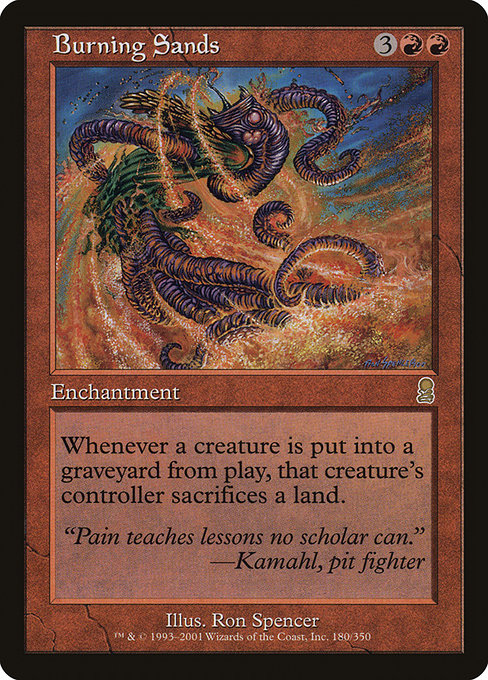
Image courtesy of Scryfall.com
Collaborations that Catch Fire: Artists and Designers Sparking Magic
Magic: The Gathering has always thrived at the intersection of artistry and engineering. The very ink on a card—its color identity, its mana cost, its rules text—exists because a designer mapped a strategic moment for the battlefield, while the artist rendered a visual heartbeat that makes players fall in love with that moment. When these two forces align, you get more than just a card; you get a memory, a vibe, and sometimes a breakthrough in how players perceive gameplay itself. 🧙♂️🔥💎
One standout example from MTG’s rich history is the red enchantment from Odyssey, Burning Sands. On the surface, it’s a straightforward punisher: the kind of enchantment red loves when the board gets brutal. But when you peel back the layers—artist, designer, and flavor text working in concert—you see a masterclass in how collaboration shapes both strategy and storytelling. The card’s heavy mana cost of {3}{R}{R} signals intent: commit, feel the heat, and be prepared to punish the other side when order collapses on the battlefield. ⚔️
Burning Sands: A Desert-Heat Collaboration, Narrated in Rules
Issued in Odyssey (the sprawling 2001 expansion that carried red’s blistering edge into a world of lore-rich deserts and tumultuous kingdoms), Burning Sands is an enchantment that embodies a red mechanic with a twist. The text—“Whenever a creature dies, that creature's controller sacrifices a land of their choice.”—turns the battlefield into a punishing, sandy arena where death is not a quiet end but a transitional moment that reshapes the map itself. It’s a design choice that rewards careful tempo and punishing planning, a hallmark of how the set balanced risk and reward in a world that rewarded bold plays. 🧭
The art by Ron Spencer, captured in the Odyssey frame, is not mere decoration. It dramatizes the card’s core idea: heat, danger, and the perpetual cost of battle. The desertscape and the fiery palette feel like a visual counterpart to the text’s abrupt reality check. When a creature falls, the sands remind us that land and life are inextricably linked in this harsh environment. The collaboration here is palpable: the designer’s rule-text logic and the artist’s desert horizon work together to push a single, memorable moment into a full narrative beat. 🎨
Odyssey as a set was a turning point for MTG’s world-building and mechanical experimentation. It leaned into more pronounced edge cases, nuanced color identity shifts, and a storytelling cadence that didn’t rely on the bright romance of earlier blocks. In this context, Burning Sands stands as a crystallization of how artists and designers talk to each other across the card frame. The typography, the borders, and the aura around the card are all calibrated to emphasize consequence—the moment you lose a creature, a land follows, and the opponent must adjust their strategy in real time. The result is a card that feels both lore-laden and brutally practical on the table. ⚔️
Flavor text often carries a whisper of a broader tale in MTG, and Burning Sands is no exception: “Pain teaches lessons no scholar can.” — Kamahl, pit fighter. That line is a narrative nudge, a reminder that the battlefield is not just about numbers but about resilience, risk, and the stubborn pursuit of victory in a sun-scorched world.
From a collectability standpoint, Burning Sands sits among Odyssey’s rarer glow—the kind of card that players recall when they think of red’s mid-era power curve and the set’s evocative desert aesthetics. It’s a reminder that not every enchantment needs to be a battlefield-wide bomb to leave a lasting impression; sometimes the thinnest sliver of text, paired with a perfect art moment, can define an entire deck’s philosophy. The artwork’s trusted alignment with a bold mechanic makes it a go-to example when fans discuss how design and art inform each other’s impact. 🧡
Design Lessons: What This Card Teaches About Collaboration
- Text as a narrative engine: The death-triggered land sacrifice creates a cascading line of decision-making that agents on both sides must respect. It turns a simple event into a strategic pivot, much like a designer-prompt that reframes a game state mid-play. The collaboration between the art’s desert heat and the card’s rule text makes the moment feel earned—the desert isn’t just a backdrop; it’s an atmosphere of consequence.
- Color identity and emotion: Red’s identity is risk, speed, and raw intensity. The artwork’s blazing tones reinforce that emotion, while the rules give red players a chance to impose a harsh price on mistakes. It’s a textbook example of ensuring that color storytelling and color mechanics reinforce each other. 🔥
- Set identity through synergy: Odyssey’s broader world-building provided fertile ground for artists and designers to push the envelope. Burning Sands demonstrates how a card’s art direction can echo the set’s themes—desert kingdoms, heat, and unforgiving battles—while the mechanic punishes missteps in a way that feels thematically coherent. 💎
- Accessibility with depth: The ability text is concise, yet the implications are rich. This balance makes the card approachable for newcomers while still offering subtle nuance for seasoned players who want to sculpt a careful land-dotting strategy. The collaboration shows how a well-phrased effect can yield durable, repeatable play patterns. 🧭
Practical Takeaways for Modern Play
In Commander or casual multiplayer formats, Burning Sands can act as a centerpiece for red’s aggressive, resource-denial playstyle. It encourages opponents to think twice about their sacrifice-corner events and to weigh the long-term value of each land drop against the immediate tempo hit. For deck builders, the card invites creative ways to maximize value from creature death triggers, forcing careful board-state management and punishments that escalate as the game progresses. The flavor and design work together to keep the player engaged in a narrative of heat and consequence. 🎲
For fans who want to appreciate this partnership beyond the table, there’s a delightful complement: a steady lineup of accessories and peripherals that keep the drafting nights smooth and stylish. If you’re looking to elevate your desk setup during late-night deckbuilding sessions, consider a Neon Gaming Mouse Pad—the kind of practical accessory that keeps pace with the intensity of a scrappy red-on-red showdown and pairs nicely with the card’s fiery theme. The product link below is a friendly nod to that vibe, offering a dash of color and durability for long sessions of planning, piloting, and playful wrecking balls of spellcraft. 🧙♂️🎨