Image courtesy of Scryfall.com
If you’ve been keeping an eye on the MTG market lately, you’ve likely noticed a quiet but persistent wave of buyouts circling around smaller-set staples. The phenomenon isn’t about blockbuster mythics or chase foils; it often centers on common and uncommon cards from core sets and smaller releases—the sort of cards you’d typically flip for lunch money at the draft table. Today, we’re using Ursine Champion from Core Set 2019 as a lens to understand why these small-set cards can become flashpoints in a market that loves drama, ноchers, and a good deal of nostalgia 🧙♂️🔥. This isn’t merely about price spikes; it’s about how supply, demand, and reprint cadence shape access for casual players, EDH generals, and budget-loving collectors alike 💎⚔️.
What makes small-set cards a buyout magnet?
- Limited print runs and long tails. Core sets and smaller blocks historically shipped fewer copies than the massive modern sets. The result: when a handful of players want a card for casual decks, budget builds, or EDH, even modest demand can tighten supply quickly.
- Habitual demand from evergreen formats. Green creatures with utility—especially affordable ones—find homes in Commander, field commanders like Llanowar Elves, or niche enablers that players discover mid-rotation. Ursine Champion is a green two-drop with a spicy pump ability that scales into big turns, which appeals to midrange and stompy builds alike 🎲.
- Reprint fate and perceived risk. The cycle of reprints often delays a card’s return, which can artificially buoy prices before a reprint is announced (or not). In Ursine Champion’s case, the card sits in a core-set block with older printings not routinely reprinted every year, making it more susceptible to price nudges when demand surfaces.
- Digital presence and market data. Online platforms reflect a blend of casual shoppers, grinder scouts, and price trackers. Even a small price movement on a card like Ursine Champion—currently around a few dimes in USD—can cascade into broader online chatter and perceived momentum, drawing more buyers into the loop 🧙♂️.
Ursine Champion: a compact snapshot with flavor and function
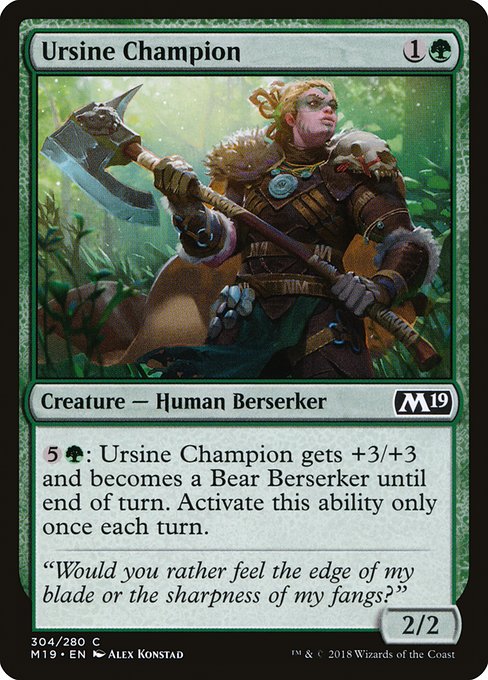
Let’s pull back the curtain on this common creature. Ursine Champion costs {1}{G} and presents as a Creature — Human Berserker with a sturdy 2/2 frame. Its true party trick comes from a single, spicy activation: {5}{G}: This creature gets +3/+3 and becomes a Bear Berserker until end of turn. Activate only once each turn. It’s not a flashy combo piece, but it rewards well-timed bravery and careful mana planning—perfect for green-centric strategies that lean into combat inevitability ⚔️. The card’s flavor text—“Would you rather feel the edge of blade or the sharpness of my fangs?”—freezes a moment of primal drama into the board, a wink to the bear-berserker vibe that makes green decks feel a touch more feral 🎨.
From a collector perspective, Ursine Champion’s identity is uncomplicated: a common card from Core Set 2019 (M19), illustrated by Alex Konstad. The card’s market data—non-foil only in this instance, with a current approximate USD value around $0.16 and EUR around €0.09—reflects its accessibility and everyday utility rather than chase-foil allure. While EDH players don’t chase it as a linchpin, the card earns a place in many green builds and budget decks, where its efficiency often beats more expensive sidekicks 💎.
Interpreting buyouts through market signals
When you watch buyouts in action, a few signals tend to stand out, and Ursine Champion is a neat case study. First, liquidity matters. Because this card appears in a core-set environment, it’s more likely to drift in and out of print cycles across reprint waves, but it frequently sits on shelves in stores and marketplaces. A sudden surge in interest—often spurred by a popular EDH decklist or a streamer’s offhand mention—can push price up, even if the card’s long-term trajectory remains flat. Second, online price tracking amplifies perception. A modest increase in USD or EUR can attract new buyers who fear missing out, prompting a self-fulfilling loop of modest buyouts 🧙♂️🔥.
- Rarity and format scope. Common cards like Ursine Champion are legal in multiple formats (Historic, Modern, Pioneer, etc.), but not all have a stable presence in every meta. The card’s relatively low EDHRec rank (around rank 25,604) underscores that it’s not a top-tier staple, yet a dedicated subset of players will pursue it for specific thematic or synergy reasons 🎲.
- Print history and reprint risk. While not currently highlighted as a reprint target, the MTG market’s memory is long. If a future core set or evergreen product revisits Berserker lore or green-beefing mechanics, Ursine Champion could surface again, nudging prices upward in the meantime.
- Platform-specific price variance. The card’s non-foil status and paper availability can diverge from MTGO or Arena economies. In practice, a spike on one platform often drags others along—especially if resellers note synchronized price actions across marketplaces 💎.
Practical guidance for players and collectors
For players building around green thresholds and midrange aggression, Ursine Champion remains a sensible, budget-friendly pick. When buyouts creep in, here are a few grounded principles to navigate the moment:
- Set a price floor and stick to it. If you’re chasing a specific price point, decide in advance what you’ll pay and don’t get swept up in hype spikes 🧙♂️.
- Diversify purchases. Rather than chasing a single card, broaden your green creature suite. You’ll ride out price fluctuations with a more resilient deck budget 🌲.
- Watch reprint chatter, not rumors alone. Reprints are not guaranteed announcements, and when they do appear, they often align with broader set rotations. Don’t assume a buyout signals a guaranteed price jump—sometimes a reprint window appears sooner than you think 🔎.
- Consider non-monetary value. If you’re a player rather than a collector, the card’s mana swing and the “bear berserker” flavor are not just numbers; they’re moments of board drama that land in every green deck’s story arc 🎨.
A small‑set card with big‑set vibes—and a desk-side companion
As you strategize your next MTG session, you might also be refreshing your desk setup. While Ursine Champion’s price might meander in the background, a reliable desk pad can keep the mood high during long nights of drafting and testing. If you’re hunting something sleek, functional, and affordable to pair with your gaming space, this Custom Desk Mouse Pad—white, cloth, non-slip—offers a quiet counterpoint to the vibrant chaos of the battlefield. It’s a reminder that the MTG hobby isn’t just about cards; it’s about creating a space where strategy, humor, and a little bit of chaos come together in harmony 🧙♂️🎲.
For those who want to explore more tap-worthy finds or catch the latest market chatter, consider checking trusted marketplaces and EDH community hubs for Ursine Champion’s current stance. The card sits at a sweet spot for budget-conscious players who still want a touch of green grit on the battlefield. It’s not a headline grabber, but it’s the kind of card that quietly compounds into a collector’s shelf and a family of green creatures that you’ll remember long after the draft night lights dim 🧙♂️🔥.