Image courtesy of Scryfall.com
Authenticity and Grading: Canal Dredger in Conspiracy’s Draft World
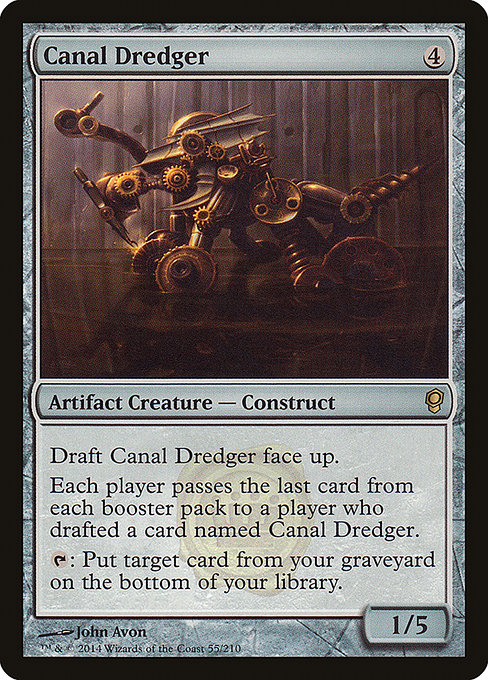
MTG card grading isn’t only about the physical pristine-ness of a card; it’s also about provenance, era, and the social mechanics that surround the card’s life in play. Canal Dredger, a rare artifact creature from the Conspiracy set, sits at a particularly interesting crossroads for collectors. Released in 2014 as part of a draft-focused line that leaned into social dynamics, this card is colorless, costs 4 mana, and shows a sturdy 1/5 body—the kind of resilient behemoth you’re happy to draw late in a long drafting night 🧙♂️🔥💎. The artwork, credited to John Avon, captures a grand canal scene that feels both grandiose and a touch whimsical, which is quintessential Avon and a reminder of how art and mechanics reinforce a card’s collectibility 🎨.
When you examine Canal Dredger for authenticity, you’re looking for a few reliable markers. First, confirm the CNS (Conspiracy) printing with the correct set symbol and the expected border style for a 2003-era frame used in Conspiracy draft-innovation sets. The card’s mana cost is exactly {4}, and the type line reads Artifact Creature — Construct. Its rarity is listed as rare, and the card text contains the distinctive drafting mechanic: “Draft this card face up. Each player passes the last card from each booster pack to a player who drafted a card named Canal Dredger. {T}: Put target card from your graveyard on the bottom of your library.” These details—font, layout, and the precise wording—are the kinds of textual fingerprints graders rely on to distinguish authentic CNS prints from notable misprints or forgeries 🧙♂️⚙️.
“Draft this card face up.” — a line that encapsulates Conspiracy’s playful, social DNA and a reminder that the card’s identity isn’t just about numbers; it’s about a shared drafting moment 🧭.
Grading markers and rarity-driven value
Canal Dredger’s color identity is empty, reflecting its colorless artifact nature. Its art credits (John Avon) and the Conspiracy watermark are important provenance clues that collectors scrutinize under strong light or high-res scans. The card exists in both nonfoil and foil finishes, with the latter often carrying a premium in sets that celebrate alternate foils or special runs. In the current market data you’ll find a baseline price—roughly USD 0.30 for nonfoil and around USD 1.15 for foil—though condition, corner wear, and printing variety can nudge those numbers up or down. Across European markets, you’ll see similar spreads: about EUR 0.31 for nonfoil and EUR 1.13 for foil. For modern collectors, these values might read as modest; for CNS enthusiasts, they’re a gateway to a memorable drafting era and a talking point in any binder stacking session 🧙♂️💎.
From a practical perspective, Canal Dredger is a card that rewards careful storage and correct sleeving. It’s a reminder that Conspiracy-era cards often trade on nostalgia as much as on raw utility. Its legal formats matter for grading context—this card is legal in Legacy, Vintage, and Commander; it’s also listed as legal in Duel, among other formats. For a collector aiming to frame a Conspiracy-themed binder or a casual cube, these format footprints translate into long-term value as a social artifact as much as a playable piece 🔥⚔️.
Why authentic Canvas and print history matter for your collection
Artifacts like Canal Dredger aren’t just about power on the battlefield; they tell a story about how MTG evolved. Conspiracy leaned into a drafting ecosystem that encouraged players to read packs like a narrative, with pack-passing and face-up drafting creating a social contract among players. The text itself—an unusual, directive ability mounted on a board that doesn’t care about color—invites a conversation about how card design intersects with play culture. If you’re grading a CNS print, you’ll pay attention to the subtlety of the border, the font weight of the ability texts, and the placement of the set watermark. In short, this is a perfect candidate for a “read the card, feel the history” checkmark on any authenticity checklist 🧙♂️🎲.
For the modern collector, Canal Dredger still shines in casual tables and alt-art showcases. Its 1/5 body sees it stubbornly soaking up damage, and its defensive stance pairs nicely with planeswalker shards and board-wipe resilience in artifact-focused decks. The card’s ability to move a graveyard card to the bottom of your library can be a small but meaningful shuffle repair mechanism—great for topdeck planning late in a game. And because it’s from a draft-centric set, the card remains a symbol of a particular MTG era when social play and clever drafting ruled the day 🧙♂️🎨.
Cross-promotional note: a collector’s toolkit and a little everyday magic
While you’re deep-diving into the grading and the lore, you might appreciate a practical, everyday companion that keeps your drafting sessions smooth and stylish. Our partner product offers a touch of convenience for any MTG night—think of it as a tiny, reliable ally as you study card text and survey your binder. The phone grip kickstand is perfect for keeping your device steady during online price checks, long lore reads, or sharing a clutch of Conspiracy discoveries with friends. A small gadget, a big smile, and a touch of shop-quality magic 🧙♂️🔥💎.