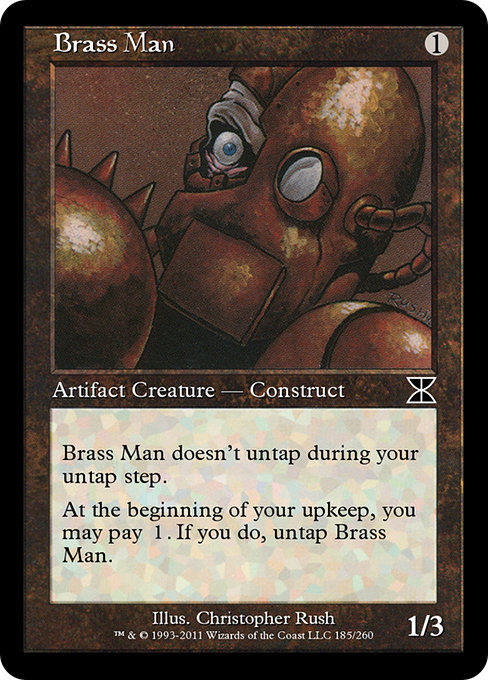
Image courtesy of Scryfall.com
Visualizing Brass Man: A Data-Driven Look at a Humble Artifact
If you’ve ever built a deck around the quiet mechanics of untapping and upkeep, Brass Man deserves a seat at your table. This 1-mana artifact creature — a Construct with a sturdy 1/3 profile — isn’t flashy in the traditional sense. It doesn’t boast flashy combos or flashy color synergies. What it does excel at is being a perfect case study for how even a modest card can lend itself to clean, data-driven visual storytelling. 🧙♂️🔥💎
From Masters Edition IV, a set that fans often revisit for its reprints and the nostalgic glow of early artifact strategy, Brass Man is a great example of a card whose value isn’t in raw power but in tactical timing. Its key ability — a mandatory untap blocker unless you pay {1} at the start of your upkeep — embodies the elegant friction between resource management and tempo. It’s a small sandbox where data visualization shines: how do you map a card’s cost, stats, and text into a picture that helps players, collectors, and designers reason about play patterns? This article leans into that question, using Brass Man as our template. 🎲🎨
A Quick Glance: card data at a glance
- Name: Brass Man
- Set: Masters Edition IV (me4)
- Rarity: Common
- Mana Cost / CMC: {1} / 1
- Type: Artifact Creature — Construct
- Power/Toughness: 1 / 3
- Colors: Colorless
- Text: This creature doesn't untap during your untap step. At the beginning of your upkeep, you may pay {1}. If you do, untap this creature.
- Artist: Christopher Rush
- Legal in Vintage/Commander: Yes; older reprint in core-like older formats
To visualize Brass Man, we lean into approachable, serial data: cost, stats, and the unique upkeep-untap arc. The values themselves are simple, but the story emerges when you plot them side by side. Let’s dive into the charts that bring this humble artifact to life, and how you can borrow these ideas for your own card breakdowns. 🧙♂️⚔️
Shaping a tiny data portrait: a trio of visuals
First, a compact bar chart that signals the creature’s economic and combat footprint. The bars are deliberately modest—this is a 1-mana, 1/3 artifact creature—so the visuals reflect the card’s understated nature while still inviting comparison with flashier siblings.
Next up, a micro-flowchart of the card’s core mechanic. Brass Man’s timing is all about the upkeep step and the optional mana payment to untap. We can represent that as a cycle with a single optional node: pay 1 to untap, or stay tapped and maintain tempo. This tiny loop is a perfect target for a deck builder to visualize tempo windows and maintenance costs. The chart below abstracts the flow in a readable, color-coded way. 🧭
- Untap step begins
- You may pay {1} to untap
- Paying keeps Brass Man active for the turn
- Not paying leaves it tapped, affecting future turns
- Low mana cost; early game presence
- Maintenance risk increases with more upkeep steps
- Supports strategies that value disruption or stalling
“Some artifacts hum quietly in the workshop; Brass Man hums a little louder with just a coin flip of upkeep.” 🧙♂️
Design notes: why Brass Man matters as a data specimen
The card’s creator, Christopher Rush, etched a design that’s perfectly legible on a data sheet: a colorless, affordable creature that compels you to make a tiny economic decision every upkeep. The artwork—brass and mechanical with a touch of retro-futurism—emphasizes the metal-on-metal thrift of early artifact creatures. When you visualize Brass Man, you’re not just counting numbers; you’re narrating a play pattern: a steady, creeping tempo that rewards with untap leverage if you’re willing to pay. This is data storytelling in practice: take a simple rule text and map it to a decision tree that even a casual observer can understand. 🎨⚔️
In Masters Edition IV, the card’s reprint status, rarity, and digital availability add another layer for collectors and historians. Being listed as common, and available in foil and nonfoil finishes, Brass Man also serves as a touchstone for price-slash discussions around common artifacts in modern MTG markets. The Scryfall data confirms its me4 print and the ongoing interest in artifact-based strategies, which remain a staple of the game's sandbox experiments. For new players, Brass Man is a friendly entry point into how upkeep costs shape board state; for veterans, it’s a reminder that even the most modest card can be a data-rich teaching tool. 💎🧰
Turn data into confident play and curated collections
If you want to share your Brass Man analysis with friends or present it at a casual tournament, these visual templates scale nicely. Swap in other artifact creatures or colorless staples, and you’ll have a mini-portfolio of “data decks” ready to showcase. The approach is straightforward: extract the core attributes (mana cost, power/toughness, rarity, set) and pair them with the unique text trait. Then, plot them in a clean, digestible visualization that sits nicely on a blog, a deck-building sheet, or a social post. The art of storytelling with MTG data is less about overwhelming charts and more about clarity, accessibility, and a dash of nostalgia. 🧙♂️💬
Speaking of decks and storytelling, if you’re looking for a little desk-side inspiration while you analyze card histories, try pairing your data-dive with a peek at premium desk gear. A neon desk mouse pad—like the one featured here—adds a splash of color to your analysis setup and keeps your notes readable during long data sessions. If you’re curious, you can grab that style of desktop accessory here: Neon Desk Mouse Pad. Because even wizards need a comfortable workspace. 🔥🎨
For researchers who want to cross-check source details, Scryfall remains your reliable companion for card data. Brass Man’s card text, set information, and print status come from a trusted API feed that feeds many data visualists and MTG historians. If you plan to extend this visualization approach, consider layering additional metadata: print run counts, foil availability, and market prices over time. The more dimensions you add, the more you’ll illuminate how a single card fits into the broader tapestry of the game. 🧭💎