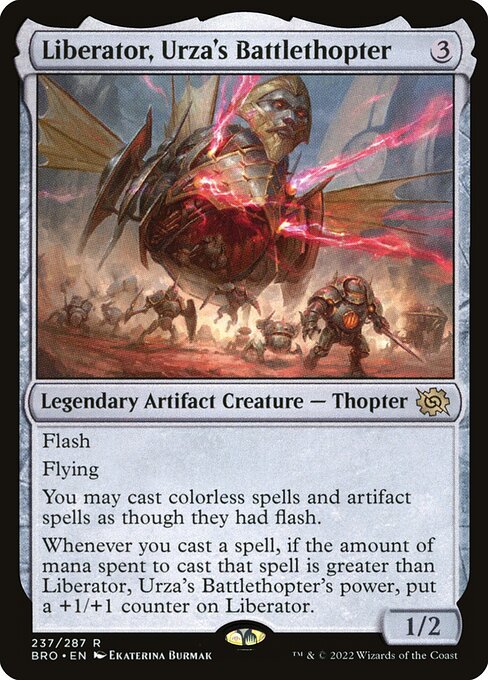
Image courtesy of Scryfall.com
Color Psychology in Magic Art: A Deep Dive into Liberator, Urza's Battlethopter
MTG art has always been a bridge between mechanic identity and emotional resonance. When you stare at Liberator, Urza's Battlethopter, you’re invited into a world where color identity is deliberately pared down to a gleaming, neutral canvas. This colorless frame isn’t a limit so much as a psychological invitation: it asks you to lean into the machine’s logic, to read the chrome, and to anticipate the calm cadence of a spell being woven into reality. The absence of color identity lets the artwork lean on texture, contrast, and motion—everything you’d expect from a flying, lightning-fast thopter crafted for battle 🧙♂️⚔️.
First Impressions: The Colorless Canvas
The Brothers’ War era is steeped in archetypes of conflict and ingenuity, and Burmak’s piece for Liberator captures that tension without tinting it with a single hue. The subtle metallic palette—the silvered body, the coppery glow of exposed joints, the electric blue sparks—reads as a study in precision. In psychology terms, colorless imagery often signals neutrality and rational control, inviting players to project their own strategic aims onto the frame. It’s a bit like stepping into a laboratory where every assumption must be tested against outcomes, not intuition 🧪🔬.
Art as Emotion: Metallic Blues, Chrome, and the Calm of Process
Metallic tones in MTG art tend to evoke two moods at once: cool calculation and sudden motion. The Battlethopter piloted by Urza’s legacy leans into that duality. The chrome surfaces reflect an almost clinical clarity, while the wing structure and aerodynamic lines suggest speed and adaptability. This is art that whispers: “Plan your next move, then pivot with grace.” The Flying and Flash keywords reinforce the effect—Liberator isn’t just a statue on the battlefield; it’s a flexible engine of timing and tempo, ready to surprise opponents the moment you decide the moment has come 🎨🔥.
Gameplay Implications: Strategy Through a Colorless Lens
From a strategy perspective, Liberator offers a compelling interplay between its colorless nature and its unusual trigger. With Flash and the clause that lets you cast colorless and artifact spells as though they had flash, you can threaten on multiple fronts. The real psychological edge comes from the +1/+1 counter mechanic: “Whenever you cast a spell, if the amount of mana spent to cast that spell is greater than Liberator’s power, put a +1/+1 counter on Liberator.” Since Liberator’s power is 1, any spell you pay at least 2 mana for will push a counter onto it. That turns big, payoff spells into potential growth engines, and it does so with a clean, colorless logic—no color identity baggage to weigh down your sequencing 🧙♂️.
- Tempo through flash: You can surprise opponents on their turns, deploying artifacts and colorless spells when they least expect it.
- Mana-sink momentum: Prioritize spells that you’re comfortable paying two or more mana for; each successful cast nudges Liberator closer to a formidable presence.
- Artifact synergy: Lean into decks heavy on artifacts to maximize both your threat density and spell-casting opportunities.
- Board growth: The counters on Liberator scale your threat even as you deploy other artifacts, turning a quiet start into a late-game push ⚔️.
A colorless gaze looks through steel and glass—calm, precise, and always ready to strike when the moment is right.
Design & Lore: Burmak’s Craft Meets Urza’s Machinery
Ekaterina Burmak has long been celebrated for her ability to fuse character with intricate machinery, and Liberator is a prime example. The Brothers’ War era is built on the tension between rampant invention and strategic restraint, and the artwork mirrors that balance. Liberator’s form—sleek winged frames, the gleam of alloy plating, and a posture that hints at lightning-fast reflexes—says: "I am forged for decisions, not grudges." In a world where the color wheel often dictates conflicts, the absence of color in this piece channels a universal machine language—one that speaks to players across decks, from casual to competitive, about precision, speed, and the quiet thrill of a well-timed play 🎲🎨.
From a lore perspective, the card sits in a narrative space where Urza’s omnipresent engineering ethos meets the battlefield’s immediate demands. The artifact creature—flagged as legendary—carries the weight of both a name and a role: a guardian of tempo who grows stronger as you invest more mana into your spells. The art’s stern elegance aligns with that ethos, reminding players that in a world of grand plans and grander engines, sometimes the most impactful move is a perfectly timed swing of a chrome wing ⚔️.
Collector Value, Culture, and the Space Between Rarity
In the collector’s market, Liberator sits as a rare card from The Brothers’ War, a set that continues to captivate players with its storied conflict and mechanical imagination. The card’s foil and nonfoil finishes appeal to different kinds of collectors, and its versatility in Commander and other formats keeps it in the conversation. Current price data place it at a modest but steady value—enough to be worth the eye-catching art without demanding a fortune, with foil variants often drawing particular attention from players who prize display-grade pieces 💎.
As a piece of the broader MTG art ecosystem, Liberator also demonstrates how color psychology can work in tandem with mechanical design to create a narrative experience. The colorless aesthetic makes the image feel universal—less about a faction’s ideology and more about the pristine logic of invention. It’s a reminder that in a multiverse full of color-coded heroes and villains, sometimes neutrality itself can be a powerful story choice 🎨.
For players who love the tactile ritual of assembling a game night and for collectors who chase the perfect art-forward piece, Liberator offers a bridge between function and imagination. The fact that it’s part of a modern-era set with high-quality reprints means you can enjoy both competitive play and appreciation for the craft—making it a nice centerpiece for both the table and the shelf 🔥.
While you’re sharpening your deck-building instincts, you can also give your desk a little MTG flair. A round or rectangular neoprene mouse pad makes those long drafting sessions a joy—supportive, non-slip, and stylized with a touch of the same mechanical elegance you see in Liberator. It’s the kind of product that keeps your focus on the cards and your hands in the vibe of the game 🧙♂️💎.