Image courtesy of Scryfall.com
Tempo, Lifegain, and a Quiet White Engine
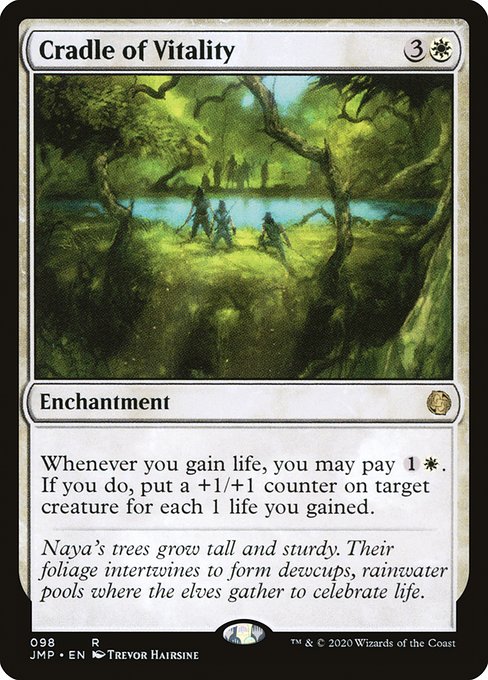
White doesn’t always shout first in the MTG meta, but Cradle of Vitality quietly builds tempo by turning small life gains into durable board presence. With a mana cost of {3}{W} and a sturdy four-mana investment, this enchantment earns its keep by rewarding you for something you already do in many white shell strategies: gain life. The card’s Oracle text—“Whenever you gain life, you may pay {1}{W}. If you do, put a +1/+1 counter on target creature for each 1 life you gained.”—is a compact blueprint for tempo with a lifegain twist. On its face it rewards incremental advantage, but in practice it scales into real board pressure as your life total climbs. And in a crowded arena of removal, stax, and snap decisions, that incremental push can tilt the tempo in your favor 🧙♂️🔥💎⚔️🎲.
What the card does at a glance
- Color and cost: White mana symbol, {3}{W}, Enchantment. A four-mana investment that fits into typical midrange or lifegain shells.
- Type and rarity: Enchantment, rare, from Jumpstart’s draft-innovation set. The Jumpstart frame carries a nostalgic weight, but the card remains a useful tempo engine in both Arena and paper play.
- Core effect: Each time you gain life, you may pay {1}{W} to put a +1/+1 counter on a creature you control for each 1 life you gained. It’s a scalable payoff that rewards lifegain synergies and careful life-timing.
Tempo Advantage: turning life into board presence
Tempo in MTG is all about making each move count. Cradle of Vitality aligns with that philosophy by converting life gains into tangible threats. When you gain life through a buddy-lifegain package (think classic white staples like Soul Warden, Auriok Champion, or a broader lifegain suite), Cradle gives you a decision point: do you pay the extra mana to pump up your board immediately, or hold the life to fuel future turns?
In practice, the pivot is about risk vs. payoff. Gaining life is often a defensive play—stabilizing against aggro, buying time to assemble your plan. The optional {1}{W} tax on each life gain transforms that defensiveness into offense. If you choose to pay, the number of +1/+1 counters you place scales with life gained, turning a few points of life into a growing threat that opponents must answer. That makes Cradle a subtle tempo engine: you aren’t racing to a single large payoff, you’re engineering a steady, cumulative advantage that compounds as the game unfolds 🧙♂️🎨.
Control tactics: stabilizing while pinching the clock
From a control vantage point, Cradle’s strength lies in its flexibility. It plays nicely with sweepers and hands you a buffer while you stabilize. If you’re facing a board wipe or a stall tactic, you can let life accumulate to push a pump on a key creature after you untap. The ability to pump “for each 1 life you gained” creates layered decisions: you weigh how much life you’re comfortable letting slip away and how aggressively you want to pressure the board post-touchdown.
Furthermore, Cradle’s mana investment sits neatly within white’s long-horizon plan: protect your life total, deploy threats that scale with your gain, and guide the game toward your preferred endpoint. This is lifegain as a tempo engine rather than a pure drain strategy. You’re not just surviving; you’re turning life gains into a rolling, evolving advantage that can outpace opponents who rely on one big swing. In the modern landscape of removal and graveyard hate, that incremental pressure is a credible alternate win condition 💎⚔️.
Deckbuilding paths: weaving lifegain with tempo control
Constructing around Cradle means embracing lifegain as a synergy core rather than a side dish. A classic approach includes white creatures that value life gain themselves, letting you generate immediate payoff when Cradle triggers. Think of paying off life gains with creatures that scale when counters appear or with bodies that threaten immediately once buffed. Cards like Ajani’s Pridemate or other creatures that benefit from +1/+1 counters can curve nicely into Cradle’s pipeline, creating a momentum engine that can outrun midrange and control matchups alike 🧙♂️🔥.
In terms of deck architecture, a lifegain tempo shell often blends early defensive plays with midgame threats that can close out games once Cradle has started stacking counters. You’ll want redundancies for lifegain sources (creatures, spells, or effects that trigger life gain), ways to protect your pieces, and reasonable ways to leverage your life total when you choose to push. This is part math, part poetry—the lifegain triggers become a chorus, and Cradle is the conductor that decides when to raise the tempo with a few well-timed payments ⚔️🎨.
Flavor, lore, and art: a nod to Naya’s forests
The flavor text—“Naya's trees grow tall and sturdy. Their foliage intertwines to form dewcups, rainwater pools where the elves gather to celebrate life.”—places Cradle of Vitality squarely in the lush, life-affirming biome of the Naya shard. Trevor Hairsine’s artwork, with its earthy tones and vibrant life, echoes the set’s theme of growth and resilience. That aesthetic isn’t just pretty; it frames how the card feels in play: a steady harvest, a patient plan, and a forest that keeps giving back. In Jumpstart, this card arrives with a sense of history and a wink to the joy of discovering lifegain interactions in a draft environment 🧙♂️🎲.
Play patterns and practical tips
- Track your life gain carefully. You’ll optimize when to pay {1}{W} to convert gain into counters, and you don’t want to overpay when you’re short on life.
- Use Cradle to fuel a key attacker. A creature that’s already threatening can become a genuine problem after receiving multiple +1/+1 counters.
- Balance your threats and answers. White lifegain is strong, but you still need to handle opposing offense and recurring disruption. Cradle rewards a patient, well-timed push rather than reckless aggression.
- Value multi-step combos that use lifegain as a resource. If you have other sources of gain, Cradle can amplify them, creating a feedback loop that surprises even experienced players.
As you tune your sideboard and staple pool for the white lifegain tempo archetype, remember that the joy of the craft—whether in Arena or on the table—stems from building a narrative. This enchantment invites you to tell a story where life is not a barrier but a resource, a counter on a booming creature, a lever you can pull to tilt the board toward your victory 🧙♂️💎.
And if you’re deepening your battlefield ergonomics as you dive into long sessions of drafting and legacy play, a reliable gaming setup can help you stay sharp. The Non-Slip Gaming Mouse Pad 9.5x8 is a sturdy companion for those marathon evenings, keeping your grip steady as you navigate taps, triggers, and life-swing decisions. Check it out and find a comfortable fit for your playstyle.