Image courtesy of Scryfall.com
Culture, myth, and a wink: how MTG’s humor cards lean on symbol and storytelling
Magic: The Gathering has long traded in big ideas—cosmic powers, dragon-filled skies, and civilizations teetering on the edge of reality. But some of the most memorable moments come from a playful wink at culture and myth, especially when powerful beings become a vehicle for humor and commentary. The Ancient One, a mythic blue-black powerhouse from The Lost Caverns of Ixalan, is a perfect case study. Its presence invites players to explore how symbolic language—eldritch grandeur, graveyard rituals, and the tension between intellect and appetite for knowledge—can be used to land a joke that resonates with longtime fans and casual players alike. 🧙🔥💎⚔️
Ancient symbolism with a modern twist
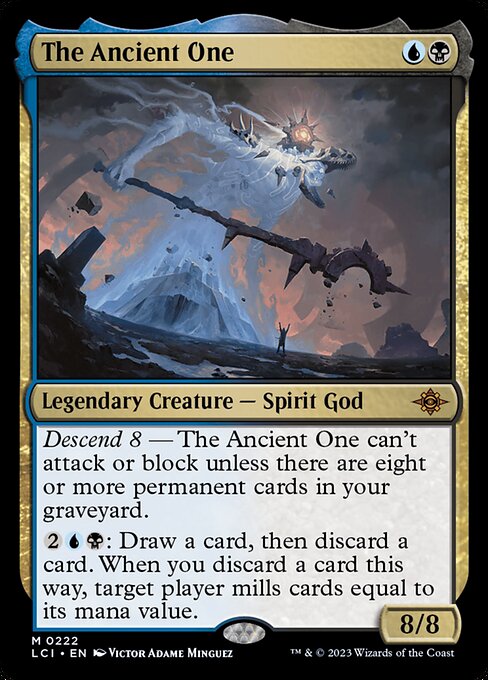
In MTG, color pairings are already a shorthand for personality types and worldviews. The two-color identity of The Ancient One—blue for knowledge, curiosity, and control, and black for ambition, inevitability, and the inevitability of the grave—creates a stage where cultural symbolism can play out in microcosm. The artwork by Victor Adame Minguez leans into stone and statue imagery; a towering figure, half-remembered pantheon, half-haunted ruin, speaks the language of many mythologies about ages past. The humor here isn’t jokey for joke’s sake; it’s a careful calibration of awe and absurdity: a creature that embodies vast intellect and an unsettling readiness to tilt the board in your favor, but that requires a condition—eight permanents in your graveyard—to strike. The joke lands because the setup mirrors real-world storytelling: legends demand accumulation, ritual, and audience investment before the dramatic reveal. 🎨🎲
Descend 8 — The Ancient One can't attack or block unless there are eight or more permanent cards in your graveyard.
{2}{U}{B}: Draw a card, then discard a card. When you discard a card this way, target player mills cards equal to its mana value.
The flavor text and mechanics work in concert to create a cultural symbol: an elder deity who only fully awakens once enough memories (the graveyard’s tally of permanent cards) have gathered like a choir of witnesses. The ability to draw and discard, fueling a milling effect, nods to a familiar horror trope—the mind’s hunger and the consequences of forbidden knowledge—while keeping the game’s rhythm alive. This is where humor becomes cultural commentary: the card invites players to consider how societies treat the past, the taboo of forbidden lore, and the psychology of power—without taking itself too seriously, because the payoff is a dramatic, satisfying turn when the condition is met. 🧙🔥
Humor as a lens on ancient mythologies
Humor cards have always done more than make you smirk. They’re often a prism through which popular culture and ancient archetypes are refracted. The Ancient One sits in a curious position: it’s not a knock-knock joke about a familiar god-king, but a stylized homage that recasts the “ancient” trope for modern play. In the context of The Lost Caverns of Ixalan, the mythic aura is flavored with a subterranean, treasure-haunted vibe—think ruins, crypts, and forgotten libraries—while the actual effect on the board invites a playful strategy: mill-up the graveyard to unlock the beast and to tempt others into the ornamental theater of control. It’s a nod to how many cultures build myth around your “old ones” and then have players debate whether awakening such beings is a heroic act or a perilous gamble. And yes, the humor lands because it’s anchored in game terms that players recognize—choices, consequences, and the ultimate joy of outmaneuvering a rival in a nail-biting, brainy moment. 🧠💥
Design choices that fuel cultural resonance
From a design perspective, The Ancient One showcases how MTG’s card art and mechanics can echo broader cultural motifs while remaining accessible. The color pair signals a balance between curiosity and consequence; the Descend condition is a clever nod to ritual thresholds—akin to ancient rites—where power reveals itself only after a community of tokens, graves, or memories coalesces. The milling trigger tied to discarding a card emphasizes the cold, inexorable logic often depicted in mythic accounts of sages who trade memory for insight. All of this is layered within a single card, so players experience a small, narrative moment each time they play or counter it. It’s the kind of design that fuels both flavorful storytelling and strategic depth, making players grin when they realize a pivotal draw extra step has just unlocked a big plan. ⚔️🎨
Gameplay patterns and tabletop storytelling
For players who want to lean into the cultural symbolism while maintaining solid competitive edges, several paths emerge. First, build around the graveyard as a resource and stage for the ancient awakening. Cards that accelerate card draw and graveyard filling pair naturally with The Ancient One’s costed power, letting you assemble eight or more permanents in the graveyard and unleash a fearsome eight-toughness-on-turn-eight moment. Second, the card-draw-and-mill loop is itself a thematic engine: you trade a card for knowledge, and your opponent loses cards to the graveyard as a form of cosmic debt. In multiplayer formats, that dynamic can spawn memorable political moments as you steer a conversation about who deserves a turn to enact the mythic spectacle. Finally, the blue-black identity invites a strategy focus on disruption, countermagic, and resource denial—epitomizing the tension between enlightenment and ruin that pervades legendary myths. 🧭🫙
Collectibility, art, and cultural memory
The artist, Victor Adame Minguez, brings a tactile, sculpture-like presence to the card, and the LCI set (The Lost Caverns of Ixalan) delights collectors with its mythic rarity and evocative flavor. As with many iconic MTG pieces, the balance of rarity, artwork, and lore fuels both personal attachment and market interest. For fans who love to study how art conveys cultural memory—through iconography, color, and posture—this card offers a compact case study of how a single image can carry centuries of influence, reinterpreted for a modern tabletop audience. The card’s relatively accessible price point today makes it a compelling entry into a broader conversation about how mythic figures are celebrated, teased, and reimagined across MTG’s evolving multiverse. 🧙🔥💎
Fans looking to deepen their appreciation for the intersection of culture, humor, and strategy can draw inspiration from this blend of motif and mechanism. Whether you’re collecting, crafting thematic decks, or just enjoying a narrative moment during a Friday night game, the card offers a reminder that mythic storytelling can be both grandiose and gleefully tactical. And if you’re streaming your next session or journaling about your favorite archetypes, a clean surface to map your thoughts goes a long way—hence the little cross-promo below. 🎲
- Symbolic pairing: blue for knowledge, black for ambition; a combination that invites mid-game planning and late-game brainpower.
- Ritual threshold: eight permanents in the graveyard as the gateway to power—perfect for thematic “threshold” decks.
- Flavor-leaning mechanics: milling as a narrative device tied to forbidden knowledge and the consequences of awakening ancient powers.
Curious to have a tangible piece of your setup that echoes your MTG journeys? Check out this customization option for a desktop companion—the perfect desk companion for a deck-building session or a lore-filled lore night. The practical side of magic meets the playful side of symbolism in a way that only this game can deliver. 🧙🔥🎨