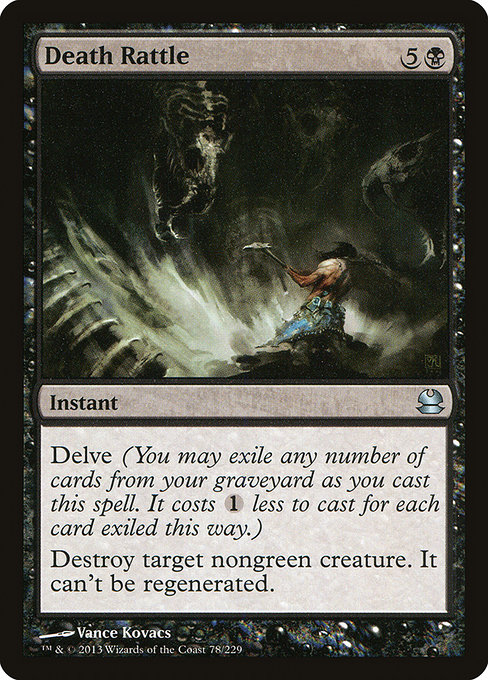
Image courtesy of Scryfall.com
Rarity and Mana Cost: A Modern Masters Perspective
Magic lore loves a good paradox: the bigger the spell, the pricier the mythos, right? Yet Death Rattle from Modern Masters presents a compelling case where a hefty mana investment is softened by a clever mechanic and a strategic niche. Black, instant-speed removal with a Delve twist, this uncommon instant costs a formidable {5}{B} on its face, for a total of six mana, and a 6-CMC that invites a question we players love to ponder: does rarity mirror mana commitment? 🧙♂️🔥💎
Death Rattle at a glance
- Name: Death Rattle
- Set: Modern Masters (mma)
- Rarity: Uncommon
- Mana cost: {5}{B}
- Converted mana cost (CMC): 6
- Type: Instant
- Oracle text: Delve (Each card you exile from your graveyard while casting this spell pays for {1}.) Destroy target nongreen creature. It can't be regenerated.
- Colors: Black
- Legalities: Modern, Legacy, Commander, and more across formats where applicable
- Artist: Vance Kovacs
- Print status: Reprint in a Masters-era set, with foil and nonfoil finishes
In the box of a casual cube or the bustle of a multiform tournament, Death Rattle stands as a reminder that power and rarity don’t always march in lockstep. Its uncommon status signals that it’s a little rarer than typical commons but not the megatower of a rare or mythic. The art and wording lean into a unique role in black’s toolkit: precise removal with the option to ramp the spell’s accessibility via delve. This makes the card a talking point about how rarity interacts with board impact in real play. 🧙♂️🎨⚔️
Delve and cost management: turning a big price tag into tempo
Delve is the standout mechanic here. The basic idea is elegant: you exile cards from your graveyard to pay for the spell, effectively substituting spent cards in your graveyard for mana. Death Rattle’s reminder text says: “Delve (Each card you exile from your graveyard while casting this spell pays for {1}.)” In practice, that can dramatically alter whether this six-mana spell becomes a bargain or a burden. If you exile five cards, you’ve shaved the generic portion of the cost down and you’re left with paying only {B} (one black mana) to cast the spell. The more cards you exile, the less mana you spend overall, with the color requirement still looming as your minimum payment for the spell. It’s a crystalline example of how the delicately balanced Delve mechanic can morph a high-cost removal into a potentially tempo-positive play—especially when your graveyard is already full of fuel. 🔥🧙♂️
From a design perspective, this creates a rare and satisfying three-way interaction: the rarity signals collectible value, the mana cost signals deck-building constraints, and the delve trigger signals strategic depth. The player who understands how to sequence dredge-level blocks with efficient curve-toppers can leverage Death Rattle to swing the game at the right moment. In practical terms, you might cast Death Rattle for a minimal cost late in the game when you’ve already filled your graveyard, ensuring you remove a non-green threat while leaving your opponent scrambling to answer the post-spell board state. The text’s line about regeneration is a classic reminder that some protections simply can’t save a creature from the finality of a well-timed spell. ⚔️🎲
Does rarity reflect mana commitment? A nuanced view
Looking across MTG’s history, you’ll find high-impact spells at all rarity levels. Death Rattle challenges the simplistic equation “cost = rarity” by showing how a well-chosen mechanic can offset a high base cost. Modern Masters, a Masters-era reprint set, intentionally reshuffled power into rarities to balance draft viability with value retention. The card’s Uncommon status paired with a six-mana base cost—yet potentially paying far less thanks to delve—illustrates a broader truth: rarity often encodes long-term collectible and strategic value rather than a strict indicator of play potency in every matchup. In other words, the card’s true strength lies in its flexibility and how you leverage graveyard resources, not merely its sticker price on the card stock. 🧙♂️💎
Practical play ideas and deck-building notes
If you’re building a black-based deck that can reliably fill the graveyard while also pressuring opponents, Death Rattle becomes a compelling—and occasionally surprising—tool. Here are a few ideas to consider:
- Graveyard fuel economy: Pair delve with spells or creatures that naturally shuffle cards to the graveyard or allow you to exile cards efficiently. Delve rewards you for your graveyard’s activity, turning it into a resource bank rather than a liability. 🧙♂️
- Targeted removal with staying power: Destroying a nongreen creature and preventing regeneration is particularly relevant against a lot of classic threats—think planeswalkers or big green beasts that rely on regeneration to stay alive. This is removal with a built-in disruption tag. ⚔️
- Commander and casual formats: In Commander or grind-heavy formats, Death Rattle can shine in Black-based lategame archetypes where Delve access is reliable and your graveyard can be stacked with value. Its flexibility makes it a spicy include in certain metas. 🧙♂️🎲
Value, art, and collector culture
From a collecting standpoint, Uncommons like Death Rattle occupy a delicate zone: they’re not the flashy chase of Mythics, yet they’re not throwaway rares either. Current market glimpses place nonfoil copies around modest value with foils often pulling higher, which aligns with Modern Masters’ era aesthetics. The card’s pricing narrative—where a six-mana clone of a big effect can be budget-friendly in paper—echoes a broader trend in Masters sets: reprinted power that balances out in casual and mid-power environments while still offering a legitimate craft/play distinction. The art, by Vance Kovacs, carries a stark, necromantic atmosphere that fans remember fondly from that era’s stark contrasts between shadows and magic. It’s a reminder that card design isn’t just about numbers—it’s about the moment you flip the card and feel the momentary hush before the game explodes into action. 🎨🧙♂️
“Delve isn’t just a mechanic; it’s a dial you turn to transform a bulky threat into a lean, tempo-friendly answer. When you’ve got the right fodder in the graveyard, even a hulking six-mana instant can look like a bargain.”
If you’re curious to explore more about this card’s market presence or want to chase the kind of real-world value that modern play can offer, it’s worth scanning price guides and collector channels to see how nonfoil and foil copies trend over time. And if you’re in the mood to pair a bit of MTG math with practical gear, check out a different kind of treasure—the rugged, dependable protection of a rugged phone case. It’s the kind of accessory that travels from the battlefield to daily life with you, keeping your gear safe as you build your next mana curve. Because every table deserves a sturdy companion. 🧙♂️💼
Product note: for practical accessories that travel with your MTG adventures, consider this rugged phone case designed for durability and daily carry. It’s a nice companion to long nights at the table and the constant shuffle of a busy meta.