Image courtesy of Scryfall.com
Inside the Art: Deathlace and Its Creator
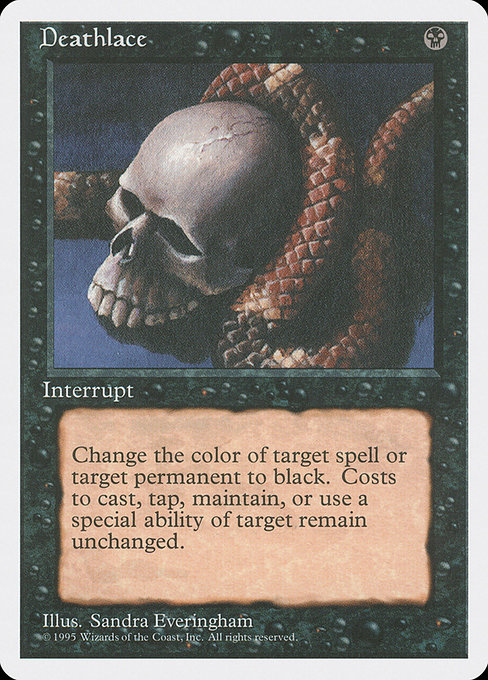
Magic: The Gathering has always been a tapestry of color, lore, and bold artistry, and Deathlace sits at a curious crossroads of that tapestry. This compact black instant from Fourth Edition (4ed) doesn’t just disrupt a board state; it changes the color identity of a spell or permanent in a way that feels mischievous and precise 🧙♂️🔥💎. The piece is anchored by a single mana investment, a lone black mana, yet its impact stretches across the moment you cast it and into the decisions your opponent makes in the next dozen turns. The art, painted by Sandra Everingham, captures a mood that feels like a whisper of shadow—the kind of image that makes you pause during a nostalgia-filled flashback to early MTG days ⚔️🎨.
A quick snapshot: Deathlace in Fourth Edition
- Name: Deathlace
- Set: Fourth Edition (4ed), core set
- Rarity: Rare
- Mana cost: {B}
- Type: Instant
- Oracle text: Target spell or permanent becomes black. (Mana symbols on that permanent remain unchanged.)
- Color: Black
- Artist: Sandra Everingham
- Released: 1995-04-01
- Legal in formats: Legacy, Vintage, Commander, and several other eternal formats (within their respective rules) as indicated by historical printings
- Print details: White-bordered Fourth Edition card, non-foil
Artist spotlight: Sandra Everingham
Sandra Everingham’s contributions to the MTG universe took shape during a formative era for card art, where line work and moody palettes defined the visual identity of many classics. Deathlace is a compact showcase of her skill: a clean, confident composition with a subtle sense of motion and a focus on the moment of transformation rather than spectacle. The card’s look leans into the gothic elegance that many black spells carry, yet the clarity of the figure and the balance of negative space reveal a craft that stands the test of time 🧙♂️. For fans who enjoy digging into the artists behind the cards, Everingham’s work on this piece offers a perfect entry point into the feeling of early MTG printing—where each card was as much a piece of collectible art as it was a game mechanic.
“Magic art invites you to look twice—first at the spell’s effect, then at the world the artist conjures around it.”
From a career-curation perspective, Deathlace remains a window into Everingham’s style and the broader design language of Fourth Edition. The 1990s era of MTG is beloved for its distinct borders, bold contrasts, and the sense that every card could be a doorway to a story. The card’s rarity and its place in a core set also reflect the era’s willingness to experiment with color-shifting effects in a way that felt approachable for players new to the game and veterans revisiting their roots alike 🧭. The combination of a single black mana commitment and a color-altering effect makes Deathlace a memorable artifact in the catalog of perennial favorites, a prime example of how a simple text update can ripple through gameplay decisions and deck-building aesthetics.
Gameplay, aesthetics, and collector value
From a pure gameplay lens, Deathlace is a versatile tempo tool. For one mana, you threaten to bend an opponent’s key spell or threat into the color you control best—black’s disruption and resilience often become more accessible to you. The reminder that “mana symbols on that permanent remain unchanged” ensures players must account for the card’s effect without overestimating the transformation’s scope—it's not a complete color-shift; it’s a targeted, elegant nudge that can complicate an opponent’s plan and create new line-tricks in long games 🧙♂️. In formats where legacy and vintage staples still breathe, a rare card from Fourth Edition becomes a conversation piece, not just a playset addition. The card’s border, its era, and its rarity combine to create a distinctive collector’s aura, especially for those who treasure the aesthetic of classic MTG art.
Price data from public price indices hints at Deathlace’s status as a desirable, affordable classic: listed around $0.34 USD in some markets, with European values around €0.27. That makes it approachable for new collectors who want a tangible piece of history without breaking the bank, while still offering a recognizeable artwork to display in a binder or on a shelf 🧩. The card’s print status as a 4ed rare means it’s a strong candidate for both grading consideration and casual appreciation—two roles that many players and collectors value in equal measure 🔎.
Further reading and community notes
For players who want to explore more about Deathlace and its place in MTG history, several public databases offer deeper dives. The Gatherer entry provides official card details and rulings, while EDHREC helps see how vintage black-control players might reference a card with a color-altering twist. You can also explore Scryfall’s extensive catalog to compare printings, variations, and art notes across MTG’s long arc of releases. Links below give you a well-rounded portal into Deathlace’s world and its artist’s broader legacy:
As we celebrate Sandra Everingham and the spell that made a subtle splash across an entire color identity, it’s worth remembering how a well-placed instant can redefine a moment in the game. Deathlace doesn’t shout; it murmurs and then shifts the room—an artful reminder that MTG’s power often hides in the most economical packages 🧙♂️⚔️.