Image courtesy of Scryfall.com
Turning a single ETB effect into a design classroom
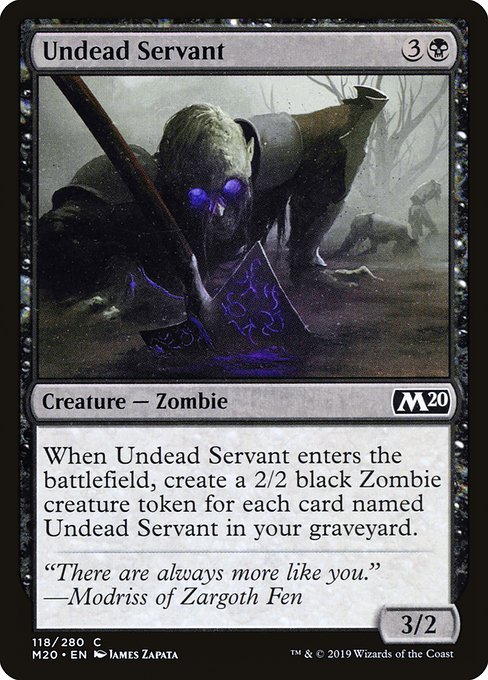
Undead Servant, a black Zombie from Core Set 2020, arrives for a modest 3 mana with a 3/2 stat line and a quirky, self-referential twist: when it enters the battlefield, it creates a 2/2 black Zombie token for each card named Undead Servant in your graveyard. It’s a compact idea—the graveyard becomes a resource you actively mold as you play—yet the execution rewards careful deck-building decisions and timing. This is a perfect case study in how a simple trigger can cascade into meaningful volatility on the battlefield, while staying approachable for players of all levels. 🧙🔥
What the mechanic teaches about design space
- Clear, scalable payoff: The card scales its output with a straightforward state: the number of copies named Undead Servant in your graveyard. That clarity helps players visualize the potential impact from turn to turn and rewards planning around resource placement. 💎
- Resource-as-asset mindset: The graveyard isn’t a discard pile in this design; it’s a bank of “tokens to come.” This invites players to think about what they bury, tutor for, or recur, rather than merely what they cast. The payoff grows as you cultivate the graveyard, which is a timeless design lever in MTG. 🎲
- Self-contained motif with broad utility: The card’s name is baked into its own effect, creating a self-referential loop that feels like a natural extension of the lore. It’s a small design flourish that resonates with players who enjoy thematic cohesion without forcing a novel gimmick into every set. ⚔️
- Accessibility through rarity: As a common card, it remains approachable and frequently playable in Limited, while still offering a path to bigger plays in longer formats. This balance demonstrates how rarity tier can influence a card’s risk-reward profile without compromising its identity. 🎨
There are always more like you.
— Modriss of Zargoth Fen
Balancing the bloom: why it feels fair yet exciting
The on-entry token generation is a strong tempo tool, but it isn’t a guaranteed game-winner out of the gate. The card’s power curves with the state of the graveyard, not with a single moment of play. This creates engaging tension: you might slam Undead Servant early to threaten a growing swarm later, or you might wait to fill the graveyard first and then unleash a timely flood of 2/2 zombies. The balance is deliberate—large enough to spark a reaction, modest enough to avoid overwhelming midrange boards on a casual table. 🧙🔥
Flavor, art, and the tactile design echo
The flavor text, “There are always more like you,” grounds the card in a brutal, endless undead narrative that designers love to lean on when crafting a zombie tribe. The art by James Zapata depicts a morgue of rusted patience and rising silhouettes, a visual cue that the graveyard is not inert but alive with the possibility of conversion into matter on the battlefield. This alignment between flavor and mechanical intent is a textbook example of how aesthetics can reinforce play patterns. The Core Set 2020 frame and black border anchor the card in a moment of MTG history where players valued identity and modular synergy as much as raw stats. 🎨
Practical design takeaways for players and builders
- Maximize value by shaping the graveyard: If your deck naturally enables graveyard interaction—whether via discard outlets, self-mostly-mill effects, or recurrent recursion—the payoff from Undead Servant scales dramatically. Consider ways to ensure a few Undead Servant copies end up in the graveyard for a strong late-game spike. 🎲
- Pair with token-heavy or synergy-driven themes: The produced 2/2 Zombie tokens pave the way for tribal synergies around zombies, sacrifice themes, or token swarms. It’s a card that invites you to lean into a second-phase plan rather than forcing a first-turn win. 💎
- Limited-friendly yet channel-ready: In draft or sealed, the card’s impact grows with how much you can fill the graveyard. It’s a gentle introduction to graveyard mechanics for newcomers, while offering depth for seasoned players who can leverage repeated entries into play. ⚔️
- Narrative cohesion matters: The self-referential naming and flavor text reinforce a storytelling thread that players can latch onto. When a card feels like it belongs to a wider world, its interactions gain extra resonance at the table. 🎨
Design lessons you can apply beyond MTG
Undead Servant illustrates a broader principle: the most memorable card designs often blend a simple engine with a scalable payoff. A few copies in a graveyard become an army; a single ETB effect becomes a recurring theme. Designers can borrow this approach—give players a clear threshold to aim for, then reward them with escalating impact as they push past it. The result is a feel-bad-for-your-opponent, feel-great-for-you moment that stays fun rather than punitive. 🧙🔥
For readers who love the tactile side of Magic, the card’s rarity and foil options (and the relatively accessible price point) reflect thoughtful production decisions. The visual clarity of the artwork, bold frame, and the crisp, canonical text all serve to reduce confusion while inviting experimentation. If you’re chasing a small but potent concept in your decks, Undead Servant demonstrates how to make a compact idea hit hard without over-engineering the payoff. 💎
As you sketch new deck ideas or contemplate set design, remember how a single, well-placed rule can warp the entire board state. A modest 3-mana creature becomes a crossroads for strategy, storytelling, and player interaction—a microcosm of why we love the Magic multiverse. 🧙🔥