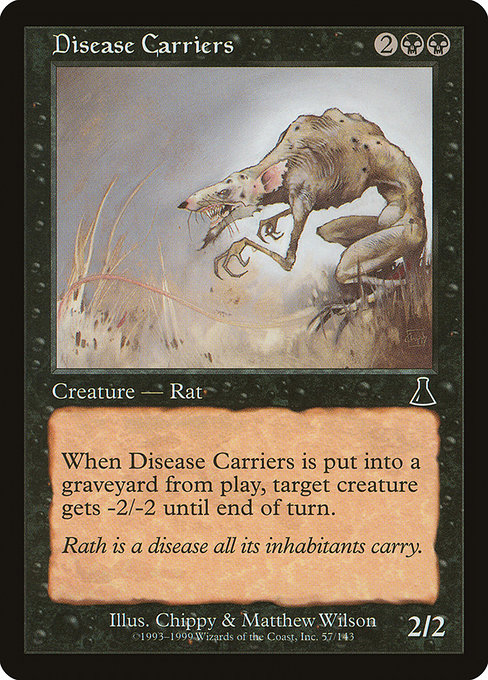
Image courtesy of Scryfall.com
Finding Value in the Long Run: A Look Through MTG Finance with a Classic Common
In the trenches of MTG finance, the true gems aren’t always the rare mythics with thunderous text. Sometimes a humble common from a classic era quietly teaches us the psychology of long-term value: scarcity, format relevance, and the stubborn persistence of player interest. Disease Carriers, a black creature from Urza’s Destiny released in 1999, is a prime example—a card that isn’t flashy in play, but carries a narrative about how a single, deterministic effect can ripple across formats and price over decades. 🧙🔥💎
Card snapshot: what you’re actually looking at
- Name: Disease Carriers
- Set: Urza’s Destiny (UDS), a classic expansion from the late 1990s
- Mana cost: {2}{B}{B} — a sturdy commitment for a 4-mana body
- Type: Creature — Rat
- Rarity: Common
- Power/Toughness: 2/2
- Text: When this creature dies, target creature gets -2/-2 until end of turn.
- Flavor: “Rath is a disease all its inhabitants carry.”
- Legalities: Legacy and Commander legal; not modern-legal, as UD is a vintage set.
- Collector data (snapshot): Non-foil around $0.19, foil around $1.95 (as of market reads), with occasional ebbs and flows based on retro formats and EDH nostalgia.
At first glance, a 2/2 for four mana with a death-trigger that nukes another creature by -2/-2 might not scream “finance darling.” Yet in the grand tapestry of MTG economics, it embodies several enduring drivers: format resilience, reprint risk, and the evergreen appeal of older card art and lore. In a game where players chase theory-crafting and niche synergies, even a small edge like a flash of extra -2/-2 can become a linchpin in a budget black deck’s toolbox, especially in slower formats where grindy wins dominate. ⚔️
Why this card still matters for long-term value
Historic and persistent demand often accrues to cards that sit at the intersection of playability, nostalgia, and scarcity—factors that Disease Carriers checks in multiple ways: - Format longevity: Being legal in Legacy and certain penny or premodern formats helps keep a baseline demand alive, even if the card isn’t a staple in every deck. Legacy, with its deep shelf of interactions and death-trigger themes, gives occasional flight to older, black-centric creatures like this Rat. 🧙🔥
- Reprint risk and vintage supply: Urza’s Destiny is a foundational set from the early era of MTG printing. The chance a common from this era returns in a flagship reprint is modest compared to modern, high-demand staples. That relative scarcity, coupled with the card’s age, helps buoy the foil market more than the base non-foil market. The foil price around $2 can reflect collector interest in well-graded UD foils from a nostalgic era. 💎
- Archetype and synergy value: While Disease Carriers doesn’t define a dominant archetype, it benefits from gravitating toward decks that leverage death triggers, sacrifice outlets, and stalling tactics. In EDH/Commander, where players curate “budget cornerstones” and have more variance in power levels, a 2/2 for BBBB with a robust, targeted effect can surprise as a cheap answer in the late game. The narrative depth—an old card that still sees light—often translates into long-tail demand: not a pop in every set, but a steady trickle of interest among collectors and casual players. 🎲
From price signals to play decisions
For the budget-conscious collector or the player building a legacy black shell on a shoestring, the economics tell an approachable truth: don’t chase heroic gains from a single card; chase a spectrum of older staples that can maintain value through reprint cycles and format shifts. Disease Carriers sits in that spectrum as a historically cheap entry point that occasionally surprises collectors when a nostalgia-driven spike hits the market. The non-foil price sits around a few dimes, while foils offer a more meaningful premium—useful markers for long-term value tracking. In other words, don’t expect a moonshot, but do expect steady, patient growth if you’re collecting UD-era pieces in good condition. ⚖️
If you’re a finance-minded player, you’ll also notice how the card’s price tends to ride on the waves of broader vintage momentum—people reacquainting themselves with older sets, or new players who discovered the charm of late-90s art and flavor. The presence in Legacy and occasional private market activity for EDH players help keep the card relevant even as time marches on. And yes, a well-tuned deck built around narrow interactions can turn this little Rat into a quietly useful piece in the right moment. 🧙♂️
Practical takeaways for collectors and players
- Consider UD foils as a value anchor if you’re chasing long-term appreciation, not because it’s a top-tier pick, but because early-era foils often hold steadier floor values for budget cards.
- For EDH players, look at Disease Carriers as a potential one-off interruption in sac-outlet-heavy branches, especially in casual black decks that love resilient threats and on-death effects.
- Watch reprint calendars. Vintage-staple-like cards from older sets tend to drift upward in price slowly as supply ages out of circulation and new cohorts of players discover the older art and flavor. 🔎
- Keep a diversified pool. The real win in MTG finance is not a single card, but a mosaic of staples, casual favorites, and a few nostalgic pieces that capture the imagination of collectors.
And if you’re browsing desk accessories while plotting your next build, you might like a little personal workspace upgrade. The product below helps you stay sharp during long drafting sessions or late-night deckbuilding marathons. A comfortable, non-slip surface can quietly improve your focus as you crunch mana and plan your next move. 🧙♀️🎨