Image courtesy of Scryfall.com
Art Evolution in Modern MTG: Doom Whisperer as a Case Study
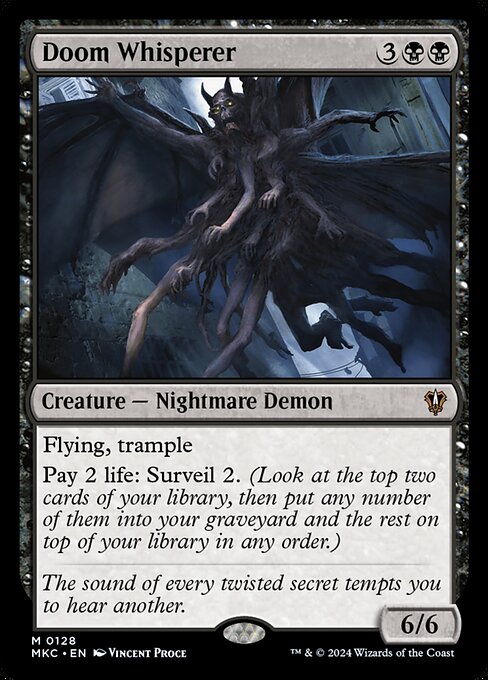
In the glittering, ever-expanding multiverse of Magic: The Gathering, illustration isn’t just decoration—it’s a heartbeat. Every new set reframes mood, scale, and the emotional intelligence of a card. Doom Whisperer, a Nightmare Demon that wades through the shadows of the Murders at Karlov Manor Commander (MKC) set, serves as a vivid bookmark in that ongoing evolution. The piece blends painterly texture with a disciplined gothic aesthetic, signaling a broader shift toward darker, more expressive storytelling in contemporary MTG art 🧙♂️🔥🎨.
Visual Language and Darkness: Doom Whisperer’s Illustration
The art for Doom Whisperer leans into high-contrast lighting, where inky blacks meet molten crimson highlights and silvery arc Light. The demon’s silhouette commands the frame—wings unfurled, claws ready, eyes catching a glimmer of malevolent intent—while the surrounding space is a ruined, almost reliquary-like environment. This composition is not just about menace; it invites the eye to wander the periphery, inviting you to read the scene and the threat it conveys in a single gaze. The painterly brushwork—soft, then abrupt—gives the creature a tactile presence: you can feel the weight of its wings and the heat of its gaze. It’s art that demands a closer look while remaining legible from sleeve to table, an essential trait for cards designed to be viewed both on kitchen tables and high-stakes tournaments 🧙♂️💎⚔️.
- Color palette: a restrained spectrum of blacks, purples, and ember reds anchors the mood, signaling the card’s black mana identity and ominous potential. This is a deliberate move away from bright fantasy toward a more pulsing, nocturnal vibe 🎲🎨.
- Texture and detail: the demon’s hide, the ruined scaffolding, and the ambient haze are painted with a tactile gloss that rewards up-close viewing, a trend you can see across many modern mythics that aim to reward fidelity in digital and print formats.
- Scale and focus: the creature often dominates the foreground while the background bleeds into shadow, emphasizing power and peril without sacrificing legibility at common print sizes.
From Frame to Flavor: Thematic Ties and Surveil
Surveil as a mechanic adds a meta-narrative layer to Doom Whisperer’s lore-friendly silhouette. The ability requires you to look ahead into your library, choosing the fate of two cards. The art mirrors this tension between what’s seen and what’s hidden—an unsettling invitation to examine the top of the deck and ask, “What secrets lie beneath the shadow?” The cool, deliberate menace of the image aligns with the flavor text—“The sound of every twisted secret tempts you to hear another”—a line that reads as both warning and temptation. In this way, the illustration doesn’t just depict a demon; it embodies the act of peeking into the unknown and paying with life to gain knowledge 🧙♂️⚔️.
“The sound of every twisted secret tempts you to hear another.”
That flavor line from the card’s lore is a perfect bridge between narrative and mechanic—a reminder that black’s strength in MTG is not just raw power but the strategic utility of information and risk. Doom Whisperer’s 6/6 presence with flying and trample compounds that idea: overwhelming force measured against a cost, a common theme in modern black designs that favors strategic tempo and battlefield pressure 🔥💎.
The Modern MTG Art Movement: Gothic Ornamentation Meets Painterly Realism
What Doom Whisperer exemplifies is a broader current in MTG illustration: a hunger for painterly realism married to gothic ornamentation. The 2015 frame and subsequent modern iterations have moved away from flat, poster-like images toward scenes that feel like a still taken from a cinematic moment. The “Murders at Karlov Manor Commander” set, with its darker aura and narrative-driven art, leans into story-forward aesthetics that serve both lore and gameplay. It’s not just about looking cool on a card; it’s about summoning a mood, an atmosphere, and a moment in time where every line and shadow has a purpose 🎨🧙♂️.
Design, Gameplay, and Collectibility: A Multifaceted Lens
From a gameplay standpoint, Doom Whisperer’s mana cost and keywords match a deliberate design philosophy: a five-mana threat that rewards tempo and selection without breaking the bank. Its black mana identity—colored in a single color—speaks to the focus on disruption, evasion, and inevitability. The Surveil 2 mechanic gives you agency: you’re peering into the future you’re about to shape, then deciding how much you’re willing to sacrifice to refine your path. The art reinforces that tension: a creature that looms larger than life, ready to tilt the battlefield while you weigh top-deck decisions. This alignment between mechanic and illustration is exactly what keeps modern MTG visually coherent and narratively satisfying 🧙♂️💎⚔️.
As a mythic rare in a Commander-centered set, Doom Whisperer also holds a certain collector’s glow. The piece by Vincent Proce carries a signature style—lush textures, dramatic lighting, and a moody, cinematic vibe—that resonates with collectors who savor mood as much as power. In terms of market context, the card’s price echo — around USD 1.43 (non-foil) and its EUR value — reflects that it’s highly playable in certain formats while still being approachable for casual collectors. The aura of mystery around this demon makes it a talking point in EDH circles and a fan favorite for showcase displays 🧙♂️🎲.
Practical Takeaways for Builders and Collectors
- The art trend favors painterly detail and cinematic lighting that communicates power and menace without sacrificing clarity at trading-card size.
- Mechanics like Surveil inspire visual motifs of hidden knowledge and controlled risk; artwork that frames a figure against shadow reinforces that theme.
- Commander sets continue to be a breeding ground for visually striking, lore-rich pieces that become touchstones for fan communities.
For players, artists, and collectors alike, Doom Whisperer stands as a vivid illustration of how modern MTG art can carry narrative weight, mechanical nuance, and aesthetic ambition all at once. The collaboration of Vincent Proce’s brushwork with a dark, pulsing card concept creates a memorable moment in the year’s DC-to-Dawn flip—the kind of art that invites you to linger, then reshuffle your deck with a sly smile 🧙♂️🔥💎🎨.