Image courtesy of Scryfall.com
Dust Corona Price Trends: MTG Finance in Focus
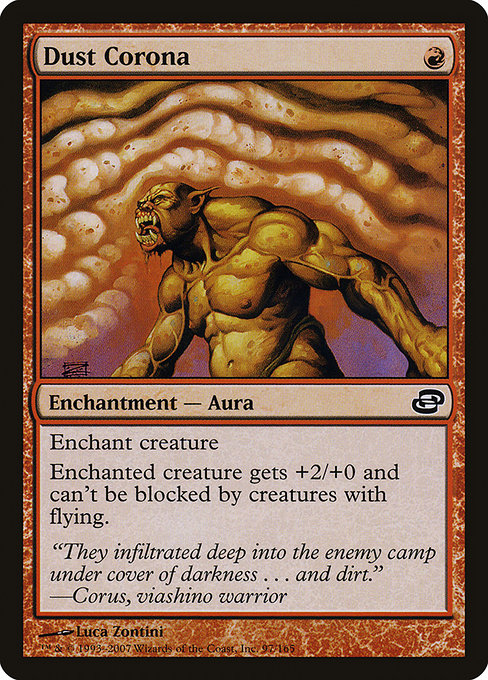
In the broader world of MTG finance, a single red aura from the Planar Chaos era offers a surprisingly instructive snapshot of how secondary markets breathe life into even the most modest cards. Dust Corona is a one-mana enchantment — aura that reads simply: “Enchant creature. Enchanted creature gets +2/+0 and can't be blocked by creatures with flying.” It’s a deceptively straightforward card with a handful of market signals worth unpacking for players and collectors alike 🧙🔥💎⚔️. Let’s unpack the data, the deck-building value, and what the numbers say about the card’s place in the long game of price trends.
What the card does, flavorfully and financially
Dust Corona costs {R}, a lean burn for red decks that want to push damage without overtaxing their mana base. The aura’s +2/+0 boost is modest by power-for-mana standards, but the kicker is the “cannot be blocked by flying” clause, which can tilt combat in the right board state, especially in formats that allow big ground threats to pressure life totals without air defense. The card’s flavor text — “They infiltrated deep into the enemy camp under cover of darkness . . . and dirt.” — by Corus, viashino warrior, echoes a ruthless, no-nonsense battlefield ethos that red magic embodies: fast, aggressive, and a little messy. In the financial sense, that same energy translates into stable, low-variance demand across Eternal formats, even if Dust Corona isn’t a marquee rare.
They infiltrated deep into the enemy camp under cover of darkness . . . and dirt. — Corus, viashino warrior
Market snapshot: what the numbers are telling us
Dust Corona sits at common rarity in Planar Chaos, a set famous for introducing color-shifted design ideas and a few timeless staples from the mid-2000s. The secondary market data attached to this card shows a classic pattern for a common from a former major set: low baseline prices with a steady trickle of foil and near-term demand from casuals and EDH/metagame players who appreciate the specific combat trick it enables.
- USD (non-foil): ~$0.13
- USD (foil): ~$0.88
- EUR (non-foil): ~€0.18
- EUR (foil): ~€0.19
- MTGO TIX: ~0.03
What do these numbers imply? Primarily, Dust Corona remains a budget-or-bargain classic in non-foil form, with foil copies capturing a premium that reflects collector interest, foil lust, and the rarity of Planar Chaos foil production. The relatively modest USD foil premium (~$0.75 above non-foil) suggests a price floor anchored by its common status and the fact that Planar Chaos has circulated widely enough to avoid acute supply shortages. The TIX price, at around 0.03, hints at a stable digital footprint in MTGO that mirrors paper scarcity, without a huge speculative spike this early in its lifecycle for a card of this nature.
From a liquidity perspective, the data suggests a practical play for investors: keep an eye on foil prices. If you’re shelving the card for long-term value, the foil variant is where the upside potential sits, while non-foil remains a straightforward, low-commitment buy for budget-minded players. The price stability is a comfort for budget guardians and new collectors who want “ownership” without overpaying in a volatile market 🧙🔥.
Format, legality, and demand dynamics
Dust Corona’s legality in a broad swath of formats—modern and legacy included—gives it a uniquely persistent demand profile. While it isn’t a standard-legal staple, it functions nicely in Modern-legal sets and is comfortably at home in Legacy and Commander decks where enchantment auras can swing combat or enable clever combat tricks. The card’s simple, elegant effect interacts with flying blockers in a way that creates tactical decision points for red-based strategies: either pressure the battlefield to threaten direct damage, or use the aura to outmaneuver aerial fleets with ground stalemates. The upshot is steady, diversified demand across formats, which supports the consistent—but not explosive—price curve we see in its numbers 🧲🎲.
Bit by bit, the Planar Chaos era itself also contributes to dust-like, collectible appreciation. Color-shifted designs and a fond memory of a pre-digital era foster nostalgia-driven buys from veteran players. As with many cards from older sets, even budget staples can shine when collectors chase condition and print run completeness, particularly for foil variants. That dynamic helps explain why Dust Corona, despite not being a headline grabber, maintains a resilient niche in the market.
Strategic angles for traders and players
For traders, a practical approach is to treat Dust Corona as a “staple for niche synergy.” The mana cost and aura traits make it a natural fit for red tempo or mono-red builds that grapple with flyers or want to swing a last-minute race. It’s the kind of card that doesn’t crash the market if a new set drops but can gain a little traction when flying tokens are common in the meta, or when a nostalgia wave pushes Planar Chaos cards back into discourse 🧙🔥.
- Monitor foil availability and price spikes, particularly around flashback drafts or legacy event calendars where foil-driven demand can temporarily lift prices.
- Watch for reprint risk signals. Planar Chaos cards don’t see frequent reprints, but market watchers should note any new printings that could dampen non-foil and foil values.
- Consider a two-pronged investment: keep a small ladder of non-foil copies for budget players, and accumulate a separate tranche of foils for collectors and EDH players who prize pristine, foil condition.
From a deck-building perspective, Dust Corona shines in decks that lean into aggression and board control. The ability to punch through defenses and invalidate a skyward defense line with flying creatures makes it a tactical asset in red-led strategies. For casual players and veterans alike, it’s a reminder that value in MTG isn’t always about the biggest numbers; it’s about timing, utility, and the story a card tells in your binder and on your board 🧩🎨.
Collector considerations: rarity, condition, and display
As a common with foil variants, Dust Corona presents a double-entry point for collectors: near-term affordability and longer-term nostalgia. Condition matters, as with all vintage and semi-vintage staples, but the card’s playability in multiple formats lends itself to straightforward storage, display, and quick trading. The card’s artwork by Luca Zontini has its own fan base, and the Planar Chaos era’s distinctive frame and color-modulated aesthetics add another layer of charm for display pieces and travel binders alike. If you’re curating a Planar Chaos-themed collection, Dust Corona is a clean, budget-friendly anchor that pairs nicely with other red and enchantment-themed cards from the set 🧙🔥🎲.
For collectors who want to showcase a tiny slice of MTG’s financial ecosystem, the product link below offers a practical way to organize or present your holdings in style. It’s a tongue-in-cheek nod to the hobby’s fusion of craft and commerce — and yes, it doubles as a conversation starter at the kitchen table or local game store hook-up.