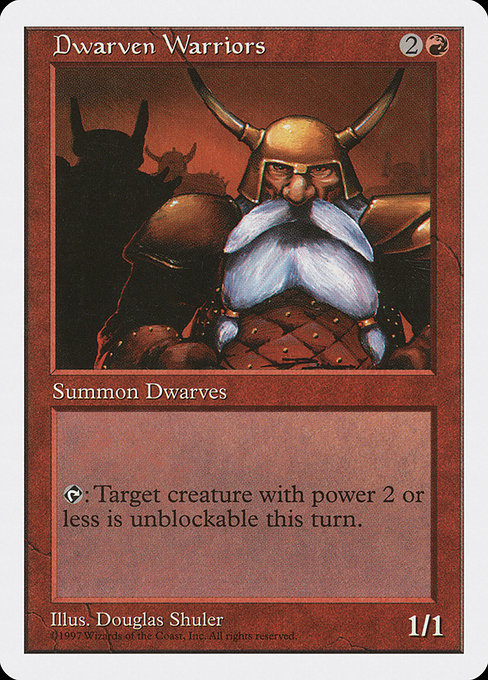
Image courtesy of Scryfall.com
Dwarven Warriors: Designing Cohesive Tribal Archetypes in MTG
Tribal archetypes are one of Magic: The Gathering’s most enduring pleasures: a theme you can lean into across multiple cards, each piece reinforcing a shared identity. When designers craft related archetypes, the goal isn’t just to tee up flashy abilities; it’s to weave a consistent thread through color identity, flavor, and mechanical rhythm. The Fifth Edition card Dwarven Warriors serves as a compact case study in making a red dwarven theme feel cohesive on the table—tempo-forward yet thematically anchored, with a straightforward real-world play pattern that resonates from casual kitchen-table games to more competitive scrimmages 🧙🔥💎⚔️.
Foundations of tribal consistency
When you build a family of cards around a tribe—say, Dwarves—there are a few core design pillars to keep in balance. First, color identity should drive the tribe’s temperament. Red dwarves tend to skew aggressive and fast, leaning into moments that pressure opponents early and often. The mana curve should favor creatures and effects that enable quick board presence, not long, grindy sequences. Second, the individual card roles within the tribe should feel like natural variations on a theme: one is a beater, another a trickster, another a support piece, all with a shared sense of “dwarven grit.” Third, the mechanics should reinforce tribal storytelling—your land has a forge’s glow, your weapons glitter with runic fire, and your creatures move with practiced efficiency. Dwarven Warriors embodies this philosophy with a crisp, tempo-friendly interaction that sits neatly alongside other potential red dwarves or earthbound allies 🧙🔥🎲.
In Dwarven Warriors, we see a simple, on-theme activation that can tilt combat in a hurry: T: Target creature with power 2 or less can't be blocked this turn. It’s a cost-efficient way to enable your micro-aggression plans. The card’s mana cost of {2}{R} and its 1/1 body might look modest on the surface, but it’s precisely that friction—moderate threat alongside a potent tempo tool—that invites players to build around it. The card’s rarity as a common in Fifth Edition is telling: the design invites broad play and deck-building experimentation without demanding rare-card power spikes. This is classic red tribal foundation, where you trade raw stats for timely violence and strategic choice 🧙🔥.
Archetype cohesion in practice
For a truly cohesive Dwarven theme, you’d pair Dwarven Warriors with other dwarven creatures and support spells that emphasize speed and pressure. Consider a hypothetical suite of red dwarves with overlapping motifs: another dwarf that pumps other dwarves, a dwarf with a similar unblockable or attacker-friendly ability, and perhaps a spell that accelerates your early run of threats. The synergy isn’t about stacking the most powerful effects; it’s about ensuring each card feels like a shard of the same metallic blade. Dwarves, after all, are often imagined as a tight-knit, clan-like faction where every swing of a hammer carries the weight of shared craft and shared risk. The elegance of Dwarven Warriors lies in its hand-off value—prepare the board, then push through a window with a clean, unblockable strike for a small cost. It’s the essence of tempo in a red archetype: not just how much damage you deal, but how quickly you can apply pressure and force decisions 🧙🔥⚔️.
“Design consistency isn’t about sameness; it’s about predictability with flavor. A tribal deck should feel like a chorus—each member contributes a familiar tone while adding its own instrument.”
Flavor and mechanical coherence
Flavor-wise, dwarves conjure images of sturdy crafts, mined gems, and practical weaponry. Red dwarves amplify that with a touch of reckless daring and frontline speed. Mechanically, that translates to cards that reward early aggression, reactive combat tricks, and a willingness to sacrifice raw stats for tempo plays. Dwarven Warriors fits this equation: a two-mana investment for a small creature, paired with a tapped ability that grants a narrow but meaningful advantage in combat. It rewards players who understand windows of opportunity—timing a tap to swing past an opposing chump blocker or to threaten a quick, direct line to victory. The effect also scales well in a gob-up tempo environment, where drawing additional red dwarves accelerates the deck’s clock and makes each attack more consequential 🧙🔥🎨.
Design tips for authors and deck builders
- Align mana costs with tribal roles: avoid overpaying for a role a tribe already covers with other cards. A common red dwarf with a tempo effect should sit on a similar mana band as its peers to maintain deck cohesion.
- Plate the deck with complementary synergies: pair quick unblockable threats with protection or burn to maximize the window when blockers are irrelevant.
- Respect the power ceiling: commons like Dwarven Warriors should enable fair, repeatable plays without steamrolling the format. The fun comes from consistent tempo rather than spiky power.
- Preserve flavor from card to card: ensure each dwarven member evokes the same craft-and-clash vibe—hammer forged, battle-tested, and ready to roll at a moment’s notice.
For collectors and lore lovers, the Dwarven Warriors card also anchors a moment in MTG’s history: a Fifth Edition core set printing that captures the era’s art direction, balance philosophy, and the early edges of tribal design in a red-tinged package. Douglas Shuler’s art lends its own timeless spark, reminding players that even a simple 1/1 can carry a burgeoning identity when placed in the right tribal context. This is the kind of card that inspires both nostalgia and practical play: a reminder that consistency across archetypes can be the quiet engine behind memorable games 🎨⚔️.
Practical deck-building takeaway
If you’re building a Dwarven-focused deck, use Dwarven Warriors as your tempo backbone for early aggression. Pair it with other dwarves that offer support or alternate angles of attack, and don’t shy away from low-cost pump or evasion lines to maximize the unblockable potential. In persistent meta play, the card invites you to experiment with timing and sequencing—how a single activated ability can open or close combat lanes, how to leverage small bodies into big swings, and how tribal cohesion helps you anticipate opponents’ answers. The joy here is the cultural continuity: a tribe that speaks with one loud, metallic voice across multiple cards and formats 🧙🔥💎.
As you curate your collection or test out a dwarven shell at your local game night, consider how a well-curated set of related archetypes can deliver consistent strategy and shared flavor. From the unassuming charm of a common creature to the dramatic pressure of a well-timed attack, the Dwarven Warriors illustrate how design can stay tight, thematic, and delightfully effective.
And if you’re ready to bring a little more sparkle to your desk while you craft, game, and discuss MTG with friends, check out this stylish add-on crafted to spark joy during your build sessions. It’s a small nod to the playfulness of the multiverse—a reminder that even a casual hobby can feel like entering a cavernous forge where ideas shine as brightly as gems 💎🎲.