Image courtesy of Scryfall.com
Efficiently Harnessing the Tutor Engine for Sickening Shoal
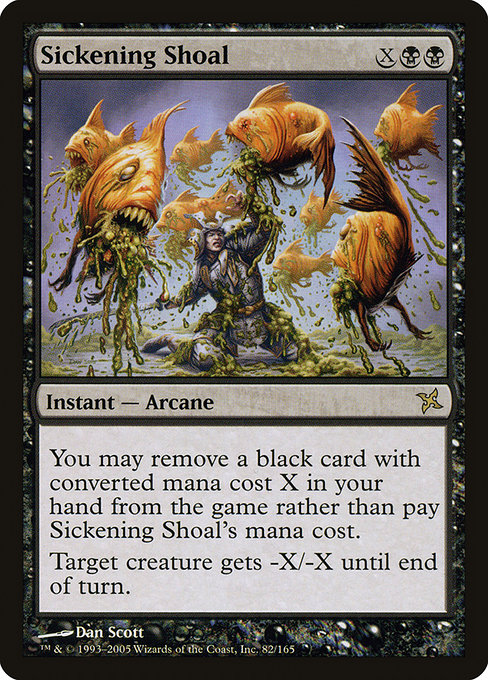
When you sleeve a classic black instant with the arcane flair of Kamigawa’s era, you’re not just casting a spell—you’re orchestrating a tempo-rich, mind-bending play pattern. Sickening Shoal, a rare instant from Betrayers of Kamigawa, asks you to lean on your hand and your library with surgical precision: you may exile a black card with mana value X from your hand rather than pay this spell’s mana cost, then your target creature takes -X/-X until end of turn. The result is a toolbox that scales with your tutoring power, which is where the pros come in 🧙🔥💎⚔️. The combination of Arcanes, potent black tutors, and the Shoal’s X-factor makes for a surprisingly resilient line in the right deck.
At its core, Sickening Shoal rewards players who lean into the “tutor this one efficiently” philosophy. Rather than simply hoping to draw Shoal, you can fetch the spell with Demonic Tutor or Vampiric Tutor, then rely on your hand-discard sprint or other card-drawing engines to assemble the correct black mana-value X in time. The cost replacement—exiling a black card from your hand with mana value X—turns the concept of “mana efficiency” on its head. You’re paying with a card you control rather than mana you generate, which can be priceless in stalled games or when you’re hewing to a low-curve, disruption-heavy plan. It’s a beautiful intersection of deck design and timing, where the rhythm of draws, tutor tendrils, and the Shoal’s arithmetic all align like a well-tuned symphony 🎲🎨.
Why tutors matter so much with this spell
- Speed and inevitability: Vampiric Tutor and Demonic Tutor are classic one-card solutions to fetch Sickening Shoal exactly when you need it. Vampiric Tutor’s instant speed adds a layer of surprise, while Demonic Tutor’s reliability ensures you can assemble the combo before your opponents blink. Both enable you to place Shoal in your hand or cast it with a precise X value you plan to exile.
- Alternate paths and redundancy: Diabolic Intent and Rune-Scarred Demon are other powerful options. Rune-Scarred Demon, for instance, enters the battlefield and then tutors a card to your hand, giving you a second, built-in fetch from your own board state. That extra fetch cadence can be crucial in multiplayer matches where you’re racing under a tight clock.
- Cost-flexibility via exile: The ability to replace the mana cost with exiling a black card of value X invites thoughtful sequencing. You can tutor for a handful of black cards with varied mana values, then choose the X that best fits your hand and graveyard state. This is where Beseech the Queen and Diabolic Intent shine as practical, mid-range option-tuners—they provide a less explosive but highly reliable route to the Shoal line when you’re building toward a longer grind.
Top black tutors to power Sickening Shoal
- Vampiric Tutor — Instant-speed nightmare fuel for any black deck. It ensures you can grab Sickening Shoal from your library or set up the exile-cost line when you need it most, often turning a mid-game threat into a one-turn clock. Its status in the tier lists is almost universal for a reason: it’s fast, flexible, and players love having a plan B—and a plan C—on demand 🧙🔥.
- Demonic Tutor — The staple that most black decks rely on to fetch any card from the library. While it costs a premium in mana value, its raw fetch-power means you can seize Shoal, a removal spell, or even a key enabler in a pinch. If you’re piloting a dark-steeped toolbox, Demonic Tutor is your best “round peg for that round hole” option.
- Diabolic Intent — A modern, more tempo-friendly take on the classic tutor. It behaves like a two-card engine: you play it, you put the card you want into your graveyard or hand, and you kick into the exact scenario you need. It’s a fantastic upgrade when you’re trying to smooth out the curve between cast and exile payoffs.
- Rune-Scarred Demon — A creature-based tutor anchor. It’s not a pure instant, but when it lands, it corridors a library grab to your hand, enabling you to "set up" the Shoal line in the following turn. In a deck built to maximize value from your board presence, this demon can be the perfect piece to accelerate your lockpiece with a little board pressure.
- Beseech the Queen — A solid, mid-range tutor that can target a crucial card from your library and put it into your hand. It’s less flashy than Vampiric or Demonic Tutors, but it has the reliability you crave when you’re setting up a complex play that revolves around the Shoal’s replacement cost.
Practical play patterns to make the most of Sickening Shoal
In practice, you’ll be looking for sequences that maximize the benefit of exiling from hand. A typical line might go like this: tutor for Sickening Shoal with Vampiric or Demonic Tutor, then cast Shoal by exiling a black card from your hand whose mana value aligns with the X you want. If X equals the mana value of a card you’re comfortable sacrificing from your hand (perhaps a threat you’re not ready to cast yet), you can chain Shoal to weaken a big blocker or threat while you preserve your mana for a follow-up play. The arcane nature of the card also dovetails nicely with Kamigawa’s flavor—arcane spells feeling like whispered tricks from an older, more fissured magic tradition 🧙♂️🎨.
In a game where tempo matters and resources are scarce, trading one card from your hand for a powerful, instant-speed spell—while simultaneously threatening to swing a board with a -X/-X blast—creates a compelling decision point. This is exactly the kind of engine that makes black tutor suites feel like a Swiss Army knife: they adapt to the situation, and Sickening Shoal becomes a ready-made finisher whenever you’ve assembled the right X in the exile pile.
A note on value and collecting vibes
From a collector’s perspective, Sickening Shoal sits in the rare tier with a price tag that reflects both nostalgia and practical value in legacy and casual play. In this card’s market snapshot, non-foil copies hover in the mid-teens to mid-twenties range, while foil versions push higher, a reminder of how reactivity and snap plays translate into long-term demand. If you’re chasing a particular look for your Commander deck or just savor the moment of casting a well-timed Shoal, there’s a satisfying symmetry between the card’s design and its price trajectory. And yes, that’s part of the thrill—kind of like finding a pristine foil of a card that helped you pull off a legendary clutch moment in a game you’ll tell your LGS crew about for years 🧩💎.
For builders who want to literally preface a Shoal-heavy plan with a touch of modern practicality, consider pairing with accessory gear that keeps your setup clean between turns. As a gentle nod to cross-promotion, if you’re toting your own gaming kit at the table, a sleek, slim case can keep your phone safe between rounds—hence the handy Slim Glossy iPhone 16 Phone Case High Detail Design, a stylish companion for your on-the-go gathering. If you want a closer look at that design, you can explore the product here:
Whether you’re drafting a compact, tutor-heavy Black Control list or just exploring Sickening Shoal’s clever cost-structure for a casual kitchen-table game, the arcane power of this spell invites you to plan several moves ahead. The real joy is seeing a well-timed exiled card unlock a play you didn’t quite think of in the moment—the kind of moment that makes MTG fans grin and say, “Of course that works.” It’s the joy of discovery, wrapped up in a black spell and a sleeve-worthy moment of triumph 🧙♀️⚔️.
As with any top-tier tutor suite, your mileage will vary by your local meta and the specific rituals of your playgroup. Still, Sickening Shoal remains a striking example of how a single, modular card can be the centerpiece of a broader tactical plan when you bring the right tutors to bear. The synergy between library-finding power and hand-exile flexibility creates a memorable, flashing moment that’s pure MTG joy—especially when you pull it off with a flourish that would make Dan Murayama Scott smile behind the artwork 🎨.