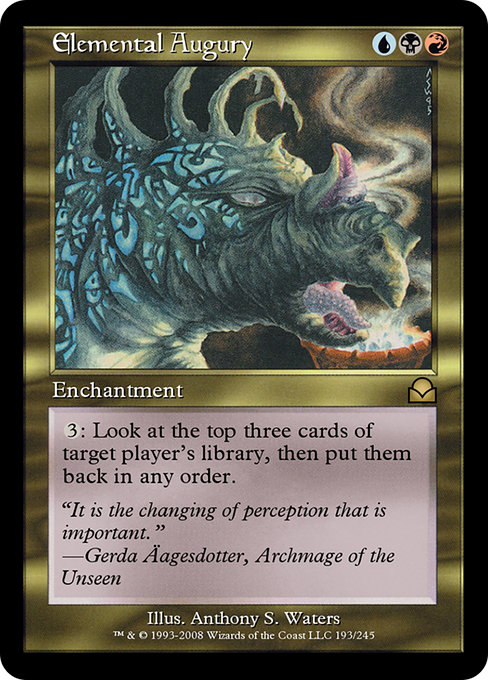
Image courtesy of Scryfall.com
Spotlight on an Artist’s Spectrum: Anthony S. Waters and the MTG Gallery
Magic: The Gathering has always rewarded fans who look beyond the mechanics and into the creative psyche behind a card. Anthony S. Waters is one of those artists whose work makes you pause, squint at the colors, and feel the magic rise off the page. In the wake of Masters Edition II, Waters’ piece for Elemental Augury stands as a vivid example of how a three-color enchantment can carry more than just rules text—it can carry a mood, a story, and a spark of nostalgia for the era when collectors hunted down rare reprints with the vigor of seasoned treasure hunters 🧙🔥. This article dives into why Elemental Augury is often cited among Waters’ top MTG cards and how its art complements the card’s strategic texture with a flair that still feels modern today.
Elemental Augury: A Card at the Intersection of Information and Color
From Masters Edition II, the rare enchantment Elemental Augury bears the mana cost {U}{B}{R}, a bold tri-color invitation that mirrors the card’s own triple-scope ambition. Its type line reads “Enchantment,” and its oracle text is compact but potent: "{3}: Look at the top three cards of target player's library, then put them back in any order." If you’ve ever played a control shell that prizes tempo and disruption, you’ll recognize the psychological tug this creates—information is power, and rearranging future draws can tilt the balance of a match in your favor. The card’s rarity is listed as rare, a fitting badge for a piece that feels like a director’s cut of a three-color narrative in a single enchantment slot. In terms of playability, Elemental Augury is legal in Legacy and Vintage, with Commander and other formats embracing its unique utility in multi-player skirmishes.
The artwork by Anthony S. Waters captures the essence of that three-color triad—blue for knowledge, black for fate, red for disruption—coalescing into a single, kinetic scene. The imagery you glimpse at the top of the library is not simply decorative; it’s a visual metaphor for the card’s core effect: peering into possibilities and reordering what might come next. The flavor text—"It is the changing of perception that is important." — Gerda Äagesdotter, Archmage of the Unseen — echoes this theme, reminding us that perception can be just as decisive as raw power on the battlefield. The combination of color, motion, and mood makes this piece a standout example of Waters’ approach to fantasy illustration: dynamic energy meets careful composition, with a focus that rewards a second, slower look 🧙🔥🎨.
What the Art Communicates: Waters’ Signature Style
- Triadic energy: The palette in Elemental Augury leans into the blue-black-red spectrum, creating a sense of arcane momentum that feels both chaotic and purposeful. This is a deliberate reflection of the card’s ability to manipulate outcomes—an aesthetic parallel to the in-game effect.
- Motion and focus: Waters guides the eye with swirling shapes and elemental iconography that suggest motion, almost as if the top three cards themselves are tumbling through a magnetic field. The result is a piece that reads well at game-night scale and still shines on high-resolution displays.
- Narrative depth: The flavor text anchors the visual drama in a larger MTG universe, giving players a reason to care about the moment beyond the immediate card play.
- Texture and light: The contrast between luminous fragments and deeper shadows gives the enchantment a tactile feel—an inviting texture that makes collectors and players want to inspect the art up close.
Top MTG Cards by This Artist: A Curator’s Perspective
If you’re curating a collection that highlights Anthony S. Waters’ contributions, Elemental Augury sits near the top as a touchstone piece. While Waters’ portfolio spans various sets and themes, this ME2 enchantment is often cited by fans as a quintessential example of his ability to fuse elemental fury with a cool, cerebral mood. It’s a card that invites discussion about how art and mechanics can align to tell a story—the moment you realize a three-color enchantment can be both a strategic tool and a gallery showcase. 🧙♂️💎
For collectors, the ME2 reprint status (Masters Edition II) adds a layer of vintage appeal. The set itself is beloved for revisiting classic MTG moments with a modern edge, and Elemental Augury’s rarity, combined with Waters’ distinctive artistry, makes it a sought-after piece for fans of the tri-color motif and for those who relish the tactile history of Masters-era reprints. Even if you’re not chasing a playset, owning this card feels like owning a small piece of MTG design history—where a single spell reflects both a strategy and a painter’s voice 🎲⚔️.
Design, Lore, and Community Impact
Elemental Augury isn’t just a remove-from-table gadget; it’s a window into how MTG designers and artists collaborated to create a richer playing field. The card’s targeted library manipulation speaks to a philosophy of information control—something that remains highly relevant in multiplayer formats like Commander, where reading opponents’ libraries and anticipating draws can swing the game. The artist’s portrayal amplifies this concept by giving the viewer a sense of the magic behind the curtain—the moment of choice that defines so many memorable MTG encounters. The artwork reinforces the idea that knowledge, when wielded with intention, can be as mighty as any creature on board 🧙🔥.
Format Presence and Collector Notes
- Legal formats: Legacy, Vintage, Commander, Duel, and others listed as legal by Scryfall data for ME2 prints.
- Rarity and reprint status: Rare in Masters Edition II, with ME2’s status as a collectors’ favorite for vintage reprint provenance.
- Market nuance: The card’s price can be influenced by its status in ME2 and the enduring appeal of Waters’ art, making it a welcome addition for both art connoisseurs and MTG historians alike.
Beyond the card itself, Anthony S. Waters’ body of work continues to spark conversations about how art styles influence deck-building and nostalgia. The fusion of science-fictionic energy with classic fantasy motifs is a thread that runs through Waters’ pieces, turning each card into a mini-portrait of a broader dream for the game. For fans who grew up in the era when ME2 cycles through reprints and reimaginings, Elemental Augury remains a vivid reminder of why we fell in love with MTG art in the first place: color as emotion, strategy as storytelling, and a little bit of chaos that keeps every game fresh 🧙♀️🎨.
Curious to explore more about this blend of art and card design? If you’re looking to brighten your desk while you build your next multi-colored commander, there’s a modern-day product that might tickle your fancy—perfect for MTG fans who appreciate both form and function. Check out this foot-shaped memory foam mouse pad with a wrist rest for comfortable long sessions of drafting and deck-building. It’s a playful nod to the tactile joy of tabletop play, and a neat companion to your MTG corner.