Image courtesy of Scryfall.com
Parody cards as mirrors: what the MTG community teaches about play, value, and culture
Magic: The Gathering isn’t only a contest of who drafts the most elegant curve or who topdecks the perfect answer. It’s a living culture, a tapestry of memes, house rules, and riffs that keep the game feeling fresh even after a thousand ladder matches. Parody cards—cards that lampoon mechanics, stereotypes, or even the game’s own storytelling—have become a joyful lens into how players think, joke, and argue about what the game should be. In that light, a seven-mana green behemoth from the Scars of Mirrodin era becomes more than a stat line: it’s a touchstone for how the community negotiates power, flavor, and the line between serious strategy and playful critique. 🧙♂️🔥
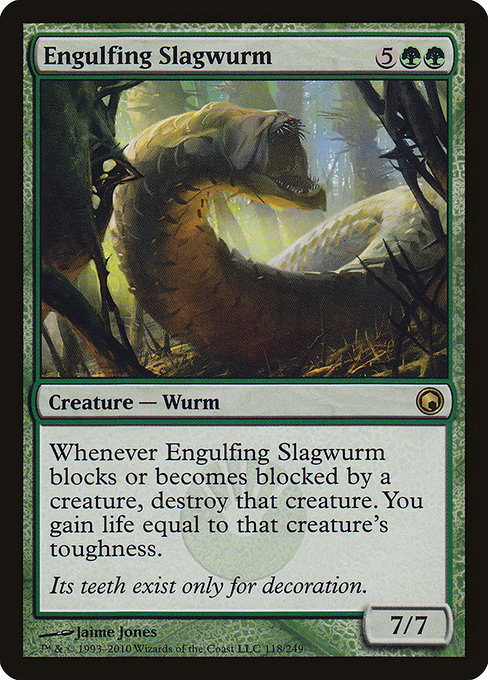
That green giant, a rare from the Mirran side of Scars of Mirrodin, costs {5}{G}{G} and clocks in at a sturdy 7/7. Its ability reads like a rulebook’s punchline: whenever this creature blocks or becomes blocked by a creature, destroy that creature. You gain life equal to that creature’s toughness. It’s a design that says, in essence, “If you bring a creature to the party, you might walk away with more than a headache.” The flavor text—“Its teeth exist only for decoration.”—is a wink to players who love flavor over caution, a reminder that even a game with rigorous balance can tickle the brain with humor. The watermark mirran hints at the ongoing metaphor of competing factions and the war-for-resource narrative that runs through the block. And yes, it’s a reminder of why green’s identity in MTG often centers on big bodies, big plays, and a slightly smug sense of inevitability. 🎨⚔️
Why parody cards click with us, strategically and culturally
Parody cards work because they compress a complex set of ideas into a single, memorable joke or critique. They reveal the community’s shared anxieties and loves—power levels, the tyranny of combos, the absurdity of some card names, or the ritual of how we test a new mechanic. In the context of the green behemoth from Scars of Mirrodin, the card’s emphasis on destroying a blocking creature and gaining life mirrors the old-school dream of fat stompy creatures dominating combat, while also nodding to MTG’s life-gain subthemes that sometimes feel underappreciated in a fast meta. It’s a design that invites players to discuss tempo, value, and survivability in a way that’s instantly viral in streams, forums, and table chatter. 🧙♂️💎
From a gameplay perspective, the card’s effect can swing a board state when a big creature is involved. A single block can wipe out a rival beater and leave you net-positive on the exchange, especially if there’s a higher-toughness behemoth on the battlefield. It’s a reminder that parody or not, MTG’s core ideas—combat, resource management, and lifegain—persist as the backbone of conversation. In that sense, parody cards aren’t just jokes; they’re pedagogical tools that teach us how to read the board, anticipate archetypes, and measure risk with a smile. 🥳🎲
Art, flavor, and the collector’s eye
Jaime Jones’ illustration for this card anchors it with a blend of menace and mythic heft. The visual language of a Scars of Mirrodin Wurm—lush greens, metallic undertones, and a sense of weight that seems to press down on the battlefield—lands squarely in the realm where players imagine the very soil breathing with coppery energy. The physical card is a tangible artifact of design and lore: a rare that sits in the middle of a game’s history, not a reprint but a moment that signals a block’s shift in tone. For collectors, the card’s foil variants, market volatility, and long-tail appreciation (or lack thereof) offer a study in how rarity and era shape value. The currency data tucked in its database pages—a few decimals here, a couple of dollars there—reminds us that even nostalgia has a price tag in the modern hobby economy. 💎🧙♂️
Parody cards also become a kind of art critique: they measure the ambitions of a set, the humor of its players, and the boundaries of what magic—the game—will tolerate in jest. The behemoth’s elegant line work, paired with a flavor missive about decorative teeth, invites us to think about what “serious” fantasy art costs and what it gives back in personality. In a world where a card can be a conversation starter at a tournament or a dinner party, art becomes another form of gameplay—one that’s often just as important as the rules text. 🎨🔥
The modern collector’s mindset and the cross-promotional moment
In today’s MTG ecosystem, even a classic rare has to contend with digital marketplaces, foil premiums, and the occasional nostalgia-driven reprint controversy. This card’s market data—roughly $0.45 for non-foil in USD and about $4.24 for the foil—illustrates the typical price arc: inexpensive enough to be a curiosity, meaningful enough to be slabbed in a binder of favorites. The euro equivalents and the tucked-away tix values remind us that global fans interact with the game in many currencies and formats, each with its own thrill. It’s a quiet reminder that a community’s affection for a card isn’t only about power on the table; it’s about memories of game nights, store drafts, and the first time someone lived out a “block this, lifegain that” fantasy. ⚔️🧩
And because this conversation thrives in the overlap of play and culture, there’s always room for a gentle nudge toward practical gear. If you’re curating a night of nostalgic MTG games or streaming a layman’s dive into card lore, consider pairing your table with a little peripheral flair. A neon, non-slip gaming mouse pad—bright, responsive, and sturdy—helps you stay sharp as you track an ever-evolving board state. Digital Vault’s non-slip gaming mouse pad offers a splash of glow-age utility, a playful echo to the glow of mana across the table. It’s the kind of cross-promo that feels natural: gear that supports the craft while reminding us to have fun with the fiction we build around the game. 🧙♂️💡
- Humor as a structural force: parody cards keep power fantasies honest and community-minded.
- Story meets sticker price: flavor and art become investment-grade memories for collectors.
- Gameplay as conversation: the board state drives discussion as much as the memes do.
Whether you’re a veteran player who remembers the origin of Scars of Mirrodin or a newer enthusiast who loves the conversation around parody cards, there’s a shared thread: the game thrives on the space where strategy meets culture, where a card’s mechanics spark a grin and a debate in equal measure. And if you’re hunting for a little tangible sparkle to accompany your next Friday Night Magic, that neon mouse pad might just be the perfect sidekick for your desk—the kind of practical magic that makes your hobby feel a little bigger, a little brighter, and a lot more you. 🧙♂️🔥