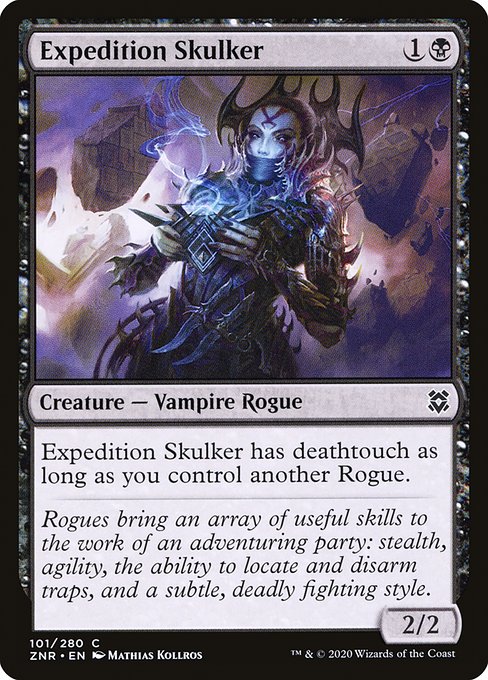
Image courtesy of Scryfall.com
Expedition Skulker and the Fourth Wall: MTG Design Secrets
There’s something delicious about a card that feels like it’s winking at you, the player, while still doing its job on the battlefield. In the grand tapestry of Magic: The Gathering design, 2/2 for {1}{B} with deathtouch—conditional on you controlling another Rogue—reads as a compact lesson in meta-awareness. It’s a creature that doesn’t just sit there; it signals a design philosophy: empower subtypes, reward board-state storytelling, and nudge players to think about the game as a living conversation between deck, strategy, and the moment you draw it. 🧙🔥💎⚔️
A quick snapshot of the card
- Name: Expedition Skulker
- Mana cost: {1}{B}
- Type: Creature — Vampire Rogue
- Power/Toughness: 2/2
- Rarity: Common
- Set: Zendikar Rising (ZNr)
- Oracle text: This creature has deathtouch as long as you control another Rogue. (Any amount of damage it deals to a creature is enough to destroy it.)
- Flavor text: “Rogues bring an array of useful skills to the work of an adventuring party: stealth, agility, the ability to locate and disarm traps, and a subtle, deadly fighting style.”
Design secrets behind a fourth-wall moment
First, Expedition Skulker leans into a familiar MTG millstone: subtypes. By tying deathtouch to the condition of “another Rogue you control,” the card rewards players who embrace Rogue tribal or synergy-based strategies. It’s a nod to the player that says, “Your deck’s choices matter in a concrete, visible way.” The fourth-wall wink isn’t loud; it’s a quiet acknowledgement that the game’s rules are a living ecosystem where your decisions shape what your cards can become in the moment. 🎲
Second, the card’s power curve is on-brand for Zendikar Rising: a lean, affordable creature that scales its threat through relationships on the battlefield rather than raw stats alone. For players piloting Rogue-heavy decks or party-based strategies, Skulker helps accelerate the board while keeping the door open for drama—do you try to squeeze in a rogue to enable deathtouch, or do you lean into a wider shell? This tension is a microcosm of fourth-wall design: it invites anticipation, but it also makes players aware of the mechanics they’re leaning into. ⚔️
Another neat trick is flavor text and lore integration. Wizards often uses flavor to seed a world-building signal: Rogues aren’t solitary shadows; they’re part of an adventuring party, with traps, stealth, and a subtle, deadly fighting style. That line footnotely reinforces the “play with your expectations” principle—when you draft, you’re not just assembling cards; you’re composing a story on a tabletop stage. The art by Mathias Kollros further sells that mood, with a vampiric silhouette that feels equal parts danger and elegance, a visual echo of the card’s conditional menace. 🎨
Fourth-wall design in action: practical takeaways for creators
“Design for moments of recognition—where a card seems to know what you’re trying to do—and reward players for thinking ahead.”
From a gameplay perspective, Expedition Skulker demonstrates several transferable lessons for designers, whether you’re crafting a digital game or a tabletop expansion:
- Conditional power as a design space. A static ability that requires a board state (another Rogue) creates a gating mechanic that feels earned. It encourages players to plan around their opponents, not just their own deck.
- Subtypes as strategic levers. When a card’s strength hinges on a creature type you already plan to deploy, you deepen the sense of a living ecosystem. Rogue synergy isn’t a gimmick; it’s a path to a more textured battlefield.
- Flavor as gameplay texture. The flavor text and art don’t just decorate; they communicate tone and strategy. Players feel like they’re part of a rogue-centric world, which makes the decision to play or pass more meaningful.
- Accessible entry points with depth. Being common keeps the card approachable for many players, while the potential for deathtouch adds an undercurrent of menace that rewards veterans who spot synergies.
Zendikar Rising’s core motif—adventure, exploration, and perilous journeys—meets the rogue’s toolkit in a way that feels both thematic and mechanical. Expedition Skulker bridges the gap between narrative and nuance, a design philosophy that can guide future sets aiming to break the fourth wall without shouting. The result is a card that feels like a quiet aside from the world’s drama—an invitation to lean into your strategy and listen for the small, clever cues that only mid-to-late-game readings reveal. 🧙🔥
From table to collection: value, art, and the fan experience
As a common foil in a set built around exploration and discovery, Expedition Skulker is a great example of inclusive power that doesn’t overshadow rarer threats. Its foil treatment adds a tactile thrill for collectors, while its nonfoil printing ensures accessibility. The artwork, the flavor text, and the design tension all contribute to a card that sits comfortably in both builder’s minds and casual players’ decks. For those who relish the storytelling aspect of MTG, Skulker is a tiny, elegant chapter in the larger Rogue saga that Zendikar Rising offered to players at the draft table. 🎲
For fans who enjoy blending hardware with high fantasy—or simply want to protect their devices in style—the link below points to a product that pairs well with a hobby in which you can literally sleeve your magic and your phone. It’s the kind of crossover that makes tabletop life feel a little more cinematic, a little more personal, and a lot more fun. 🌟