Image courtesy of Scryfall.com
Art Style Showdown: Parody vs Serious in MTG
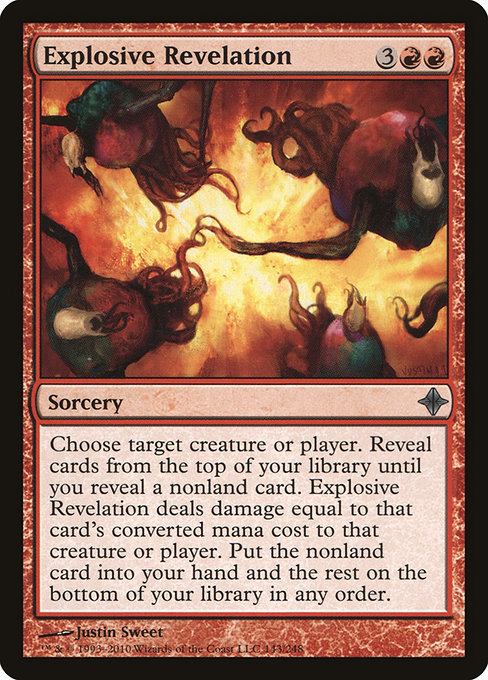
Magic: The Gathering has long been a laboratory for art direction, where color, composition, and brushwork whisper as loudly as text boxes and mana costs. When we swing from the playful edge of parody cards to the high-stakes gravitas of serious work, we witness a deliberate tension that shapes how we read a spell before its rules even click in our heads 🧙♂️. Explosive Revelation, a red sorcery from Rise of the Eldrazi (ROE), sits squarely in the latter category: a piece that feels like a cinematic blast rather than a punchline. Red as a color is all about motion, risk, and the thrill of impact, and the art mirrors that energy with a precision that fans love to parse as soon as the card lands on the table 🔥.
In the broader arc of MTG, parody cards—think Un-sets and other humor-forward rarities—often rely on exaggerated proportions, cartoonish expressions, and foreground gags. The humor is unmistakable, and the art cues you in with a wink: the stakes are real, but the setting is deliberately ridiculous. On the flip side, the serious side of MTG art leans into epic scale, dramatic lighting, and painterly texture that sells the worldbuilding as a shared mythos. Explosive Revelation rides that line of seriousness with a clean, operatic clarity—the kind of image that makes you pause before you even read the oracle text. It’s the difference between a rallying war cry and a punchline delivered at the wrong moment; both have their place, but the impact hinges on how the art frames the moment ⚔️.
The card in focus: Explosive Revelation
From the Rise of the Eldrazi set—an era defined by cosmic scale and molten energy—the card’s text speaks to classic red temperament: power delivered through risk, reward, and a dash of chaos. The oracle text reads, in full:
Choose any target. Reveal cards from the top of your library until you reveal a nonland card. Explosive Revelation deals damage equal to that card's mana value to that permanent or player. Put the nonland card into your hand and the rest on the bottom of your library in any order.
Mana cost {3}{R}{R} signals a big, spicy play that requires a moment of setup and a moment of consequence. The card’s color identity is red, and its rarity is uncommon, which places it in that sweet spot where a spell can swing a game without becoming a cornerstone staple. The artwork, painted by Justin Sweet, leans into a kinetic narrative—fire, pressure, and a sudden rupture of energy—so the moment of revelation feels as tangible as the damage that follows 🔥. This is a card designed for spectacle, not subtleness, and the art reinforces that intention with a composition built to propel your eyes forward and your decisions forward at the same time 🧙♂️.
What art communicates about the spell’s function
Great MTG art acts as a visual shorthand for a spell’s function. In Explosive Revelation, the image of combustion and rupture suggests a chain reaction: you don’t know what you’ll draw next, but you sense the inevitability of a burst. The fiery palette—amber, crimson, and blackened shadows—conveys heat, danger, and the randomness of revelation. The figure or the focal point isn’t just dramatic flair; it’s a cue that the spell is a gamble that can pay off in a big way, or punish you with overreach if you miscalculate. The art’s pacing—an implied burst radiating outward—mirrors the way the card’s effect ripples across the battlefield, forcing decisions about what to target, what to reveal, and what to keep for later 🎲.
Parody vs serious: how visual tone changes strategy at the table
Parody visuals often invite a playful read of the card’s intent, sometimes leading players to approach the card with a lighter, more experimental mindset. In contrast, a serious, painterly render like Explosive Revelation’s tends to nudge players toward macro-think: plan multiple turns ahead, size up risk vs reward, and anticipate how the revealed card’s mana value translates into damage. The distinction matters in deck-building and in match play. If you’re piloting a red control or a proactive midrange shell, the art’s gravitas can reinforce a sense of inevitability about the spell’s punch, making you more willing to lean into a high-variance moment when the top card proves worthy of a big payoff 🔎💥.
- Color and mood: The warm, volatile reds project urgency, while parody art often uses palette jokes and exaggerated expressions to ease the tension.
- Composition: Explosive Revelation leans into diagonal lines and central focus, implying motion and consequence; parody art might use circular, playful motifs that defuse tension.
- Texture and lighting: Painterly brushwork and dramatic lighting amplify gravity; cartoon lines in parody pieces can soften the edge and invite experimentation.
Even with a serious tone, Explosive Revelation maintains the sense of wonder that makes MTG art so magnetic. The narrative curvature—select a target, reveal a nonland card, unleash damage equal to its mana value—reads like a mini-movie: a moment of discovery, followed by a moment of impact. That arc is precisely what fans crave when a card lands on the battlefield, and the artwork primes you to feel the drama before you even resolve the spell 🔥🎬.
Art, lore, and the cultural memory of a set
Rise of the Eldrazi channels apocalyptic awe, and Explosive Revelation sits within that ecosystem as a combustible tool that fits red’s identity: impulsive, resourceful, and all about the moment of truth. The card’s art helps etch that identity into memory. It isn’t just a visual flourish; it’s a key that unlocks the emotional context of a red spell—risk, reward, and the thrill of seeing a perfect top-card moment unfold. For collectors, the combination of a well-composed painting by a respected artist and a strategically satisfying effect makes Explosive Revelation a memorable entry in ROE’s gallery of fiery demonstrations 🔥💎.
Building a narrative around art in your cube and decks
If you’re curating a red-heavy cube or drafting a deck that leans into explosive finishes, you can lean on the art to reinforce your theme. Choose stories and artworks that mirror the pace you want—fast, kinetic bursts or methodical, check-and-cascade plays. Parody pieces can inspire fun, offbeat builds where you lean into humor and unusual outcomes; serious pieces like Explosive Revelation push toward grand, game-altering moments that become legendary in your play group 🎨⚔️.
As MTG mixes artistry with engineering, the dialogue between parody and seriousness becomes a living tradition. Every time you glimpse a high-contrast explosion like the one captured here, you’re reminded: art doesn’t just adorn a card—it informs your perception of power, risk, and the story you tell with your spells 🧙♂️.
“In a single frame, a card’s art can prime your strategies as surely as its rules prime your decisions.”