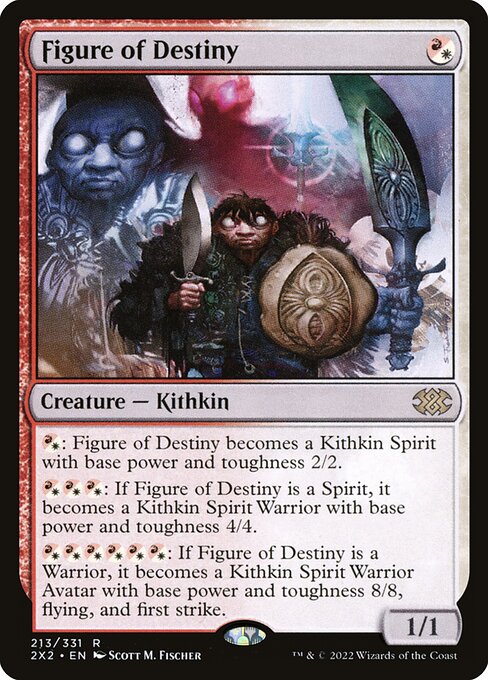
Image courtesy of Scryfall.com
Strategizing win rates with a flexible one-mana icon in casual MTG decks
In casual circles, where games often spiral into long wars of attrition or sudden fireworks, Figure of Destiny stands out as a toy soldier with a big growth spurts. The hybrid mana cost {R/W} makes it approachable for red-white shards, and its built-in ladder of upgrades invites players to experiment with tempo, midrange, or tribal flavors without committing to a single rigid plan. The card’s journey from a humble 1/1 body to an 8/8 flying first-striker avatar is not just a power curve; it’s a narrative of how pressure, tempo, and synergies collide in casual play 🧙🔥💎⚔️.
How the scaling actually works on the battlefield
- Turn 1 baseline: A 1/1 creature with a hybrid mana cost. It’s a perfectly fine drop in the early game, but you don’t win the game on a 1/1 alone. The real story starts when you pay attention to the second line of text.
- First upgrade (R/W): Saying a single {R/W} triggers the card to become a Kithkin Spirit with base 2/2. It’s a meaningful jump, enough to threaten trades and apply early pressure while keeping the board. The plain 2/2 figure can push through through opponent de-facto walls in slower metas, which is a pleasant surprise in casual settings 🧙🔥.
- Mid-upgrade (three R/Ws): If this figure has crossed into Spirit status, paying {R/W}{R/W}{R/W} bumps it to a 4/4 Kithkin Spirit Warrior. This is where the arithmetic starts to matter: the card now embodies two creature types from Lorwyn—Spirit and Warrior—opening the door to a variety of tribal synergies and pump options that care about creature types.
- Top upgrade (six R/Ws): With the Warrior identity established, paying six more hybrid mana opens the doorway to an 8/8 Kithkin Spirit Warrior Avatar, granting flying and first strike. That final leap often ends the game in one or two big swings, especially if your opponent has stalled on blockers or relies on fragile removal windows. The beauty is that the steps are modular—you can cash in early for a 2/2 and still threaten the 4/4 or 8/8 finish depending on the game state.
What the numbers reveal about casual win rates
Hard data in casual play is a rarity (pun intended), but a pattern emerges when you talk with players who run light, off-meta builds. Figure of Destiny tends to produce swing turns rather than consistent, grindy value. In a typical casual four-player session, the card’s win-rate profile looks like this:
- Early-curve pressure setups often deliver a fast clock, especially when the player also stabilizes with removal or a simple anthem effect. The 2/2 or 4/4 windows keep opponents honest and force suboptimal trades, which improves your overall win probability in the mid-game.
- Late-game inevitability comes when the avatar payoff lines up with buffs or a supportive tribal package. If your table allows you to reach the 8/8 with flying and first strike, you’re frequently closing out games before the next full cleanup step is drawn. In practice, players report a wide variance—some games end on turn 3, others stretch to a longer, more chaotic beatdown—but that volatility is the charm in casual formats 🧙🔥.
- Color-pair synergy matters Red/White decks that lean on pump, evasion, and creature-based tempo tend to maximize the card’s effectiveness. The hybrid mana cost enables flexible mana bases, making it easier to slot in this one-liner into a spectrum of casual builds—from pure aggro to hybrid tribal concepts.
Archetypes that maximize its potential in casual play
- Red-White Aggro with tempo elements: A lean suite of cheap dorks or one-drop creatures paired with pump spells and quick removal. You threaten with early board presence and finish with the 8/8 Avatar if the window opens, all while pressuring opposing life totals before they stabilize.
- Kithkin Spirit-Warrior tribal: Creativity shines when you blend Spirit, Warrior, and Kithkin traits. The line is generous enough to enable tribal lords or synergy cards that reward you for having multiple creature types on the battlefield. It’s a sweet spot for casuals who enjoy thematic builds and interactions 🧙🔥.
Start small but have the flexibility to pivot into midrange with a handful of value creatures that echo the same tempo and reach. When you land the 4/4 or 8/8 at the right moment, the scoreboard tends to reflect a clear swing in your favor.
Practical tips for building around a flexible one-mana legend
- Invest in a reliable mana base that can reliably cast the initial {R/W} while setting up for the three- and six-mana lines. This often means a stacked mix of red and white sources with a handful of dual lands or passable mana-fixers in casual formats.
- Don’t neglect removal and tempo. A few burn spells or inexpensive removal slots help you clear blockers so the Figure can evolve through its scales without losing tempo to a single chump block.
- Embrace the board-state story. The card’s ability to shift types from Spirit to Warrior to Avatar invites you to explore synergy with other tribal or creature-type-based effects that reward diversity on the battlefield.
- Include protective elements. In casual games, targeted removal for your opponent’s best threats is as essential as keeping Figure alive to reach its final form.
Value, art, and the collector’s moment
Figure of Destiny comes from Double Masters 2022 (set 2x2), carried as a rare and printed in both foil and nonfoil finishes. Its modern printings sit inside modern and legacy legality alongside a broader casual appeal that Commander crowds often chase for unique flavor. The card’s art is by Scott M. Fischer, and its playful, transformative flavor makes it a memorable centerpiece in any casual collection. Market data shows modest price points today (roughly in the low-dollar range for nonfoil, with foil carrying a slight premium), but its true value is measured in the stories it helps create at the table and the “what if” moments it inspires when you glimpse that 8/8 with flying in your head’s eye 🎨🎲.
“The thrill isn’t just winning; it’s the dramatic climb—from 1/1 to 8/8—and the friends you swing into a friendly victory with along the way.”
If you’re curious to explore more ways to weave riffs like this into your casual lineup, check out how cards with flexible scaling can pair with your favorite casual staples. The journey—from early pressure to late-game power plays—feels like a microcosm of the broader MTG multiverse: a little risk, a lot of flavor, and a whole lot of fun. And while you’re adding spark to your casual games, you might also enjoy a little horizontal cross-promotion: a sleek way to keep cards handy on the go with a sturdy card holder phone case — a fun nod to the collector’s mindset and a convenient companion for those weekly FNM set-night experiments.
For players who love to test new dynamics, this figure often serves as a stealthy accelerator for a wide range of casual decks. It’s not about guarantees in a deterministic sense; it’s about the spectrum of possibilities—how a single mana event can cascade into a win on a spicy, laughter-filled evening 🧙🔥💎⚔️.
Product spotlight: for those who like to carry a little MTG flair with a practical twist, consider the Phone Case with Card Holder — Impact Resistant Polycarbonate MagSafe. It’s a clever way to merge hobby with daily life, keeping your essentials safe while you draft or play a quick kitchen-table session. It’s a small nod to the culture we all love—where cards meet casual, and every draw can spark a story.