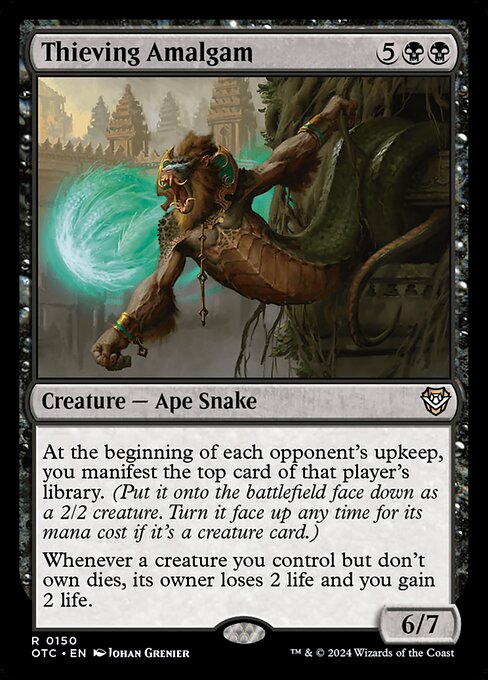
Image courtesy of Scryfall.com
Flavor-Driven Mechanics Behind Thieving Amalgam
Magic: The Gathering thrives on smaller moments that unlock big stories. Thieving Amalgam is one of those cards that feels like it’s stealing not just cards, but the narrative of the entire game. A rare-black creature from Outlaws of Thunder Junction Commander (OTC), it arrives on the battlefield as a fusion of ape cunning and snake stealth, a true embodiment of “theft by design.” Its mana cost—{5}{B}{B}—asks you to invest heavily, but the payoff lands with a satisfying snap when you see your opponents’ own strategies turn against them. 🧙♂️🔥💎
At its core, Thieving Amalgam is a study in flavor and function. Its official text codifies two intertwined ideas: first, a recurring disruption that pulls from the very hands of your rivals; second, a lifegain/life-loss dynamic that makes each theft feel personal. The artifact of its flavor is clear: a monstrous blend that not only takes from others, but also siphons life when a creature you control—but don’t own—dies. It’s a microcosm of the dicey, social gamesmanship that makes multiplayer formats so memorable. ⚔️🎨
“At the beginning of each opponent's upkeep, you manifest the top card of that player's library. (Put it onto the battlefield face down as a 2/2 creature. Turn it face up any time for its mana cost if it's a creature card.) Whenever a creature you control but don't own dies, its owner loses 2 life and you gain 2 life.”
That is the heart of the card’s flavor-driven design. Manifest is a mechanic that doesn’t just shuffle cards—it reshapes the battlefield by turning a slice of your opponent’s fate into a tangible, if ambiguous, presence on your side of the board. The top card of each opponent’s library becomes a face-down 2/2 creature you temporarily control. If you’re lucky (or cunning) it flips face up later, becoming a creature you can deploy under your own tactical umbrella. And when those non-owned bodies finally die, the life exchange—2 life from them to you—feels like a slow, inexorable scorekeeping of the “thief” archetype. It’s flavor that invites dicey decisions: do you flip that face-down 2/2 now, or wait for a moment when it becomes a real threat? The tension is deliciously thematic. 🧙♂️💀
Why this works on the table—and in the lore
Mechanically, Thieving Amalgam asks you to think about control in a new light. It’s not just about who has the most cards in hand or who can untap the most lands; it’s about who owns what exists on the board. The “creature you control but don’t own” clause creates a living ledger of power that shifts as the game evolves. When those creatures die, the life swing isn’t merely a point total—it’s a narrative beat: the Amalgam’s mastery is only as secure as the fate of the bodies it rides. That interplay between ownership and presence—the thief who wields another’s ghastly body—captures a uniquely MTG flavor: a world where power is not just what you summon, but what you sustain through others’ losses. ⚔️🧪
From a rules perspective, the card’s black identity and its seven-mana commitment push you toward a late-game plan: ramp into a towering threat, weather the early pressure, and then slowly sculpt the battlefield with stolen assets. The rarity (rare) and the set’s commander emphasis reinforce the social dimension: in a room full of friends and rivals, every manifest becomes a talking point, every face-down 2/2 a potential misdirection, and every life swing a reminder of just how precarious your position can be. And let’s be honest—there’s a certain mischievous glee in watching an opponent realize their own cards are now living under your control. 😈🎲
Strategic threads you can weave around Thieving Amalgam
- Mana as a commitment to risk: With a mana cost of 7 and black mana identity, you’re looking at a game that rewards deliberate setup. Use rituals, mana rocks, or reanimation to ensure you’ve got the cushion to cast it when the moment is right. The payoff—manifesting an opponent’s top card and potentially turning that card into utility for you—feels earned. 🔮
- Controlled chaos via ownership: The “don’t own” clause makes your board feel like a rotating gallery of borrowed power. Decks that lean into theft or control effects, or that can easily flip face-down creatures into something threatening, pair nicely with Amalgam’s long game. It’s not just board presence; it’s a living narrative of who’s in charge. 🧟♂️
- How to maximize the lifegain/lifeloss swing: Since life is a scarce resource in Commander, the life drain on non-owned creature deaths can propel you toward victory through attrition or stymie an opponent’s plan by sapping their life total as they blunder into combat. Pair this with removal or protection for your new body fleet, so you don’t lose momentum when a key piece is removed. 💎
- Flip or not to flip? Turning a manifested card face up hinges on whether it’s a creature card with a meaningful mana cost. Use this feature to sculpt your battlefield: flip a powerful creature that better fits your strategy or leave a surprising, noncreature face-down body as a surprise blocker or attacker. The decision is tactical and flavorful in equal measure. 🃏
- Commander-friendly considerations: In a 1v1 or multiplayer Commander, Amalgam’s ability to pull a piece from multiple opponents’ libraries adds a political layer. It invites negotiations, alliances, and the occasional “you scratch my back, I’ll scratch yours” moment that keep the table dynamic and entertaining. 🗺️
For builders who adore flavor-forward design, Thieving Amalgam offers a rare blend of threat, intrigue, and tactical depth. It’s a card that rewards long games, careful mana engineering, and a tolerance for the glorious chaos that comes with borrowing a foe’s power. If your meta enjoys back-and-forth manipulation and dramatic reveals, this creature will feel right at home on your battlefield. 🧙♂️🔥
If you’re curious to see how this blend of flavor and mechanics sits beside contemporary design, it’s worth a look in OTC Commander decks. And if you’re plotting your next purchase or desk-ready display, a neon card holder phone case might be a perfectly stylish companion—both vivid and sturdy, much like the Amalgam itself. Neon vibes meet Night-Black strategy here. 🔥🎨
Note: Thieving Amalgam’s design interacts with a broad spectrum of cards and strategies found in the Commander format, including those that alter control, ownership, or the size of the battlefield. Always consider how your deck handles stolen assets and the impact on your group’s dynamics.
Neon Card Holder Phone Case MagSafe PolycarbonateMore from our network
- https://transparent-paper.shop/blog/post/freemium-models-that-convert-practical-growth-strategies/
- https://transparent-paper.shop/blog/post/practical-scalability-for-small-digital-products/
- https://blog.digital-vault.xyz/blog/post/red-bp-rp-color-sparks-synthetic-star-populations-at-27-kpc/
- https://blog.digital-vault.xyz/blog/post/master-ga4-setup-for-content-creators/
- https://blog.digital-vault.xyz/blog/post/embereth-skyblazer-inspired-red-deck-archetypes-and-strategies/