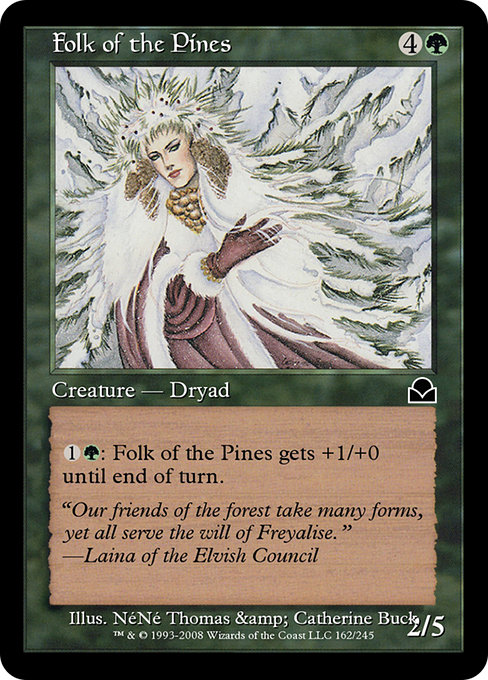
Image courtesy of Scryfall.com
Power-Toughness Ratios in Folk of the Pines
Green magic has never been shy about turning simple bodies into stubborn monsters on the battlefield, and Folk of the Pines serves as a classic case study for understanding how a creature’s power and toughness interact with the cost you pay to cast it. With a mana cost of {4}{G} and a base body of 2/5, this Dryad leans into a strategy that emphasizes staying power and swing weight rather than pure aggression. The creature’s punch-for-cost ratio isn’t outstanding in raw power, but its exceptional toughness for a five-mana body makes it a formidable blocker that can stall opponents while your deck wheel-greens toward bigger plays. 🧙🔥
In MTG terms, a 2/5 on five mana translates to a power-to-cost ratio of 0.4 and a toughness-to-cost ratio of 1.0. That means Folk of the Pines is more about soaking damage and delaying the opponent’s advances than delivering decisive blows on the first turn. That kind of resilience is exactly what green thrives on when it leans into terrain control, ramp, or token generation, because it lets you weather early pressure while curating a late-game board presence. The card’s design is a reminder that not every green behemoth needs to smash the opponent early; some simply refuses to break down under pressure. 🌳
Turning the Tables with a One-Mana Boost
The activated ability on Folk of the Pines—{1}{G}: This creature gets +1/+0 until end of turn—is the mechanical twist that makes the ratio matter in real games. For a single green mana you can threaten quick trades, push through a last few points of damage, or keep a favorable combat outcome against a timely blocker. In practical terms, that extra +1 power on a 2/5 creates a 3/5 for a turn, which can chew through a surprising number of early-game creatures and threaten to pressure your opponent’s life total in late-game races. It’s the kind of swing that compounds with pump spells, anthem effects, or power-boosting synergies you might add to a green-focused deck. 💚
- Against aggro: The 5-toughness delta means Folk of the Pines can stall multiple early assaults, obtaining time to stabilize and draw into grazier cards or ramp spells. A timely +1/+0 boost can turn it into a capable attacker if you’ve already stabilized the board. ⚔️
- Against removal: A 2/5 body is not an easy removal target for every spell, especially if you can back it with a few defensive tricks. The ability to push a surprise punch helps justify continuing to play it even when you’re not currently pressure—surprise power can tilt the next combat in your favor. 🧭
- With green’s typical toolkit: Folk of the Pines shines when paired with anthem effects, breeding grounds for token swarms, or follow-up threats that capitalize on favorable trades. The math becomes friendlier as you stack extra power on turns you need it most. 💎
“Our friends of the forest take many forms, yet all serve the will of Freyalise.”
—Laina of the Elvish Council
In Masters Edition II, Folk of the Pines is not just a nostalgia piece; it’s a lens into the era’s design priorities. The set, a Masters Edition II reprint, offered fans a curated look at classic green deviations, with a flavor that still resonates today. The card’s Common rarity in ME2 doesn’t diminish its potential in the right shell; it invites players to experiment with budget-friendly ramp and value-based aggression. The green art, credited to NéNé Thomas & Catherine Buck, captures a forest-dense mood that invites you to imagine the forest guarding its own, even as it reshapes the battlefield with a single, strategic boost. 🎨
Art, Flavor, and the Ritual of Green
Beyond raw statistics, Folk of the Pines embodies green’s ethos: endurance, resilience, and the capacity to outlast opponents through attrition and careful tempo. The flavor text—a line that ties Freyalise’s will to the forest’s folklore—reminds us that the card’s power scales not just with mana, but with story and atmosphere. In this light, the card’s 2/5 frame feels less like a mismatch and more like a deliberate reinforcement of green’s stubborn, rooted identity. The illustration’s lush greens and dogwood textures invite a tactile immersion for fans who savor both the game’s mechanical and narrative layers. 🧙🔥
Design Notes: What Folk of the Pines Teaches Us
If you’re a designer or a curious player, Folk of the Pines demonstrates a few timeless lessons about power-toughness allocation. First, a high toughness for a mid-to-late-game creature can create meaningful value when paired with a robust green mana curve. Second, a small, reusable pump ability adds strategic depth without breaking the bank—this is how you craft cards that feel both fair and flavorful. Third, a reprint in a Masters set underscores how older mechanics can still resonate in modern decks when balanced thoughtfully.
For collectors and players who enjoy tracking the arc of MTG’s evolution, Folk of the Pines sits at the intersection of nostalgia and functional design. It’s a common card with a surprisingly long shelf life in the right builds, especially in formats that allow its Legacy and Pauper vibes to shine through. If you’re browsing EDH (Commander) lists, you’ll see the value of a rugged green beater with a removable punch—enough to unsettle an alpha strike but patient enough to accelerate your land drop and ramp plan in later turns. ⚔️
Practical Decking: How to Play Folk of the Pines Today
In a modern retrospective sense, Folk of the Pines is best deployed in green-centric strategies that lean on resilience and value over raw aggression. Here are a few tips to squeeze more out of this Dryad:
- Pair with pump spells and stat-boosters to maximize the temporary +1 power boost’s impact. Even a single turn of a 3/5 can swing a race in your favor. 🎲
- Use it as a staging ground for bigger threats—if you can keep it alive for a couple of turns, you’ve created gaps your opponent must address, buying you time to deploy larger creatures or bombs. 💎
- Consider green staples from the era that preserve a board state, such as those that replenish or re-create bodies after combat, ensuring Folk of the Pines remains relevant as the game evolves. 🧙♀️
If you’re curious to explore more about this concept in a tangible way, you might enjoy exploring cross-promotions that pair MTG nostalgia with modern goods. For instance, retailers blending gaming culture with everyday gear offer quirky, collectible collaborations that feel right at home for fans who live in the fusion of hobby and lifestyle. And if you’re browsing deals and collector-friendly finds online, consider how this card’s ME2 heritage sits alongside a modern budget-friendly pick—two ways to celebrate the enduring charm of green’s stubborn, forest-heart. 💚