Image courtesy of Scryfall.com
Card Frames and MTG Perspectives: A Deep Dive with Quicken
Blue magic in Magic: The Gathering has always loved tempo, timing, and the thrill of catching opponents off-guard. When you pull Quicken from the Ravnica Remastered subset, you’re not just getting a neat little instant; you’re stepping into a design conversation about how frames, wording, and flavor shape our perception of a spell’s potential on the battlefield. This isn’t a gloss-over; it’s a chance to frame the frame itself — to see how a humble one-mana spell can bend the timeline, twist expectation, and still draw a card 🧙♂️🔥💎⚔️🎨🎲.
A quick look at the card’s bones
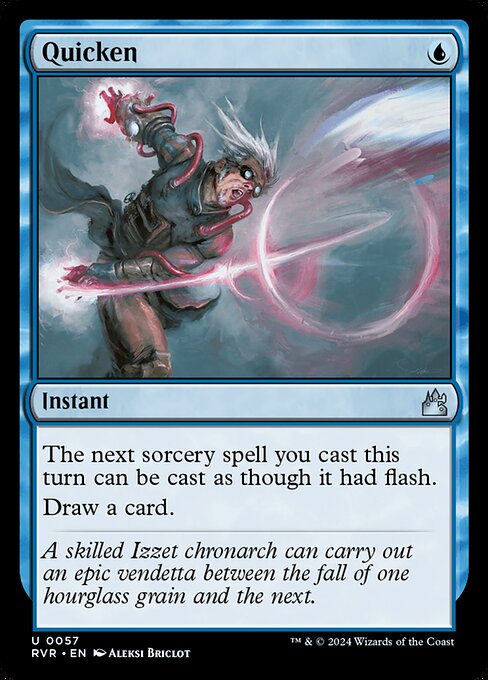
- Set: Ravnica Remastered (Masters-style reprint block, released in 2024), frame: 2015-era border with classic black frame.
- Name: Quicken
- Mana Cost: {U} (blue)
- Type: Instant
- Rarity: Uncommon
- Oracle Text: The next sorcery spell you cast this turn can be cast as though it had flash. (It can be cast any time you could cast an instant.) Draw a card.
- Flavor Text: "A skilled Izzet chronarch can carry out an epic vendetta between the fall of one hourglass grain and the next." — flavor that ties time and experimentation into the Izzet identity
- Artist: Aleksi Briclot
From the outset, Quicken is a compact, clever package. Blue mana, a tidy single mana cost, and a training-wheel ability that tilts the turn in your favor without upping the card’s clock. The effect transforms a sorcery into something you can cast as if it had instant-speed, letting you weave tempo plays and surprise your foe with a late-card draw. In a meta where “answering on the stack” is the everyday grind, Quicken’s design feels almost mischievous in the best possible way 🧙♂️.
Frame design in the 2015 era and why it matters
Ravnica Remastered sits squarely in the 2015-era frame, a time when Wizards refined readability and storyteller alignment in card design. The 2015 frame emphasizes a clear color identity, a balanced layout, and a slightly larger, crisper art presentation compared to the earlier border styles. The mana cost is easy to scan, the card type line sits comfortably beneath the name, and the rules text is laid out to minimize confusion during fast turns. This framing makes Quicken’s flip-of-the-tight-turn feel both elegant and approachable—it’s the sort of spell you want to see at a glance when planning a sequence that hinges on timing and surprise.
The frame also plays into how players absorb flavor and lore. Aleksi Briclot’s illustration—tidally focused on motion and time in the Izzet spectrum—reads through the frame with an anticipation that matches the flavor text. When you study the image with the clockwork of the frame in mind, you sense a perspective that’s less about raw power and more about control over moments. That sense of time slipping and snapping back is a perfect visual partner to a spell that reads, in essence, “you may bend the rules of timing, just for this turn.” The synergy between art and frame is a hallmark of how MTG communicates story and strategy in one glance 🧙♂️🎨.
Flavor, art, and narrative perspective
“A skilled Izzet chronarch can carry out an epic vendetta between the fall of one hourglass grain and the next.”
The flavor text anchors Quicken in the Izzet identity—the guild of arcane experimentation and clockwork precision. It hints at a perspective that treats time as a manipulable resource, a concept that resonates with the card’s mechanics. The art by Aleksi Briclot reinforces that idea, presenting a moment of motion frozen in a frame whose edges feel like the margins of a timepiece. The frame’s lines guide your eyes to the moment where memory and plan converge, a subtle reminder that in a blue deck, knowledge and timing beat brute speed every time 🧙♂️💎.
Framing perspective in practice: how Quicken changes the turn structure
On the table, Quicken isn’t about brute card advantage so much as it’s about reforming the rhythm of a game. Let’s break down how the card’s perspective translates into actual play:
- Tempo engine: You cast an instant early and hold up a surprise sorcery later in the same turn, which now can be cast with flash-like flexibility. This lets you deploy a late-game spell while your opponent is mid-tap, catching them off-guard and buying you an additional draw engine for the turn.
- Card advantage by design: The draw-a-card clause ensures you don’t just tilt the tempo; you also refill your hand, keeping options alive as you navigate counterspells and removal. In blue-heavy setups, that extra card can turn a fragile position into board presence.
- Synergy with cantrips and cheap spells: When you script a sequence of cheap cantrips, Quicken can maximize value by enabling a protected sorcery you might cast later in the turn, while your draw engine keeps you ahead on cards. It’s a play pattern that rewards careful sequencing and risk management ⚔️🧙♂️.
In commander and other multi-player formats, Quicken’s perspective shifts again. Its ability to “cast a sorcery as if it had flash” opens doors for surprise mass removals or instant-speed card draws in the presence of tapped blockers or a stalled mana base. The 1-mana cost keeps it affordable in early turns, while the flexibility shines when you’re aiming to stabilize or exploit a narrow window before your opponents re-assert control 🧭.
Collecting, value, and frame-aware care
As a remastered reprint, Quicken sits in a unique niche for collectors and players alike. Its rarity is uncommon, which often yields a balanced price point while still being a sought-after part of blue mana’s toolbox. The card’s foil and non-foil finishes provide different collector values, with foil editions typically fetching a premium in the long run. For reference, the market price sits around the mid-teens to a few dimes depending on condition and edition, but the value of the copy you’ve got in your binder tends to grow with the love players show for the 2015-frame aesthetic and the Izzet flavor 🧙♂️💎.
From a framing perspective, Masters-era reprints like this one often attract players who love the tactile and visual continuity of a modern frame with classic gameplay. If you’re building a blue tempo shell that leans into flash-like play patterns, Quicken is a strong pick not just for its raw effect, but for how it sits within the frame—easy to read, gratifying to cast, and satisfying to collect as part of a broader Ravnica Remastered portfolio.
And if you’re curating a digital or physical collection that celebrates the cross-pollination between art, lore, and strategy, consider how product choices can complement your display. A well-timed Quicken pick can anchor a blue-focused deckbuilding narrative around time, control, and unexpected value. For fans who love the hobby as much as the game, that’s the sweet spot where art, mechanics, and nostalgia all align 🧙♂️🎨⚔️.