Image courtesy of Scryfall.com
Artful contrasts in MTG: parody aesthetics vs serious storytelling
If you’ve spent time rifling through Battle for Zendikar and its allied brothers, you’ve glimpsed an interesting tension that defines the visual language of Magic: the line between parody-friendly whimsy and solemn, world-building grandeur. Grovetender Druids sits near the heart of that conversation. The card’s gleaming white-green color identity, its rally-enabled board presence, and its forest-forged vibe lean into earnest storytelling. Yet the very concept of an Ally-themed creature—one that invites you to churn out Plant tokens with a casual tap of your will—invites a degree of playful, almost parlor-game charm that fans of humor-adjacent sets still hold dear 🧙🔥. The result is a memorable texture: a card that feels both like a nod to living forest and a sturdy weapon in an Ally tribal deck.
Grovetender Druids at a glance: mechanics that sing with the forest
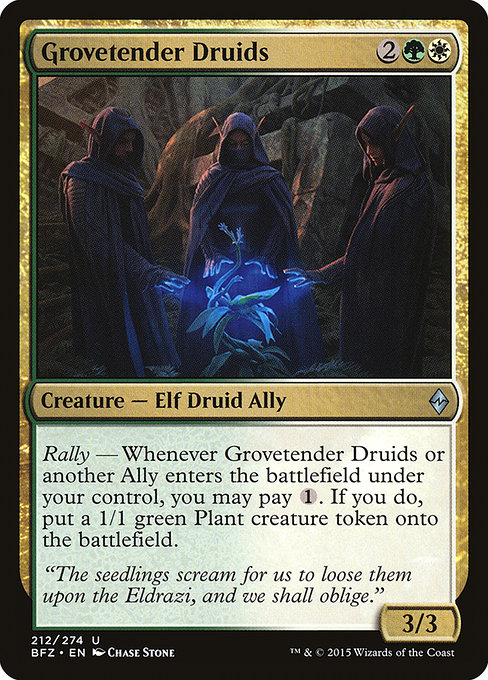
From a rules perspective, Grovetender Druids is a four-mana 3/3 creature—Elf Druid Ally—casting cost is {2}{G}{W}. The real sparkle, though, emerges from the Rally ability: “Whenever this creature or another Ally you control enters, you may pay {1}. If you do, create a 1/1 green Plant creature token.” The cadence of this ability rewards you for simply filling the battlefield with Allies. It’s a design that leans into synergy rather than sheer raw power, a hallmark of ally tribal strategies that thrived in BFZ-era limited play and found homes in Modern and Commander circles alike ⚔️💎.
The card’s lore-tinged flavor text—“The seedlings scream for us to loose them upon the Eldrazi, and we shall oblige.”—cements its identity as a guardian of growth facing an existential threat. The Eldrazi invasion is not a distant myth here; it’s the battlefield’s current horizon, and the Grovetenders are the quiet stewards who turn growth into defiant momentum. The flavor invites players to imagine a chorus of woodland nurses and wardens weaving life into a clearing that stands as a bulwark against the otherworldly intruders 🎲🎨.
Art direction: serious realism meets forest-drown whimsy
Chase Stone’s illustration for Grovetender Druids anchors the card in a tactile, almost tactilely tactile realism. The palette glows with mossy greens and sunlit whites, a deliberate contrast that communicates both healing and resilience. This is not a jokey caricature; it’s a pastoral sermon whispered through vines and birch bark. You can almost hear the rustle of leaves and smell the resin as the Druids weave their protective canopy. In the broader spectrum of MTG art, this piece sits comfortably among the series’ more solemn woodland portraits—art that reinforces a card’s mechanical promise rather than trading on gag-status or meta-jokes. That’s the core of serious imagery: it respects the card’s function while inviting players to linger on the lore and the world-building that fuels the game’s multiverse 🧙🔥.
When you compare this to parody-focused art from other corners of MTG, like the zany exaggerations found in Un-set cards or the tongue-in-cheek color-bending humor of some crossover promos, Grovetender Druids demonstrates a different ambition. Parody imagery often thrives on immediacy and a wink to the audience, while serious imagery leans into atmosphere and narrative gravity. Both modes have their place, their fans, and their champion cards; Grovetender Druids is a strong reminder that a well-painted forest scene can carry as much strategic weight as a flashier combat spell, especially in a deck that wants to flood the board with Plant tokens and racial synergy among Allies 🧩⚔️.
Gameplay implications: token generation as a storytelling mechanic
Token generation is one of MTG’s most beloved design motifs, a way to visualize progression from a few skilled cards to a forest-wide rapture of life. Grovetender Druids embodies this in a clean, repeatable loop: drop an Ally, watch a new Plant token sprout, and consider paying a little for another token to accelerate the grove’s growth. The combination of a 3/3 body with a rally-triggered token engine creates a rhythm that supports midrange strategies and late-game board states. In the right shell, you can chain multiple Allies onto the battlefield and pepper in Plant tokens to overwhelm opponents while your ramp and removal pieces hold the line 🧙🔥🎲.
- Ally tribal synergy: Grovetender Druids is a natural fit for decks that lean into allies, stamping a reliable token-making engine on each entry to the battlefield.
- Token density: Plant tokens give you not just bodies but a substrate for buff effects, enchantments, and combat tricks that reward wide boards.
- Rally timing: You don’t need to play the full board before leveraging this ability—timely plant production can swing the tempo in your favor on each Ally entry.
“The seedlings scream for us to loose them upon the Eldrazi, and we shall oblige.”
From a collector’s perspective, Grovetender Druids sits in an approachable tier. As an uncommon from Battle for Zendikar, it offers accessible play and a chance to appreciate the set’s artistry without the steep price tags of mythic rares. Its foil treatment is a collectible draw for players who enjoy glossy reminders of a forest’s resilience, with foil values historically tracking higher than their non-foil counterparts, though the card’s core utility remains the headline for most players. In market terms, it’s a card for players who value function, flavor, and a solidly themed tribal engine rather than a pure power spike. The data from Scryfall shows the typical price range for this card aligns with uncommon staples, making it a practical addition to a builder’s collection and a flavorful centerpiece for an Ally-focused deck 🧙🔥💎.
Design, lore, and culture: why the contrast matters
MTG’s art direction isn’t just about pretty pictures; it’s a cultural barometer for the game’s evolving narratives. In sets like BFZ, the artwork leans into grand world-building—massive trees, shifting skies, and the quiet, patient power of nature. The contrast with parody-oriented imagery—where art twists expectations for humor or meta-jokes—helps keep the game vibrant for both die-hard lore fans and casual players who adore a well-painted card on the table. Grovetender Druids proudly embodies that tension: it invites you to savor the visual storytelling of a forest alive with guardians and tokens, all while reminding you that the real spectacle is how those tokens matter in battle, not just how they look on a card gallery page 🧙🔥🎨.
If you’re curating a drafting station or a M:tG watching desk, consider pairing the experience with a playful desk accessory. A foot-shaped mouse pad with wrist rest can keep your drafting sessions comfortable as you lead your grove to victory—an oddly perfect complement to the serene, green-white aesthetic of Grovetender Druids. For a quick browse, you can explore the product here: Foot-shaped Mouse Pad with Wrist Rest, a small nod to the tactile joy of collecting and playing in comfort. It’s the kind of desk-side detail that makes every card encounter feel just a little more magical 🧙♀️🧭.