Image courtesy of Scryfall.com
Artist Spotlight: Bram Sels and the living loom of growth
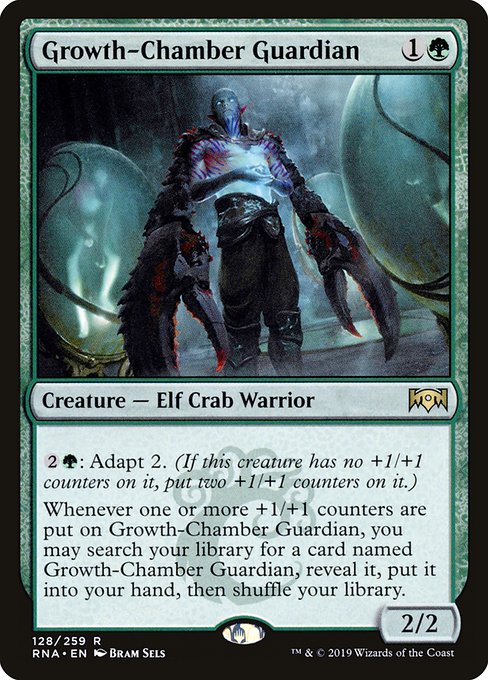
Magic: The Gathering has always been a artists’ playground, a mosaic where color, silhouette, and story braid themselves into something iconic. When we zoom in on the work of Bram Sels, the Simic-stamped world of growth and adaptation comes to life with a certain tactile immediacy 🧙♂️. The artist’s brushwork in this piece—plump with life, a hint of biomechanical texture, and a pulse of verdant energy—speaks to the way Simic identity threads biology with curiosity and invention. In the 2019 expansion Ravnica Allegiance, Sels contributed a memorable creature that embodies the guild’s desire to nurture, mutate, and reconfigure the natural world. The result is more than a card; it’s a snapshot of Sels’s career arc as an MTG artist who can render the living system with crisp linework and a glow of green wonder 🔥💎.
Meet the creator: Bram Sels’s MTG journey
While the gallery of Sels’s MTG work spans multiple sets, Growth-Chamber Guardian anchors his Simic-themed portfolio with a design that feels both organic and engineered. His art for this card leans into the guild’s hallmark themes—growth, adaptation, and the clever fusion of plant life with elemental science. Sels’s career—much like the creature he paints—flourishes at the intersection of nature and craft. The result is a style that invites MTG players to lean in, study the details, and imagine the lab where green magic and coral-gray armor meet in a symbiotic dance 🎨.
Artistic style: color, texture, and the Simic mood
- Palette: Lush greens with teals and a pop of luminescent detail that evokes fresh growth and bioluminescence. It’s less about a single focal point and more about a field of life that invites inspection and awe 🧬.
- Texture: A careful balance of organic textures and clean linework—think vines, shells, and chassis-like structures coexisting in a single frame.
- Composition: The gaze is drawn to movement and potential—anticipation of change as if the guardian is about to push a new mutation into existence.
- Theme: Growth through adaptation, a core Simic motif that translates neatly into a creature that can literally become stronger while enabling a strategic engine in play 🧪.
How the card works on the battlefield: strategy and synergy
Growth-Chamber Guardian is a creature with a distinctive, game-mechanical heartbeat. For two mana (1G), you get a 2/2 Elf Crab Warrior, a little oddball, but one that wears its adaptability like a badge of honor. The real payoff shows up with its adapt ability: “{2}{G}: Adapt 2. (If this creature has no +1/+1 counters on it, put two +1/+1 counters on it.)” This is not just a tempo play; it’s a self-propagating engine. Each time you invest mana to adapt, you nudge the Guardian toward a larger presence, and you unlock a secondary trigger: “Whenever one or more +1/+1 counters are put on this creature, you may search your library for a card named Growth-Chamber Guardian, reveal it, put it into your hand, then shuffle.”
In practical terms, the card encourages a few different lines of play in Simic and +1/+1-counter themed decks. First, you can deploy Growth-Chamber Guardian early, protect it, and plan to adapt once or twice to excite its library-searching loop. When you add counters, the Guardian virtually tutors itself into your hand, letting you re-cast it or chain more copies if your deck includes multiple copies. It’s a recursive engine that rewards tempo, card selection, and careful sequencing. In modern and eternal formats where Simic engineering shines, this kind of card shines brightest in ramp or midrange builds that want a durable threat capable of expanding its own battlefield presence while tutoring for redundancy 🔧🎯.
Beyond its mechanical quirks, the card embodies the playful design philosophy of the Simic identity: a creature that grows into a calculable threat, while thinning the deck with a targeted fetch to hand. The synergy with +1/+1 counters aligns with the broader Ardent growth motifs you’ll find in green decks across MTG history. And because Growth-Chamber Guardian is a rare, you’ll often see it as a centerpiece card in “build-around” strategies where players lean into the idea that growth can be staged, not rushed, and that a guardian made of vines and circuitry can outthink and outlast rivalling boards 🪴🧠.
Lore, flavor, and the art’s storytelling impact
Ravnica Allegiance places Simic color identity squarely on the map, and Bram Sels’s Guardian is a microcosm of that blend of biology and engineering. The card’s name itself—Growth-Chamber Guardian—evokes a future where living chambers nurture organisms until they are ready to emerge as something more capable. This is not mere aesthetic; it’s flavor that translates into gameplay: growth is not a single incursion but a continuous process, and the guardian embodies the patience and precision of Simic experimentation. For players who love the lore of the guilds, the art tells a story of guardianship, experimentation, and the hum of a biotech lab where life is both subject and tool 🎨⚔️.
For collectors and lore-hounds alike, the Simic watermark on this card is a signal of family resemblances across cards from the same guild. Bram Sels’s work, particularly on RNA’s Simic outputs, helps anchor a shared visual language—lush ecology, metallic accents, and a sense of organized growth. That consistency makes the set feel cohesive in a way that fans can point to while drafting or trading at pre-release events, or during a casual Friday night where the kitchen-table deck-building becomes a micro-maga legend 🧙♂️🎲.
Value, collectability, and community impact
Despite its striking art and unique mechanic, Growth-Chamber Guardian sits in the lower to mid-price range for most collectors, with USD prices around 0.11 for non-foil and about 0.24 for foil, depending on market dynamics. That makes it an accessible card for players building Simic strategies who also savor the artistry. The card’s rarity—rare—guarantees it to pop up in booster packs with a bit of fanfare, and its foil variant offers that extra pop on display boards and binder pages. For newer players, it’s a friendly entry point into the broader ecology of +1/+1 counter interactions and tutor-like effects, a neat gateway into more intricate counter-based decks ⚡💎.
For fans following artist careers, Growth-Chamber Guardian is a nice case study of how a single MTG illustration can anchor a card’s identity in a set’s broader narrative. Bram Sels’s involvement helps remind collectors that MTG’s art can be as collectible as the card itself—both in terms of in-game value and the emotional resonance players feel when a familiar artist’s palette returns in a set they love. The card is also a nice spark for online discussions, fan art mashups, and community-driven deck-tech showcases that celebrate the marriage of image and mechanic across formats 🧙♂️🎨.
Practical tips for players and fans
- Pair Growth-Chamber Guardian with other +1/+1 counter synergies to maximize its tutor trigger—think of ways to proliferate counters or to recast multiple copies from your hand as your board develops.
- Use the Guardian as a stabilizing mid-game threat in green-heavy decks that want to pivot into late-game value via library tutoring.
- Appreciate the art and the lore together: track Bram Sels’s portfolio to spot recurring motifs and celebrate the Simic aesthetic across different releases 🧙♂️🔥🎲.
For readers who want to explore more about the card’s design lineage, or who want to scout similar Simic gems, there’s a convenient cross-promo path you can take. A quick browse through official MTG retailers and Scryfall’s card pages will reveal similar creatures with the same spirit of growth and recursion, perfect for fans who love a good green engine. And if you’re considering upgrading your mobile game-night setup while you build your deck, the product below offers rugged protection for your gear—because even Planeswalkers need sturdy storage when they travel between conventions and kitchen-table leagues alike 🔥🎲.