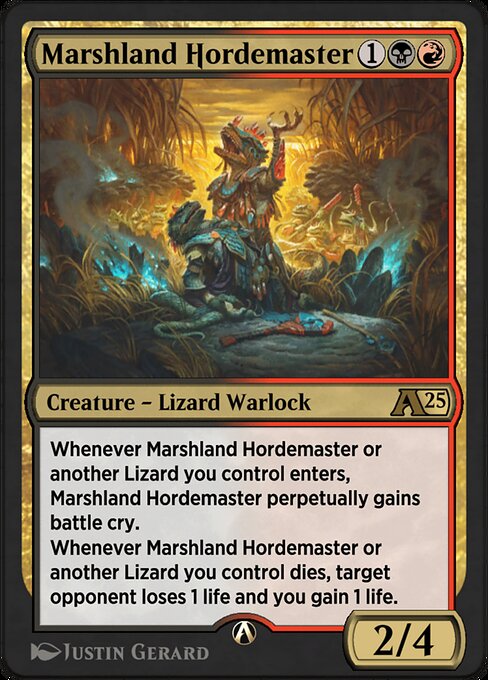
Image courtesy of Scryfall.com
Subtle Clues from a Swamp-Locked Warlock
Magic: The Gathering has a long love affair with the idea that a single frame can tell a thousand stories. Marshland Hordemaster, a rare creature from the digital-focused Alchemy: Bloomburrow set, is a perfect case study in how art, color, and mechanics converge to hint at a deeper strategy. The piece—illustrated by Justin Gerard—binds a vivid swamp aesthetic to a compact red-black (BR) package: {1}{B}{R} mana, a 2/4 body, and a text box that mutates the battlefield with every return of the lurker in the reeds. As fans, we’re invited to analyze not just what the card does, but how the artwork foreshadows the tempo, the risk, and the payoff of playing it. 🧙♂️🔥
On first glance, the creature reads as a small but sturdy threat: a Lizard Warlock who can surge into battle through perpetual Battle Cry whenever a Lizard you control or Marshland Hordemaster itself enters the battlefield. The second line—where death becomes life for you and a sting of life loss for your opponent—turns a typical board state into a chessboard of lifepaths and counterplay. The artwork, with its murky palette and hint of hidden motion in the reeds, seems to tease that the marsh is not merely a setting but a living engine feeding both fire and shadow. The card’s rarity, trackable in the set’s Alchemy lineup, hints at a design intent: you’ll need to plan around multi-creature entries and the inevitable casualties that come with BR aggression. ⚔️
“The marsh isn’t just a backdrop; it’s a living engine that chews through a deck’s sacrifices and a player's nerve.”
— fan reflection
Design Notes: Color, Mechanics, and the Artist’s Touch
Marshland Hordemaster is a creature with a dual identity: its BR mana cost signals a blend of removal, reach, and aggression, while its ability set rewards you for building a chorus of Lizards. The card text reads two distinct but intertwined ideas. First, a continuous growth of its own “Battle Cry” is unlocked whenever a Lizard you control—or the Hordemaster itself—enters the battlefield. This is a clever nod to tribal synergy: the more Lizards you deploy, the more aggressive your board becomes on each attack step. In practice, this means careful timing: you want to maximize the number of enter-the-battlefield moments while ensuring your Lizard count remains robust. Second, the death trigger creates a life swing that punishes opponents for removing your Lizard threats while healing you—creating a tight relationship between offense and sustainability. This dual path—board growth and life exchange—makes Marshland Hordemaster a trap for players who overextend, and a gift for those who plan multiple turns ahead. 🧙♂️🎲
The artwork complements this mechanical story. Gerard’s palette leans into swampy greens, browns, and the occasional ember-red flare, a visual cue that the Hordemaster thrives on both the dark magic of the marsh and the heat of battlefield momentum. The subtle silhouettes of reeds and watery reflections suggest that danger may appear from any angle, consistent with a card that grows stronger as the board state becomes more complicated. The piece communicates a sense of patient menace—the kind of presence that lingers until you’re faced with a difficult choice about who to target for removal or when to push a lethal assault. 🎨💎
Flavor, Lore, and the Bloomburrow Aesthetic
The set—Alchemy: Bloomburrow—leans into a crossroads of arcane experimentation and swamp-blessed ecology. Marshland Hordemaster, as a Lizard Warlock, embodies that tension: a scholar-warrior who wields both necromantic lifedrain and battlefield momentum. The Lizard creature type evokes quick, nimble threats, while the Warlock annotation hints at a broader backstory where practitioners of dark bargains and swamp rites bend life and death to their favor. The design mirrors the Alchemy philosophy of reimagining classic mechanics in a modern, digital-friendly context, where a few well-timed enters and exits can swing the game’s tempo in an instant. ⚔️🧙♂️
For lore fans, the Hordemaster serves as a focal point in a marsh-drenched region where factions vie for control of resource-rich bogs and hidden sanctuaries. You don’t need a novella to feel the stakes—the art and the text together whisper about an ongoing struggle for survival, with life and lifeblood traded in equal measure as the swamp breathes and the lizards respond. The card’s Arena presence underscores its direct, efficient playstyle, inviting players to experiment with BR tempo lists that capitalize on both battlefield presence and punishing life swings when the horde falls. 🔥💎
Strategic Play: How to Use Marshland Hordemaster on the Digital Battlefield
- Early pressure with a purpose: The three-mana cost is a friendly arrival point for BR tempo builds. Deploy Lizards to start the enter-the-battlefield chain, then lean into the Hordemaster’s perpetual Battle Cry to push for incremental damage each combat step. 🧙♂️
- Intricate life swing: In games where you can protect your key threats, death triggers give you life while draining your opponent. Use targeted removal to force favorable trades and watch your life total swing as your Lizard cohort continues to enter and perish. 🔥
- Deck construction ideas: A modest tribal shell with a handful of Lizard creatures and synergistic cards that reward ETB effects or sacrifice mechanics can maximize the Hordemaster’s growth curve. Include cards that help stabilize your life total while you pressure your foe—think removal, tempo plays, and a dash of reach damage. ⚔️
- Arena considerations: As a digital-native card, Marshland Hordemaster shines in formats like Historic and Brawl where BR aggression and reanimator-ish lifegain lines can shine. The set’s legalities reflect a broader, more flexible design space that Arena players love to explore. 🎲
Collectibility, Digital-Only Status, and the Cross-Promotion Angle
Marshland Hordemaster sits in the rare slot of Alchemy: Bloomburrow as a digital-only-printing experience that mirrors modern MTG’s evolving collection philosophy. Its rarity signals value for players who chase unique BR builds and who appreciate the art’s depth—especially given Justin Gerard’s signature style and the vivid storytelling etched into the frame. For collectors and digital players alike, this card offers a fresh, flavorful exploration of lizard lore, paired with a design that rewards timing and synergy rather than brute force alone.
On a lighter note, if you’re lugging your phone or gear to your local game night, a sturdy, well-made case can be the difference between focus and chaos. Case in point: the Rugged Phone Case — Impact Resistant Dual Layer TPU/PC (Glossy). It’s a practical nudge that keeps your gaming setup—or your playmat—protected while you drop plan after plan on the battlefield. If you’re curious, you can explore the product here and imagine how a well-protected device keeps your scribbles and game notes ready for the next match. 🔎📱
As the blossoms of Bloomburrow unfold in your collection, Marshland Hordemaster invites you to balance risk and reward: a small creature whose presence grows into a growing threat, a card whose text rewards careful timing and parity between life and death, and an artwork that rewards close inspection with hidden mood and meaning. Whether you’re a casual Arena enthusiast or a seasoned BR pilot, there’s something in this card’s design that resonates with the old-school thrill of a swamp-drenched clutch play, where a single enter-the-battlefield moment can redefine the scoreboard. 💎