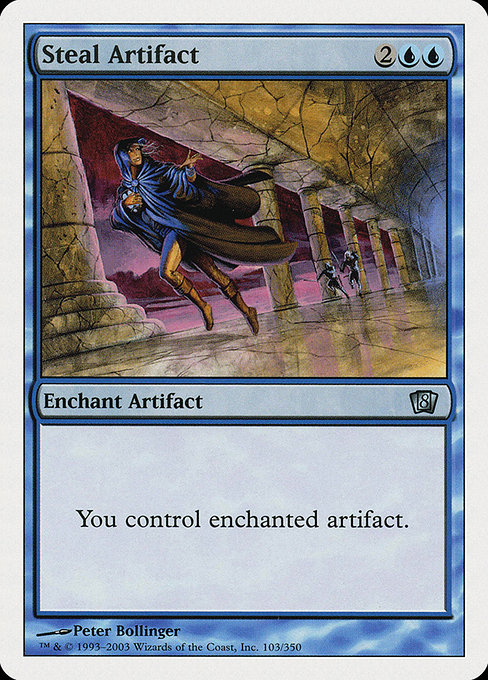
Image courtesy of Scryfall.com
Forgotten Tales and Blue Tactics: Steal Artifact in Focus
For collectors and battlers alike, Steal Artifact feels like a quiet whisper from Magic’s past—an artifact-focused era that blue winessed with surgical precision. This Eighth Edition gem, a core-set relic released on July 28, 2003, is emblematic of how blue’s intellect translates into battlefield advantage. With a mana cost of 2UU and an enchantment type “Aura,” it demands a patient, calculated approach: enchant an artifact, then call the shot—You control enchanted artifact. That simple line of text unlocks a cascade of strategic possibilities 🧙🔥💎⚔️. It’s also a reminder of the era when core sets were designed to teach players the layered rules of the game, not just to deliver flashy new mechanics. The card’s uncommon rarity and nonfoil finish may sound modest, but its every-game impact often felt legendary in the right hands.
“Blue isn’t just about drawing cards—it’s about turning your opponent’s momentum into your own.”
What Steal Artifact Actually Does, and Why It Matters
At its core, Steal Artifact is a straightforward enchantment with a deceptively deep toolkit. The instant you attach it to an artifact, you don’t simply gain a new toy—you gain control of your opponent’s gadget, vehicle, or relic for as long as the aura remains attached. In multiplayer formats, that control can shape political dynamics and tempo in dramatic fashion. You can peel away an artifact that would otherwise mana ramp into a massive haymaker, or seize equipment that would threaten your defenses. The blue control motif—the art of outthinking opponents and redirecting their resources—gets a crisp, tangible edge with this aura 🧙♂️🎲.
Considering its cost, Steal Artifact trades raw speed for late-game leverage. The two generic mana plus two blue mana for a total of four mana brings you into arena where you can plan several moves ahead. The card’s rules text—“Enchant artifact. You control enchanted artifact.”—creates a compact fusion of spell and strategy. It’s a spell that lingers on the battlefield, embedding a choice that forces opponents to re-balance their plans around the sudden shift in ownership. It’s the kind of play that can trigger a cascade of reactions—board wipes, re-targetings, and, in casual circles, some truly memorable mind games 🎨⚔️.
Flavor, Lore, and the Echoes of Forgotten Novels
Magic’s fiction heritage is a tapestry woven from many threads—novels that explored ancient libraries, vaults of power, and the crowded rooms where wizards discuss ethics, ambition, and the definitions of ownership. While Steal Artifact is a mechanical treasure, it also nods to that lore-rich tradition. The idea of seizing someone else’s artifact sits squarely in a literary vein where powerful relics drive factions and plots. The card visually and textually channels blue’s curiosity and restraint: you don’t break a relic, you gently move it into your orbit, which mirrors the suspenseful, long-game storytelling found in classic MTG novels. If you’ve ever hunted for a long-lost artifact in a story, you’ll recognize the thrill that Steal Artifact can recreate on the table 🧙🔥🎨.
In the shadow of well-known story arcs—the Thran's ancient machinatory awe, the Antiquities saga’s relics-lit intrigue, and the Brother’s War’s power struggles—Steal Artifact stands as a compact guidepost. It invites players to imagine a world where a blue mage doesn’t merely study artifacts but redirects their destinies. It’s a subtle homage to those forgotten novels that gave the multiverse a sense of history and consequence—the kind of lore that feels like a dusty tome you stumble upon in a floating library, humming with the potential of a single, decisive move 📜⚡.
Deckbuilding Notes: Making the Most of an Aura That Reframes the Board
- Target-rich environments shine brightest: Blue decks with artifact-heavy offensives or defenses—think quiet craftiness, not pure aggression—can slice away the most threatening artifacts while your darker plans stay hidden until you strike.
- Protection for the enchantment: Since the aura is a fragile piece of your strategy, guard it with counterspells, auras that grant shroud, or bounce effects only when needed. A successful Steal Artifact ride often depends on timing and the ability to keep your artifact-stealing aura alive long enough to change the tempo.
- Combo-friendly considerations: You can pair Steal Artifact with artifacts that generate value on ownership—think mana rocks or equipment whose power scales with control, creating a subtle engine that turns stolen assets into a steady stream of tempo and advantage.
- Commander-era viability: In Commander, this card becomes a political instrument. When you steal an artifact, you don’t just gain card advantage; you alter the board’s resource flow, forcing opponents to recalibrate alliances and threats.
In practice, Steal Artifact rewards thoughtful play more than brute speed. You’ll often see it in blue-blue control shells that lean on attrition and subtle theft, bending the battlefield until your adversaries are left chasing a plan you’ve quietly redirected. If your playgroup loves long games with artifact-centric themes, this aura provides a deliciously old-school flavor—like flipping through a glossy page of a forgotten novel and realizing the plot twist was hiding in plain sight all along 🧙💎.
Collectibility, Value, and Community Echoes
The card’s rarity is uncommon, and its print in Eighth Edition anchors it to a cherished era of MTG design. Current price indicators show modest value in the realm of around a few tenths of a dollar in common markets—an approachable entry point for players who relish the card’s historical aura rather than its monetary heft. Its nonfoil finish and reprint status make it a beloved choice among collectors who savor the tactile nostalgia of 8ed’s timeless core set aesthetic. The community’s affection for this card often centers on its elegant simplicity and its capacity to flip the script in a single, well-timed moment 💎🎲.
As you scan the marketplace for MTG nostalgia, you’ll notice how a card like Steal Artifact resonates with the broader conversation about forgotten novels and the quiet power of relics. It’s easy to forget how a little blue spell can tilt a match, yet those moments—the ones where ownership shifts and the board suddenly bends—are the ones fans remember for years. The card’s artwork by Peter Bollinger, captured in a high-resolution image on Scryfall, evokes a sense of arcane precision that matches the card’s mechanical elegance. It’s a reminder that even core-set staples carry a spark of the extraordinary—like a well-loved book tucked away on a shelf, waiting for a reread that reveals something new with each turn of the page 🧙🎨.
A Quick Note on Flavor Text, Design, and the Shared Experience
While Steal Artifact doesn’t feature a dramatic flavor text block, its design speaks volumes about MTG’s craft. The aura’s ability to steal and wield an opponent’s artifact mirrors the strategic playstyle that many players lived for in the early 2000s—tactful, deliberate, and always one step ahead. The combination of a clear, functional effect and a stylish, old-school blue mana curve makes it a touchstone for those who love the tactile rhythm of classic MTG games. And if you’re a fan of how novels in the Forgotten Realms of MTG lore shape the environment around each artifact, you’ll likely appreciate the card’s quiet homage to that expansive storytelling tradition 🧙🔥.