Image courtesy of Scryfall.com
Emotional storytelling at the MTG table with a single green giant
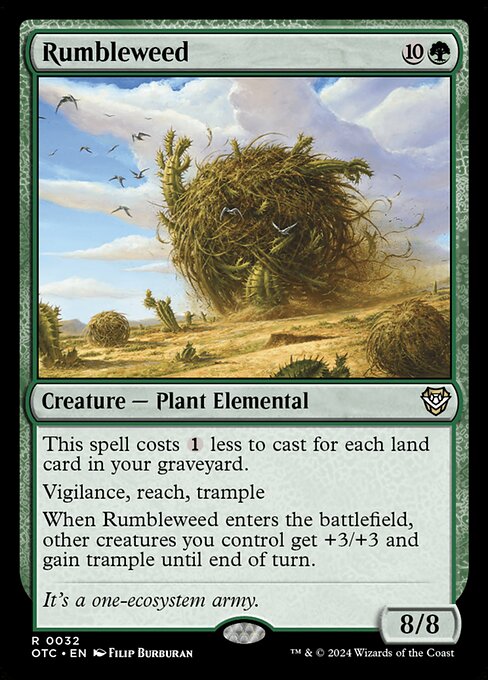
Magic: The Gathering isn’t just about math and mana curves; it’s a theater where every turn can flip the script of a night’s narrative 🧙🔥. Rumbleweed, a rare green creature from the Outlaws of Thunder Junction Commander set, arrives with the dramatic heft you want when you’re chasing a memorable session. Its imposing 8/8 frame for a cost of {10}{G} shouts “swing big, tell a big story,” and its abilities invite you to choreograph a tabletop moment that players will still be talking about days later 💎⚔️.
On the surface, Rumbleweed is a colossal Plant Elemental—the kind of creature you drop late in the game and suddenly feel the room heighten with possibility. But what makes it truly sing at the table is how its design nudges story beats forward. This is not just about smashing through a stalemate; it’s about weaving a narrative arc that hinges on land, memory, and momentum. The card’s transformative cost-reduction clause—“This spell costs {1} less to cast for each land card in your graveyard”—turns your graveyard into a reservoir of optimism. Every land you’ve played and then buried becomes a bargaining chip that accelerates a climactic arrival. The mirror-contrast between spending a scroll of mana now and the promise of a massive 11 CMC creature peaking on the horizon creates anticipation, suspense, and a touch of tension that fans latch onto with delight 🧭🎲.
Mechanics as dramatic devices
Rumbleweed’s trio of evergreen keywords—Vigilance, Reach, and Trample—are not mere stat lines; they’re storytelling tools. Vigilance lets your tank-like giant participate in offence and defense in the same swing—no needless taps, just a steady, stubborn presence on the board. Reach adds a layer of defensive narrative, hinting that this green behemoth can shepherd your creatures through aerial threats as if protecting a shared campfire. And Trample funnels the story toward decisive endings: the bigger your battlefield becomes, the sweeter the payoff when your team barrels forward with extra force on the moment you cast Rumbleweed. Together, these keywords choreograph a cinematic moment where your side surges, your opponents feel the pressure, and your own plan crystallizes into a satisfying comeback or a hard-won victory ⚔️🎨.
“It’s a one-ecosystem army.”
That flavor text from the card’s lore is more than a line of prose; it’s a mood cue. Rumbleweed embodies unity and inexorable growth, the way a single plant can become a caravan’s centerpiece in a sprawling desert saga. When you see that line paired with the card art, you’re invited to craft a story of resilience—about a single green force rallying an entire board to fight for its corner of the multiverse 🎯💚.
How to weave Rumbleweed into your tavern-table epics
- Play storytelling with ramp and refill: The cost-reduction clause rewards you for stacking lands in the graveyard. Build around cards that move lands to the graveyard safely—graveyard-friendly ramp or recursion can turn late-game turns into floodgates. The emotional crescendo arrives when you cast Rumbleweed for far less mana than its color and rarity might imply, then watch the table lean in as your team gets a +3/+3 and trample on enter-the-battlefield for the rest of the turn.
- Turn a swing into a moment of mercy or mayhem: The enter-the-battlefield buff affects your entire board, so time the moment to coincide with a key attack or a board clear. The room erupts when a single declaration of attack transforms a tense situation into a victory lap, and you feel the table’s narrative arc click into place 🧙🔥.
- Use Rumbleweed as a rallying banner: Its size and presence can become a rallying point for an emergent creature swarm. Your opponents might pivot their strategies around stopping the behemoth, which in turn opens space for the rest of your deck’s storytelling beats to unfold—think of it as the moment when the chorus joins in a power ballad 🎶.
In practical terms, the card’s green aura, coupled with a massive body that arrives amid a graveyard-centric setup, creates a narrative thread that feels both timeless and fresh. The moment you reveal Rumbleweed, you’re signaling a shift: the game’s tempo is about to swing with a big, cinematic turn. It’s the kind of card that invites you to describe what your creatures are doing, to give a name to each small victory, and to let the table share the drama as it unfolds 🧭⚔️.
Flavor, art, and the fan experience
Filip Burburan’s artwork for Rumbleweed captures the tension between stillness and surge—the plant elemental stands as both guardian and siege engine, rooted in a world that seems part desert, part cathedral. The art’s muted greens against the backdrop of life and motion gives players a tangible sense of scale. That sense of scale is crucial to the emotional payoff, because it makes the board feel like a living diorama: one card can unlock a moment where the story’s stakes feel personal to each player at the table 🖌️🎨.
Collectors and players alike appreciate a card that offers both a memorable moment and flexible gameplay. Rumbleweed’s place in the OTC (Outlaws of Thunder Junction Commander) set, its green identity, and its rare status make it a tasty target for casual and commander-focused playgroups who love big swings and narrative resonance. The card’s price points—under a dollar in many markets—make it accessible for newer players who are starting to host their own dramatic sessions, while veteran deck-builders will appreciate the layered interactions it brings to a green-heavy strategy 🧙🔥💎.
Connecting product and play space
As you craft your tablescape, you might also consider upgrading your play surface to match the level of care you bring to the table. A clean, reliable mouse pad can keep trackers, dice, and tokens moving as smoothly as your story, which is where our featured product comes in: a Non-Slip Gaming Mouse Pad designed with smooth polyester and a rubber back. It’s a small upgrade that can make the difference between a stumble and a sweeping flourish as you narrate the board’s turning points 🎲.