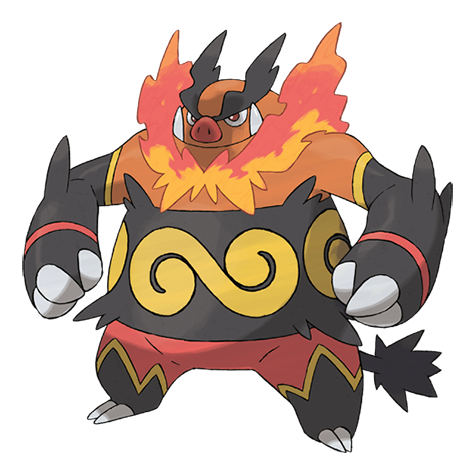
Image courtesy of PokeAPI (official artwork)
Walling Emboar Effectively: Strategy and Counters
Emboar is a compelling challenge for any team dedicated to sturdy defense. With a resilient 110 HP and formidable offensive stats—123 in Attack and 100 in Special Attack—it can pressure walls from multiple angles while still presenting a credible threat to switch-ins. Its Fire/Fighting typing gives it two powerful STAB options, making it a versatile hitter that can punish misreads and forced switches. Yet, the trade-off is a relatively balanced but not extraordinary bulk (Defense 65, Special Defense 65) and a mid-range speed of 65, which means it can be controlled with well-timed walling and careful HP preservation. The goal here is to recognize its dual-typing synergy, anticipate its most common routes, and deploy a wall that can either resist one of its main stabs or force Emboar into an unfavored line of play. ⚡🔥
Understanding Emboar’s offensive profile and what it means for walls
Emboar’s two primary attacks come from Fire and Fighting, each offering strong coverage and respectable power. The bulk statistics suggest it can stay in longer than a typical glass cannon, but it isn’t a dedicated defensive behemoth. For a wall, this means you should prioritize reliable bulk and the ability to respond to Emboar’s aggression without quickly giving up your own tempo. Because Emboar can threaten both sides, your wall should be capable of absorbing a hit from at least one of its STAB options and transition into a favorable counterplay, whether that’s forcing a switch, applying a slow chip, or initiating a pivot that opens up a late-game plan. 🌊🪨
Key stats to consider when selecting a wall against Emboar
- HP 110 provides staying power, letting you weather multiple exchanges if you time your recovery and switches well.
- Attack 123 means that a wall must be careful about being overwhelmed by Emboar’s physical presence; a resilient check should minimize the risk of a dangerous follow-up hit.
- Special Attack 100 ensures Emboar can threaten from the special side as well, so a wall that only resists physical pressure may still be tested by a mixed moveset.
- Defense 65 / Special Defense 65 indicate that Emboar isn’t a guaranteed “take-a-hit-and-wear-them-down” wall-breaker; it will profit from a wall that can sustain multiple turns and punish its overextensions.
- Speed 65 places Emboar in a moderate speed tier; you should prepare for momentum shifts and be ready to lock down the pace of the battle with your wall’s awareness of threats around it.
Category-based wall options to consider
Since exact move pools aren’t listed in the data you provided, think in terms of durable, general-purpose walls that can handle multi-type pressure. Here are practical directions to explore when building a counter-wall strategy against Emboar:
- Bulky Water-types commonly offer solid bulk and the ability to absorb Fire-type damage while pressuring back with Water-type moves. They’re a natural fit for absorbing Emboar’s Fire stab and surviving long enough to threaten with their own offense or pivot out before being worn down. 🌊
- Bulky Ground-types can present a sturdy defensive core that can weather both Fire and Fighting pressure under the right circumstances. Ground-types often excel at trading favorable matchups when paired with teammates that can handle the Fighting side or lure out Emboar’s coverage moves. 🪨
- Other durable, multi-typing walls that can resist or weather a portion of Emboar’s offensive spectrum while staying on the field long enough to force trades or create advantageous openings. The key is sustained presence and a dependable way to threaten back.
Practical tactics: how to deploy your wall in-game
The most reliable wall strategies hinge on careful reads and controlled damage. When you bring a wall to face Emboar, aim to absorb its primary threat and force it into a constraint—either a switch, a forced reveal of its non-stab move, or a recovery window that lets your team gain tempo. If you can force Emboar to commit to a move, you gain the opportunity to pivot into a counter that pressures its weaker areas or repositions your core. And because Emboar isn’t an unstoppable wall-breaker by default, you can enforce a trade that slowly chips away at its HP while preserving your own defensive hinge pieces. Remember to watch for potential coverage choices Emboar might deploy: if it leans more into Fire, you’ll want to preserve your Water or Ground checks; if it leans into Fighting, you’ll benefit from bulkier, more neutral walls that can swap in safely. ✨
Team-building tips to maximize wall effectiveness
- Anchor your team with at least one bulky answer capable of taking hits from both of Emboar’s stabs, or ensure a safe pivot that can switch in after Emboar commits to a turn. ⚒️
- Keep your defensive core versatile. If your wall struggles against Emboar’s Special Attack or a mixed moveset, pair it with teammates that cover its typical threats and provide recovery or switch options.
- Be mindful of status opportunities. If available in your game version, status inflictions (like burns) can curb Emboar’s damage potential, giving your wall more breathing room to operate—but avoid over-committing to status if it risks giving the opponent a free switch or sweeping opportunity.
In practice, successfully walling Emboar is about balancing bulk, type resilience, and how you exploit its tendencies in a given matchup. Use your walls to absorb pressure, then pivot to pressure Emboar’s options while your own offense or mid-game setup comes into play. With a thoughtful build, you’ll find that Emboar’s twin-typing becomes less of an inevitability and more of a chess move you can offset with careful planning and steady counting of turns. 🧊🐉