Image courtesy of Scryfall.com
How YouTubers Shaped Gandalf, Friend of the Shire into an MTG Icon
In the wake of Universes Beyond crossovers, the MTG community watched as familiar legends stepped onto the battlefield with new rules, new quirks, and undeniable flair. Among these pop-culture crossovers, Gandalf, Friend of the Shire rose from a charming lore cameo to a bona fide MTG icon. This blue legend from The Lord of the Rings: Tales of Middle-earth isn’t just a pretty piece of art; it’s a lens into how content creators—YouTubers who blend gameplay, theorycraft, and a dash of theater—can turbocharge a card’s story in the wider Magic community 🧙♂️🔥. Let’s unpack why this 3-colorless-blue spellcaster with flash and a ring-themed twist earned a corner of the internet’s heart, and how viewers turned a four-mana uncommon into a headline-worthy deckpiece ⚔️🎨.
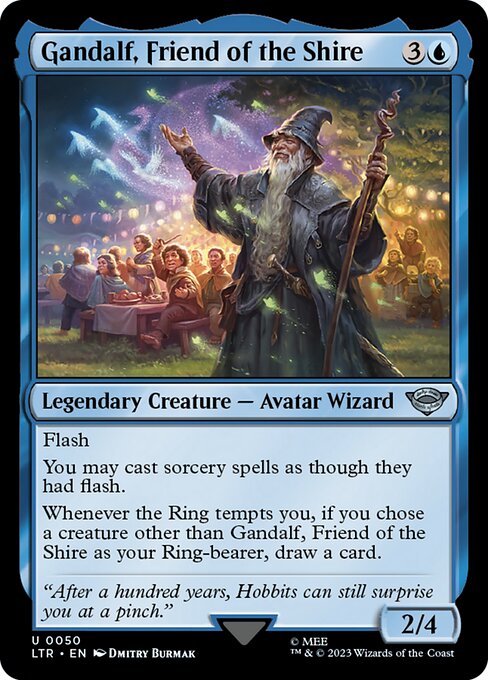
First, let’s anchor ourselves in the card’s design. Gandalf, Friend of the Shire is a Legendary Creature — Avatar Wizard with a mana cost of {3}{U} and a respectable stat line of 2/4. The mechanic is unapologetically blue: Flash allows you to snap-cast sorceries as if they had instant-speed, turning your plan into a tempo-heavy, surprise-heavy proposition. When you pair that with the often-deceptive power of “The Ring tempts you” lore, you’re building a strategy around options and timing rather than raw mana throughput. The flavor text—“After a hundred years, Hobbits can still surprise you at a pinch.”—nails the sense of mischief and long-game planning that YouTube fans adore in a clever, meme-friendly package 🧙♂️💎.
On release, content creators quickly realized Gandalf isn’t just a stat line on a card; it’s a narrative engine. The ring-themed trigger—“Whenever the Ring tempts you, if you chose a creature other than Gandalf as your Ring-bearer, draw a card”—creates a subtle, ever-present choice: do you curate your Ring-bearer to draw extra cards for tempo and value, or do you lean into Gandalf as the steadfast Ring-bearer and protect your engine? YouTubers asked these questions aloud, turning a single line of text into dozens of deck archetypes and sideboard conversations. The result is a card that invites story-driven analysis as much as it invites duel-ready plays 🧭🎲.
The YouTube Effect: Content That Converts
What did creators do to lift Gandalf from “nice mythic crossover” to “must-include” in blue shells and control shells? Three key formats emerged in the commentary and builds you could see across channels:
- Deck Techs and Build Guides: YouTubers walked through tempo and control shells that leverage Flash to surprise opponents with countermagic and sorcery-speed finishers. The idea is simple and satisfying: cast a key spell at instant speed, react to threats, then flash back a decisive play when your opponent’s guard drops. The narrative flow—planning, feint, then the actual cast—resonates with viewers who enjoy both the math and the theater 🎭🔥.
- Lore Deep-Dives and The Ring Tempt You: Lore segments that tie Gandalf’s role to the Ring’s temptations give viewers a reason to remember the card beyond its stats. YouTubers paired clips from Middle-earth lore with gameplay moments to illustrate why choosing a Ring-bearer matters—whether you’re chasing card advantage or preserving Gandalf’s strategic tempo. This content thrives on context, narrative beats, and suspense, which are all the currencies of good MTG storytelling 🧙♂️🎨.
- Unboxings, Openings, and Community Experiments: The cross-over set gave rise to unboxing videos and “pack-opening experiments” that framed Gandalf as a gate into the broader LOTR collab. Viewers love seeing how a single card can spark group storytelling—one YouTuber’s clever play becomes another’s “wait, what if I did this?” moment, and suddenly Gandalf is not just a card but a conversation starter 🧩⚔️.
Amid all the chatter, the community discovered a practical truth: Gandalf rewards timing and player personality. If you’re the kind of player who loves calculated risk, blue control mirrors, and the drama of a well-timed sorcery, Gandalf slides into your plans with elegant ease. If you enjoy spicy ring-themed decisions, you get a secondary axis of play: do you want the card draw from Ring temptations, or do you want to minimize your own card-flow but maximize tempo? Either approach fits a channel’s persona, which is why so many creators leaned into this card in their videos, streams, and even draft nights 🧙♂️🔥.
Beyond the Screen: Lore, Art, and Value
The art by Dmitry Burmak, paired with the “The Lord of the Rings: Tales of Middle-earth” frame, makes Gandalf a collectible in addition to a playable card. Its rarity—uncommon—paired with sneakily strong utility in a blue shell, turned it into a fan favorite at casual gatherings and lore-focused events alike. While market tracking shows that the foil versions carry extra value for collectors, the real payoff isn’t monetary; it’s cultural. YouTubers who stitched Gandalf into a narrative about friendship, rings, and the price of power helped fans relive moments from the Shire and Middle-earth while discovering fresh, fan-first ways to play MTG 🏷️💎.
From a design perspective, the card’s strength lies in its flexibility. The Flash mechanic isn’t just a tempo gimmick; it’s a deliberate invitation to experiment with spell sequencing. Casting sorceries “as though they had flash” means you can weave your spells into your opponent’s turns, or you can set up sequences that feel almost cinematic—the sort of thrill that content creators chase when they craft a storytelling video or a live-play moment. And the Ring tempts you trigger, when leveraged thoughtfully, becomes a perpetual engine for draw and advantage, a concept that YouTubers love to unpack in slow-motion replays and highlight reels 🧙♂️🎲.
Practical Tips for Modern Play
If you’re itching to pilot Gandalf in your next game night, here are a few starter ideas that echo the YouTube-driven enthusiasm around the card:
- Populate a blue tempo/control shell with counterspells, bounce effects, and cheap draw to maximize the value of Gandalf’s flash-enabled tempo plays 🧙♂️💥.
- Experiment with Ring-tempt decision points. Do you draft a strategy that keeps Gandalf as the Ring-bearer for discipline, or do you lean into benevolent card draw by selecting a different Ring-bearer? The choice can make a big difference in late-game clarity and hand size 🎴⚖️.
- Leverage synergy with other universes beyond cards: think about how crossovers affect deck-building culture and audience engagement when you stream or upload content. The sense of shared myth and playful exploration is part of Gandalf’s enduring appeal 🧙♂️🎥.
For collectors and performers alike, Gandalf, Friend of the Shire is more than a single card: it’s a doorway into an ongoing conversation about how fandom, lore, and gameplay intersect on the modern stage. The card’s accessibility—printable in nonfoil and foil—means you can chase the perfect piece for your deck while laughing at memes and nodding along to lore threads you’ve loved since you first opened a booster pack. And if you’re curious to explore more cross-promotional collectors’ items or want to support creators who celebrate this intersection of storytelling and strategy, you’ll find a vibrant ecosystem ready to welcome you in 💬🧙♂️.
“A card that links storytelling with strategy is rarely just a moment—it’s a movement.”
So the next time you watch a tutorial where a streamer pings a counterspell at just the right moment or see a highlight reel where Gandalf drops a well-timed draw after a Ring tempt, remember: YouTubers didn’t just showcase a card; they helped shape how players talk about it, how fans imagine the Ring’s pull, and how a blue mage with flash can steal the show in a crowded format. That collaborative magic is, in a very MTG way, almost as legendary as the character himself 🧙♂️⚔️.