Image courtesy of Scryfall.com
From Battlefield to Blueprint: Lessons for Fan MTG Card Design
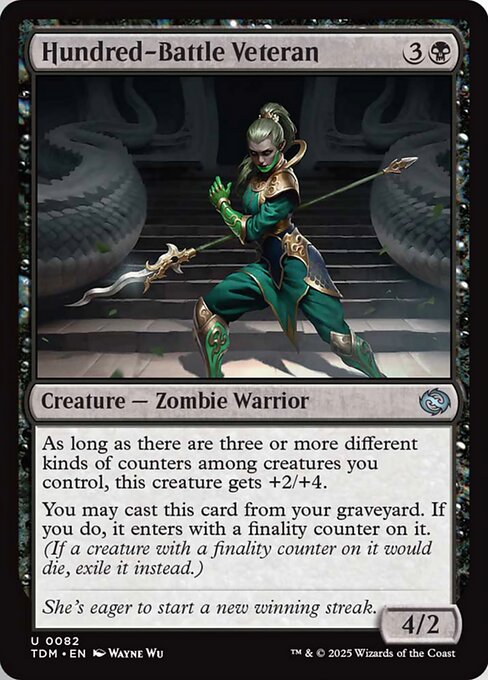
If you’re a fan who loves peeking behind the curtain of how MTG cards come to life, Hundred-Battle Veteran offers a treasure trove of ideas. This uncommon zombie warrior from Tarkir: Dragonstorm—set in a dragon-laced, time-twisted plane—shows how a single card can spark conversation about counters, graveyard interplay, and the way flavor informs mechanics 🧙♂️🔥. The design invites players to think not just about what a card does, but how its existence reshapes the board state as a living, breathing part of a deck’s story. And yes, it looks cool while doing it—art by Wayne Wu helps sell that grim resolve with a stark, battle-hardened aesthetic 🎨⚔️.
Counter culture and graveyard recursion
The core engine here is elegantly simple yet intriguingly flexible: a 4/2 body for {3}{B} in a world where counters can swing the battlefield. The first line—“As long as there are three or more different kinds of counters among creatures you control, this creature gets +2/+4.”—is a design microcosm of how fan-made cards can reward diversity. It nudges players toward building a battlefield with a variety of counters: perhaps +1/+1 counters on some tokens, loyalty counters from a few planeswalker setups, or even oil counters if your homebrew leans into colorless tech. The effect scales with board complexity, rewarding careful planning and board composition rather than a single “one-trick” play. It’s a gentle invitation to explore how different counters interact in the same list, a theme that resonates with fans who delight in synergy puzzles and hidden combos 🧙♂️💎.
“As long as there are three or more different kinds of counters among creatures you control, this creature gets +2/+4.”
Additionally, the graveyard dynamic elevates the card from a simple value engine to a tool for redirection and resilience. The line “You may cast this card from your graveyard. If you do, it enters with a finality counter on it. (If a creature with a finality counter on it would die, exile it instead.)” introduces a hybrid of graveyard recurs and a soft “exile on death” safety valve. This is a clever counterpoint to typical reanimation: instead of splashing into the battlefield every time, the veteran carries a formal fate token that can altered how removal interacts with it. It nudges players to plan not just for the next turn, but for the moment when the veteran might return from the grave, and then be exiled if it would die. Fan designers can borrow this cadence—give a card a graveyard loop that comes with a built-in, narrative risk-reward element—and watch new deck ideas bloom 🧙♂️⚔️.
Flavor, lore, and art direction
The flavor text—“She's eager to start a new winning streak.”—speaks to a character who is relentlessly forward-looking, even in the face of death and decay. In fan design, flavor text acts as a spark for your counter and recursion math; it ties mechanical choices back to a character’s aria, reminding players that every rule we write has a personality behind it. Wayne Wu’s art for the card anchors that personality with a stark, kinetic presence. The character feels both timeless and immediate—an archetype of stubborn grit who refuses to stay down. When you design fan cards, think about how your art direction can amplify the mechanical narrative, creating a cohesive moment where flavor and function reinforce one another 🎨🔥.
Gameplay implications in fan decks
In formats where this card is legal, Hundred-Battle Veteran shines in decks that lean into board presence and resilience. Its power is not just a raw stat line; it’s a living barometer for how you’ve built your battlefield—how many counters exist, what kinds they are, and whether those counters live on a recovering undead army or on more fragile components. The graveyard cast option adds a dimension of inevitability: you can grind through resource denial and still re-enter the scene with a burly buff. For fan builders, this suggests a design principle: give a card a backup plan that feels distinct from its primary role, so the card remains interesting even when the initial play path is disrupted 🧙♂️💎.
- Encourage varied counter ecosystems: design fan cards that reward diverse counters to unlock powerful synergies.
- Blend graveyard mechanics with exile or finality-like twists to create tense decision points.
- Balance is critical: if the buff from counters becomes too easy or too large, adjust with environmental or conditional checks—this is a natural step in fan design playtesting.
- Flavor should mirror mechanics: the character’s arc should echo the card’s resilience and recursion wheels.
- Artist-driven storytelling: let the art direction communicate the card’s fate and fight, a principle fans respond to in memes, fan art, and deck-building threads 🧙♂️🎲.
For fans who love the tactile side of MTG, the tactile rhythm of a well-made card—its aura, its text, its tempo—becomes a canvas for personal experimentation. The card’s uncommon rarity in the Tarkir: Dragonstorm capsule underscores a truth: fans don’t just collect rare hits; they collect moments of aha moments when a rule interacts in a surprising, satisfying way. And in a world full of flashy staples, it’s the small, smart design choices that often spark the loudest, most enduring conversations 🧙♂️🔥.
As you blueprint your own fan cards, keep an eye on the synergy between graveyard play, counters diversity, and a flavorful backstory. The best fan designs feel inevitable once you spot the breadcrumb trail—the logical extension of a character’s destiny, a battlefield that breathes with every decision, and an art direction that makes you lean in for a closer look. And if you’re grinding away on long drafting sessions or deep analysis threads, a little comfort goes a long way—like a high-quality desk companion that keeps pace with your marathon sessions. Speaking of comfort, a practical desk upgrade can be a quiet hero in your creative process. Ergonomic options are a small but real boost to focus and stamina during those late-night tweaks and playtests 🧙♂️🎨.
For collectors and players who want to explore the broader collector ecosystem, the card’s price range in recent listings points to a curious market nuance. While you’ll find the non-foil listings hovering in the few-cent range, foils tend to hold their sheen a touch longer, mirroring the card’s foil finish and collector interest. Even if the monetary value isn’t the star here, the design value—the way the card invites you to experiment with counters, run graveyard recurs, and tell a compact laurel-wrenching story—remains a lasting draw for fans who crave depth in their MTG moments 💎⚔️.