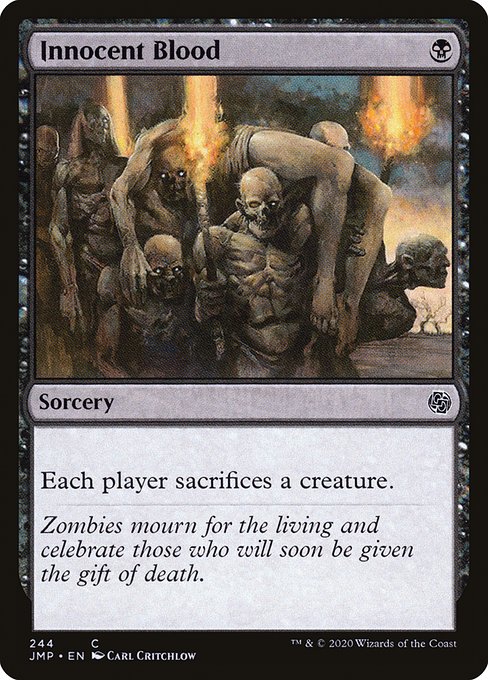
Image courtesy of Scryfall.com
Artistry Behind Innocent Blood
When you crack open a Jumpstart pack and glimpse Innocent Blood, you’re not just looking at a black Sorcery with a neat, symmetrical name. You’re meeting a piece that embodies the bite-sized drama of black mana: a single, decisive moment where the balance of power tilts not on damage dealt, but on what’s sacrificed. Carl Critchlow’s illustration carries that signature noir vibe—knife-edged lines, deep shadow, and a sense of ritual that feels both ancient and immediate. The scene doesn’t shout; it envelops you in its quiet, predatory mood and invites you to consider what it means to let go of one life to advance another. 🧙♂️🔥💎
A Brief Look at the Artist’s Career
- Critchlow is a seasoned fantasy illustrator whose work has graced books, games, and magazines across the fantasy spectrum.
- His art is often celebrated for crisp linework, dramatic lighting, and a willingness to lean into the darker corners of fantasy storytelling.
- Across projects, he tends to favor characters and scenes with a tactile, almost tactilely described texture—skin, armor, and bone all rendered with a painterly clarity that still reads crisply in card art.
- In MTG circles, his contribution to Innocent Blood is remembered for how the image communicates the card’s moral weight without overshadowing the succinctness of the text.
Style and Technique: What Makes This Piece Stand Out
Critchlow’s approach to Innocent Blood leans into contrast—the sort you notice when a lantern cuts through midnight. The black mana symbol is more than a cost; it’s a cue to the player: this moment is about what’s being given up, not what’s being gained. The composition centers on a direct, almost sacramental moment, with minimal color distraction outside of a restrained tonal palette that heightens the sense of inevitability. It’s art designed for the card’s mechanic: a symmetrical, universal sacrifice that affects every player. The result is a sense of shared fate, a visual echo of the text’s cruel fairness. 🎨⚔️
Card Mechanics as Narrative Anchor
Innocent Blood is a single-Black mana spell whose text—“Each player sacrifices a creature of their choice”—speaks to a theme you see across numerous black-focused strategies: board presence can be fragile, but it’s also temporary and negotiable. The art mirrors that: a moment where choice becomes action, and action becomes consequence for the whole table. In practice, this card shines in Commander and other social formats where it can reset the battlefield, keep complacent boards honest, or nudge the game toward a heavier, more dramatic swing. It’s not about deleting armies with a thunderclap; it’s about forcing everyone to confront the cost of the moment. And yes, that moment is surgical—just the way black loves to operate. 🧙♂️🔥
Flavor text: “Zombies mourn for the living and celebrate those who will soon be given the gift of death.”
The flavor text underlines a core pillar of undead and necromantic aesthetics that Critchlow often leans into—the grave as a stage for complex, morally gray celebrations and losses. This line ties the artwork to a broader fantasy tradition where death can be both oppressive and oddly liberating, a paradox that resonates with players in casual drafts and long-run EDH pods alike. It’s a reminder that MTG art isn’t just decoration; it’s a way to frame your decisions at the table with a touch of melancholy and mischief. 🧠🎭
From Jumpstart to Your Table: Set, Value, and Vibe
Innocent Blood appears in Jumpstart, a set designed to spark quick, throw-together games that still feel like a narrative mini-milmag. Being a common non-foil, it’s accessible to budget-minded players and fit for experimental decks that lean into sacrifice or graveyard shenanigans. The card’s legalities span a broad swath of MTG’s legacy and casual formats—from Legacy and Vintage to Commander and timeless B-race tournaments—so Critchlow’s art isn’t limited to a narrow audience. Contemporary price data places it in the affordable tier, roughly a few dimes to a few quarters on solitary print runs, which makes it a nice inclusion for players who love the dark charisma of black spells without a high-stakes price. In the community, Innocent Blood tends to be a popular pick for folks who enjoy mass-sacrifice themes and midrange grind that can tilt a table faster than a friendly wager at the local game store. 💎🎲
Collector’s Eye: Art, Rarity, and Reprints
As a common from Jumpstart, Innocent Blood isn’t a marquee chase for collectors chasing rare foils or chase mythics, but the card’s artistry matters to those who collect by artist, by set, or by the emotional resonance of a black mana moment. The card’s value on open markets reflects its availability and print status rather than an explosive rarity spike. For fans of Carl Critchlow, owning Innocent Blood—whether as a physical card or a cherished digital moment in a deck—offers a chance to celebrate a distinctive fantasy aesthetic that complements other Critchlow works in blogs, forums, and fan art showcases. The nostalgia hit is real: it’s a tangible piece of the broader undead-and-murky-night tapestry that filled countless late-night, high-spirit, low-resource games. 🧙♂️🔥
Art, Nerd Culture, and The MTG Experience
Art in MTG is a gateway to shared memory—the moment you first opened a booster and felt the surge of possibility. Critchlow’s Innocent Blood is a prime example of how a single image can anchor a card’s identity, guiding players toward a story of sacrifice that feels personal and epic at once. For collectors who savor the interplay between lore, gameplay, and art, this piece is a reminder that even a common slot can carry a reverberant moodscape—one that invites discussion at the table, in fan forums, and across curated galleries when we celebrate the artists who shape our favorite multiverse. 🧙♂️🎨💎