Image courtesy of Scryfall.com
Intertextuality Across Universes: Thief's Knife and Innistrad Echoes
Magic: The Gathering has always thrived on conversation between worlds, a kind of grand fan-fiction where a card’s flavor text, mechanics, and even its art invite a larger dialogue about storytelling in the multiverse. When Thief’s Knife arrived as part of the Final Fantasy crossover, it didn’t just bring a neat piece of equipment to the battlefield; it opened a doorway to cross-pollination between two very different reverberations of fantasy. On one side, you have Innistrad’s Gothic horror, where mirrors and moonlight tell secrets; on the other, Final Fantasy’s exuberant, class-driven world of jobs, heroes, and high-stakes capers. The result is an elegant exercise in intertextuality—where a blue artifact weapon can feel at home in a human-sized caper, and where a token named Hero can carry the lore-forward DNA of both universes. 🧙🔥💎⚔️
Card Snippet: Thief's Knife
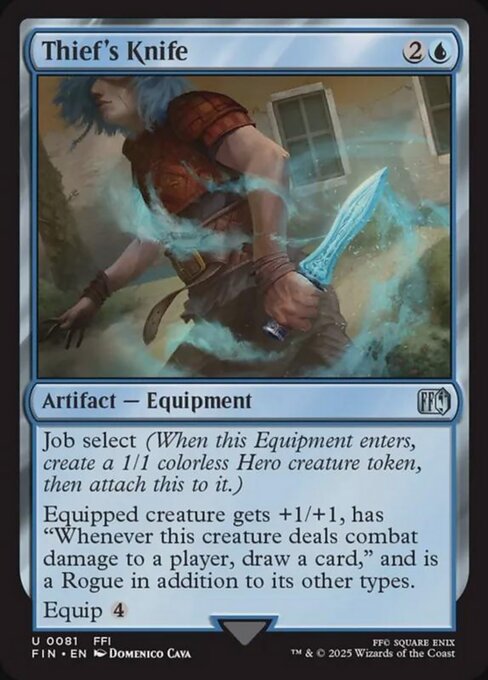
Thief's Knife is an Artifact — Equipment with a two-color cost of {2}{U} and an uncommon footprint in the Final Fantasy expansion. Its entering-the-battlefield moment is signature Nicol Bolas-level clever: when the Equipment enters, you create a 1/1 colorless Hero creature token and attach the Knife to it. That token becomes the first vessel for your new toolkit, a living conduit for the knife’s job-focused magic. The card then bestows a persistent buff on the equipped creature: +1/+1, and a nifty line—“Whenever this creature deals combat damage to a player, draw a card”—while simultaneously reclassifying it as a Rogue in addition to its other types. And if you want to keep that edge, you’ll pay Equip {4} to keep the knife snug on your new rogue-in-training.
Oracle text: Job select (When this Equipment enters, create a 1/1 colorless Hero creature token, then attach this to it.) Equipped creature gets +1/+1, has “Whenever this creature deals combat damage to a player, draw a card,” and is a Rogue in addition to its other types. Equip {4}.
Color identity is blue, and the card’s thematic core leans into the idea of an artful, cunning tool—precisely the kind of gadget a thief or rogue would covet. The “Job select” keyword is a wink to Final Fantasy’s long-running class system, a clever nod that doesn’t disrupt MTG’s balance but does push flavor into the foreground. The result is a gadget that invites players to think not just about stats, but about narrative resonance—the weapon as a storyteller, the token as a living character, the Rogue as a role that might appear in an inn, a crime scene, or a moonlit alley in a Gothic city from Innistrad’s own folklore. 🎲🎨
Innistrad Echoes: A Thematic Bridge
Innistrad has always thrived on echoes—the lingering reverberations of tragedy and courage that haunt its marshes, its manors, and its moonlit nights. When we talk about Innistrad in the context of crossovers like Final Fantasy, we’re not claiming the two settings share a single universe. Instead, we’re exploring how they converse: a blue equipment piece that creates a living “Hero” token can be seen as a meta-echo of Innistrad’s own pathos—where ordinary people become extraordinary under pressure, and where the line between tools and totems blurs. Thief’s Knife, with its Rogue-oriented flavor and card-draw upside, can slot into Innistrad’s flavor of cunning adventurers who must improvise under the watchful eyes of ghouls and vigilantes. In a world where echoes can be found on card borders, story text, and the art itself, the Knife acts as a bridge between two tonal universes—the quiet cleverness of a thief and the moonlit justice of a Hero. 🧙🔥⚔️
Gameplay Implications and Deckbuilding Flair
- Token genesis as a doorway to aggression: The enter-the-battlefield token creates a ready-made platform for your weapon, letting you jump-start pressure while you sculpt a Rogue from a Hero. It’s a neat way to pivot from a tempo plan into a midgame inevitability without over-committing mana to a heavy aura. 💎
- Rogue identity on a moving target: Granting Rogue to the equipped creature expands compatibility with those subtle, rogue-centric synergies in blue—think effects that reward evasive, opportunistic play and deck archetypes that prize card advantage. The draw trigger on combat damage scales nicely when you’re pressuring an opponent with multiple small creatures or a single rouge-ready beater. 🧭
- Equip cost considerations: Equip {4} is a meaningful commitment. In commander or other multi-player formats, you’ll want support cards that accelerate or recoup the cost (fish for card draw, or ways to untap or recast equipment). The payoff—an improving creature that both hits hard and replaces itself—can justify the price of admission when built around blue’s card-draw and control toolkit. 🧩
- Flavor-driven synergy: The job/class motif isn’t just flavor; it nudges players toward a roleplay-friendly approach—imagine building a deck that’s as much about narrative as it is about boards, with each draw a tiny scene shift in a larger, cinematic heist. 🎭
From a strategic perspective, Thief’s Knife rewards a midrange-to-control tempo approach where you control the battlefield while your Hero token grows more valuable through draws and Rogue-shaping effects. It’s not a one-card wonder, but it’s a thoughtful engine—especially if you can weave in other blue pieces that reward card advantage and draw-based payoffs. And yes, the imagery around the knife—quiet, precise, almost theatrical—lands perfectly in a setting that revels in haunted elegance and clever improvisation, the combination of a lockpick and a lit candle in a midnight corridor. 🎨
Artistry, Lore, and the Collector’s Mindset
Doménico Cava’s illustration for Thief’s Knife leans into that glossy, cinematic vibe you’d expect from a Final Fantasy crossover, while still nodding to MTG’s preference for vivid, narrative-driven art. The knife itself is almost a character, a character that knocks twice before entering through a portal of magic and strategy. Collectors may note the card’s foil option and its rarity as an uncommon, with a modest EDHREC footprint—enough to matter for themed decks but not so rare that it’s a chase piece. The art and the class-flavored text invite the kind of cross-genre appreciation that seasoned players love, because intertextuality in MTG rewards those who notice the fingerprints of different fantasy traditions on a single card. 🧙🔥💎
Value, Vibe, and a Dash of Promotion
In markets where card prices swing with novelty and cross-set hype, Thief’s Knife sits in a comfortable niche for blue-leaning players who want a flexible, flavorful piece without a premium price tag. Its printed rarity—uncommon—keeps it accessible for many decks, while its performance in casual and modern formats keeps it relevant for collectors who enjoy universes colliding in satisfying ways. If you’re browsing the broader mythos and hunting for a thematic engine that plays nicely with card draw and Rogue-subtype synergies, this is one to consider. And for those who love the tactile joy of a well-lit desk while plotting their next big play, we’ve got a soft plug that fits the vibe—a neon desk mouse pad that brings flair to your battlestation. The product line below is a little “shop window of wonder” for fans who want a splash of color as they navigate the multiverse. 🧙🔥🎲
Want a splash of color for your workspace while you draft? Check out this Neon Custom Desk Mouse Pad—rectangular, 3mm thick, with a rubber base for stability. It pairs nicely with long session nights spent exploring the multiverse.