Image courtesy of Scryfall.com
Koskun Keep, Humor, and the Pulse of MTG Community
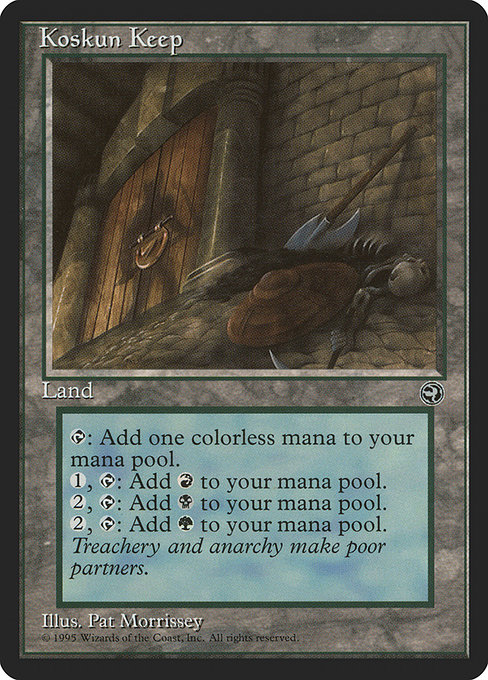
Magic: The Gathering isn’t just a game of numbers and tap sequences; it’s a living culture where jokes, memes, and shared lore keep players coming back after a brutal loss or a spectacular win. Koskun Keep, a land from the 1995 Homelands era, stands as a quirky beacon of that communal spirit. Its strange charm isn’t in raw power or flashy combos—it’s in the invitation to improvise, a little chaos wrapped in a practical, color-shifting package 🧙🔥💎. The art by Pat Lewis suggests a moody keep on the edge of a wild landscape, while the flavor text—“Treachery and anarchy make poor partners.”—reminds us that humor often thrives where rules bend and expectations break.
From a gameplay perspective, Koskun Keep is a tiny centerpiece for a larger cultural joke: mana you can coax into multiple colors with only a couple of tiny inputs. Tap for colorless mana, then spend a few points of mana to coax red, or to reach black or green. It’s a practical microcosm of MTG’s broader charm—the idea that the table can pivot on a moment’s whim, and a well-timed quip or laugh can turn a tense board into a memorable story. That flexibility invites storytelling at the table: a player can lean into a dramatic “I can improvise my mana base on the fly” moment, which often gets retold later as a humorous anecdote about a last-second swing or a bizarre, color-mive run to victory 🧙🔥⚔️.
“Treachery and anarchy make poor partners.”
Humor in MTG grows from these kinds of moments—where a card’s text invites a playful interpretation, where a flavor line nudges players toward a shared joke, and where nostalgia carries you from draft night to casual Friday podcasts. Koskun Keep embodies that spirit: it’s a reminder that sometimes the most memorable interactions aren’t the smoothest engine builds, but the table-wide grin when someone spins a plan into something delightfully off-script. In a hobby obsessed with precise lines and rulings, humor acts as the soft tissue—the glue—that keeps players of all generations coming back for more, even when the metagame shifts and the cards get older than some of the players in the room 🧙🔥🎲.
Three taps, three moods
- Tap for {C} — the quiet, neutral start. A reminder that not every turn needs to scream for a color; sometimes you just need a little steady breathing room.
- {1}, Tap for {R} — a nudge toward aggression or fast disruption. The moment you choose red is often the moment you lean into a joke about “pulling the rug out from under your opponent.”
- {2}, Tap: Add {B} or {G} — the big swing, the flexibility you’d expect from a card that’s not chasing a single color identity. It’s a playful wink at the idea that in MTG, you can be simultaneously strategic and a little chaotic.
This trio of abilities mirrors a common social rhythm at the table: start with a calm plan, pivot toward a spicy play, and finish with a green or black spark that might alter the entire narrative of the game. The humor comes not from the card’s power level but from the possibilities it opens—and from the stories we tell about those possibilities later, when the table remembers the odd, triumphant, or hilariously botched moment 🧙🔥🎨.
Humor across eras: Homelands as nostalgia, as a lesson
Homelands itself is a period many players look back on with mixed nostalgia—collectors prize the era for its distinctive art, its unusual mechanics, and yes, its quirks. Koskun Keep embodies that era’s willingness to experiment with mana dynamics and color identity, a trait that invites fans to mine humor from the past while still playing today. The card’s modern readers discover something timeless: a land that doesn’t force you into one path but invites you to craft your own narrative. That is at the heart of MTG culture—a blend of strategic depth and shared, lighthearted memory. When a group of players gathers around a table and someone quips about “affording the green mana by sacrificing the colorless one first,” you’ve witnessed the living embodiment of the game’s cultural heartbeat 🧙🔥💎⚔️.
In casual play and in long-running Commander games, Koskun Keep often becomes a talking point—an icebreaker that shifts the mood from intense focus to communal storytelling. Its existence as a nonbasic land with a flexible mana production profile makes it a demonstrable example of how the game’s design encourages social play. Humor here is not a distraction; it’s a social lubricant, a reminder that we’re all in it for the drama, the art, and the shared laughter as much as for the perfect topdeck. The community’s response to such cards—memes about “color me confused” mana bases, or jokes about “keeping it keep-level” under pressure—keeps the culture fresh, inclusive, and welcoming to newcomers who might feel overwhelmed by the complexity of newer sets 🧙🔥🎲.
From card to community moment
Every MTG set, from Homelands to today’s blockbuster releases, carries seeds of humor that sprout in the right environment: with players who love the lore, the art, and the clever wordplay. Koskun Keep isn’t just a land; it’s a mnemonic device—a reminder that sometimes the best social moments come from the most unexpected places on the table. The card’s vintage flavor, the color-mixing potential, and the casual-friendly texture make it a favorite for anecdote and cosplay alike, where players joke about the “keep” as a club hub for mischief, or as a place where “unclaimed mana” becomes the punchline of a late-night game. That’s how humor keeps MTG culture alive: by turning tactical decisions into shared stories, by letting the table riff on a theme, and by letting the art and flavor text spark conversation across generations 🎨🧙♂️.
If you’re curating a tabletop setup that invites warmth and wit, consider pairing your game night with a touch of practical flair. A sturdy desk companion—a well-made mouse mat—can be more than just a surface; it’s a small ritual that signals “this is our space for stories.” For fans who want to bring a little bit of character into their everyday desk setup, take a look at a product that blends practicality with a touch of style: Eco Vegan PU Leather Mouse Mat with non-slip backing—the kind of everyday item that makes room for laughter and long sessions alike. It’s a light, tasteful nod to the same spirit that makes Koskun Keep feel like a home away from home on the battlefield of mana and memes 🧙🔥💎.
Feeling inspired to bring some humor into your MTG nights? Tap into the fun and keep the culture alive—one story, one joke, and one topdeck at a time. ⚔️