Image courtesy of Scryfall.com
Art Style Trends Across Decades in Magic: The Gathering
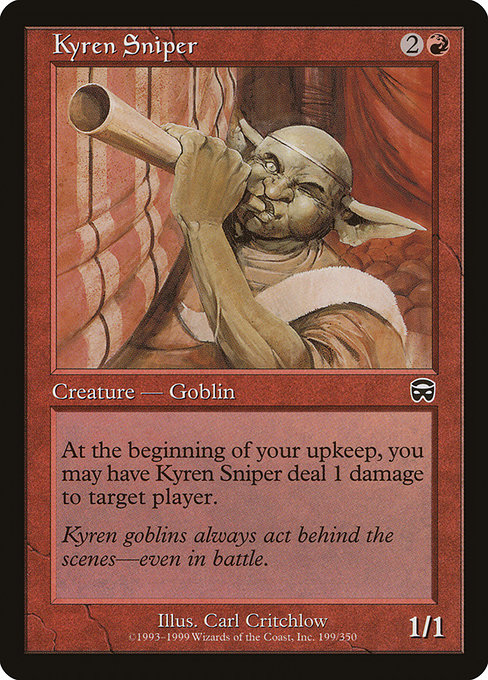
MTG has always been a celebration of visual storytelling, where every card is a tiny window into an expansive multiverse. From the late ’90s to today, the art style has swung like a pendulum—sometimes gritty and painterly, sometimes glossy and cinematic, and often wildly inventive in between. 🎨🧙♂️ Each era carries a fingerprint: the brushwork, the color choices, and how a creature’s personality is conveyed in a single frame. Kyren Sniper, a small but vivid piece from Mercadian Masques, offers a perfect lens for this evolution. Its creator, Carl Critchlow, leans into the chunky silhouette and textured surfaces that defined many Goblin cards of the period, while the red aura of the card’s mana costs and ability reminds you that instant tempo and bite-back was always part of the goblin package. 🔥💎
1990s: The painterly vigor of Mercadian Masques
Released in 1999, Kyren Sniper sits squarely in a moment when artists were still painting on canvas-palette scale but with a willingness to push fast, expressive moments into a single frame. The Mercadian Masques set—MMQ—carried a slightly darker, earthy color palette than the earlier, more saturated blocks. Critchlow’s goblin is compact, wiry, and full of mischief, with armor and gear rendered in visible brushstrokes that invite a second look. The art emphasizes character and atmosphere over photo-real replication, a hallmark of the era’s design ethos. In the card’s flavor text—“Kyren goblins always act behind the scenes—even in battle”—you glimpse that same backstage texture: goblins as chessmasters, pulling strings from the shadows while their actions feel small but decisive. This is classic, tactile fantasy, a little chaotic, a little comic, and a lot of character. 🧙♂️⚔️
2000s: The digital brush and the spark of cinematic lighting
As printing and digital tools expanded, MTG artists began experimenting with lighting, depth, and motion. The 2000s brought a shift toward more dramatic angles and sharper edges, without losing the core fantasy vibe. You’ll notice a growing interest in how goblins catch firelight, how their metalwork reflects a forge-wired pragmatism, and how the environment complements their frantic energy. Kyren Sniper’s red mana color still shines through in the artwork’s hot highlights and the sense that, beneath the goblin’s grin, there’s a plan—one that could pivot on a single, well-timed shot. The balance between realism and whimsy remains intact, a signature of many red cards that value tempo and misdirection as much as brute force. 🔥🎯
2010s: Photoreal textures meet cinematic storytelling
By the 2010s, MTG art frequently leaned into photoreal textures, detailed backgrounds, and cinematic lighting, while still preserving the fantasy core. Goblins often appear with a broader range of personalities—from chaotic alacrity to scheming cunning—thanks to a widening roster of talented illustrators. The art became more varied in technique: some painters embraced soft atmospherics, others adopted sharper digital edges for a punchier silhouette. Yet the heart of a goblin—its irrepressible energy, its love of improvisation, and its ability to punch above its weight—remained a constant through lines and inks. Kyren Sniper, with its compact frame and an arrow-ready stance, communicates that the threat can come from anywhere, even the underbrush, which is a recurring goblin theme across decades. ⚔️🎲
2020s to today: Diversity of style and the joy of reinterpretation
In recent years, MTG art has embraced a wider palette of artists, cultural influences, and stylistic choices. The canon is no longer anchored to a single look but rather a spectrum that honors tradition while inviting bold experimentation. You’ll find goblins depicted with humor, menace, whimsy, and even surreal touches—callbacks to the long-running goblin archetype while also pushing the boundaries of what a red creature can convey on the battlefield. For Kyren Sniper, that means a piece that echoes the set’s late-90s energy but sits comfortably among today’s diverse visuals, inviting both nostalgia and new curiosity. The card’s mechanics remain perfectly in step with red’s classic synergy—speed, risk, and a dash of burn that can tilt the board on a single upkeep trigger. 🧙♂️🔥
In the end, a goblin is never just a goblin. It’s a reminder that magic thrives on chaos, cleverness, and a spark that says, “I’m here to swing the game, and I brought a quiver.”
Kyren Sniper in the digital age: a quick play guide and art appreciation
The card sits in Mercadian Masques as a common with a straightforward, red-hot mana cost of {2}{R}. It’s a 1/1 creature with a tiny but mighty engine: at the beginning of your upkeep, you may have this creature deal 1 damage to target player or planeswalker. That’s tempo with a twist—burn that sits on a creature, encouraging you to leverage every upkeep step as a mini-swing. The art reinforces this narrative: a nimble goblin ready to strike from the shadows, a reminder that even small, cheap creatures can disrupt plans and force a reaction. For new players, the card is a gentle introduction to red’s pet mechanic of incremental burn; for veterans, it’s a nostalgic wink at the era when critters could become irritable pressure points that narrow the opponent’s options. 🧙♂️💎
Collectibility meets usability in Kyren Sniper’s storyline—its flavor text ties directly to the goblins’ behind-the-scenes cunning, a thread that connects across the multiverse. The card’s rarity is common, which historically means it was more widely printed and accessible; yet its distinctive Critchlow artwork ensures it remains a favorite for showpiece displays and early-collector discussions. If you’re chasing a foil or nonfoil version, you’ll notice the potential price delta is modest but real, a reminder that art quality and iconicity can outpace simple supply. The card’s historical footprint—its set, its color identity, and its place in the guild of red cards—makes it a charming lens to study how MTG’s visual language has changed while still keeping core mechanics intact. 🧪💥
Key takeaways for fans and collectors
- From painterly fantasy to cinematic digital work, MTG art reflects evolving tools and tastes without losing the heartbeat of each creature’s identity. 🖌️
- Kyren Sniper embodies late-90s goblin archetypes: cunning, compact, and capable of creating tempo with a simple upkeep trigger. ⚔️
- The card’s red mana identity and its common rarity offer a compelling blend of accessibility and character artistry for both players and art lovers. 🔥
- Appreciating the art helps illuminate why certain cards remain beloved long after their initial print run. The goblin’s behind-the-scenes vibe resonates with players who love clever plays and cheeky humor. 🎨
If you’re intrigued by the tactile joy of MTG art and the way it pairs with gameplay, there’s a chance to celebrate that passion beyond cards—like outfitting your desk with a premium accessory that keeps the magic close. This round neoprene mouse pad, designed for console-style comfort whether you’re drafting with friends or streaming a weekend grind, offers a practical nod to lifelong MTG fans. It’s a subtle way to honor the multiverse while you shuffle, plan, and play. Because every mana gifters deserve a soft landing pad for their creative rise. 🧙♂️💎