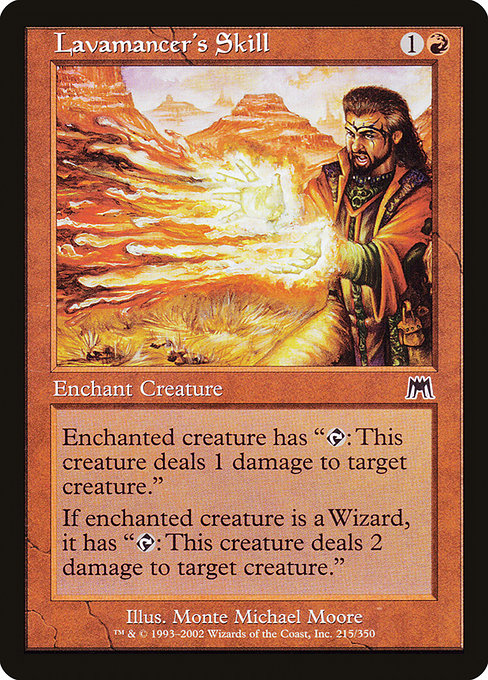
Image courtesy of Scryfall.com
Art Style Across Decades: A Visual Tour Through MTG’s Lava and Lightning
Magic: The Gathering has always been as much a visual spectacle as a strategic puzzle. The journey of its art—across decades, across tech, across palettes—parallels how players came to love and understand the game. The card in focus, Lavamancer's Skill, is a spicy lens into that history. With a cost of {1}{R}, this Enchantment — Aura hails from the Onslaught set, released in 2002, and it carries with it a fiery, kinetic sensibility that Scryfall’s archive preserves for us to study and savor 🧙♂️🔥. Its rarity is common, a reminder that some of the most memorable visuals in MTG aren’t always the rarest—but they’re often the most recognizable in the long run.
From the late 1990s into the early 2000s, illustration work moved from the bold, high-contrast fantasy realism of the early days toward a more painterly, atmospheric approach. Onslaught’s paintings sit at the crossroads of that transition. The art direction leans into molten glow, sharper edge lighting, and a sense of motion that feels almost like you’re watching a spell take form in a furnace of color. The result is a piece that reads quickly in a crowded battlefield but rewards a second look—where you notice the subtle texture of flame, the way a creature is framed, and how the aura itself seems to crackle with intention 🧪⚡.
Core Mechanics, Core Imagery
Lavamancer's Skill hinges on a straightforward yet spicy mechanic: Enchant creature. The enchanted creature gains a fiery utility: "T: This creature deals 1 damage to target creature." That incentive sharpens when the enchanted creature is a Wizard, granting it an enhanced line: "T: This creature deals 2 damage to target creature." The art and the text work in tandem to signal red’s theme—direct, proactive damage with a dash of risk management. The precise labeling—color identity R, mana cost 1R, and the set Onslaught—cements this aura as a product of its era’s design philosophy: fast, punchy, and easy to slot into an aggro or tempo strategy 🧙♂️⚔️.
Art is memory made visible, and red’s memory is a river of motion—crisp bursts of flame and a pulse you can almost hear as mana crackles in the air.
From Painterly Boldness to Digital Fluency
1990s art for MTG often balanced between painterly realism and the fantasy textbook look. By the time Onslaught arrived, digital tools began to influence workflows more noticeably, but the best pieces still carried a hand-crafted feel: layered glazes, dramatic backlighting, and a color vocabulary that leaned into magma reds and obsidian shadows. In Lavamancer's Skill, the fiery aura is not just color; it’s a narrative device that announces the aura’s purpose before you read the words. That clarity—the ability to “read” a card’s function at a glance—became a hallmark of the era’s art direction, even as the industry shifted toward higher resolution, more iterative drafts, and a growing emphasis on dynamic action on a single frame 🎨🔥.
As the decades rolled on, the style matured with newer tools and broader artistic influences, but red’s core identity—direct impact, instantaneous tempo, and a little edge—persisted. The Onslaught piece feels kinetic, not just decorative; it communicates a strategy you can feel in your fingertips as you consider spikes in tempo and the timing of damage. It’s a reminder that art and rules often feed each other: the visual cue of heat and risk mirrors the decision-making cadence of casting and attacking in a red deck 🧠💎.
Design Notes: Color, Creature, and Cachet
Color identity matters in MTG—red is synonymous with speed, aggression, and a willingness to pay in life or mana for quick, decisive blows. Lavamancer's Skill embraces that ethos: mana cost aligns with a lean, aggressive tempo; Enchant preserves a narrow target while amplifying the aura’s battlefield impact. The enchanted creature gaining the ability to deal damage to a target creature is a classic red motif—risk and reward in balance, with the notable Wizard condition providing a tiny but flavorful twist that invites tribal or synergetic play when the deck curates Wizard options. The piece’s common rarity belies its lasting impact; it’s a card that players remember not for scarcity but for the punch it brings to a moment on the battlefield 🧙♂️⚔️.
- Illustration role: Visual shorthand for danger and heat, making the aura feel like a living flame.
- Mechanic alignment: Auras that weaponize a creature’s taps and the potential to target an opposing threat align with red’s tempo goals.
- Set-era flavor: Onslaught’s art often emphasizes bold color, defined lighting, and dynamic composition that communicates motion even when the card is still.
Collector Pulse and Market Pulse
In today’s market, Lavamancer's Skill sits in a practical price neighborhood for its rarity: around $0.11 in non-foil, with foil variants typically around $0.81, and the broader market quirks reflected in typical values for the era. It’s a reminder that “value” in MTG isn’t only about rarity; it’s about how often a card is seen in decks, how iconic its image feels, and how well it ages into the broader art narrative of the game. For collectors who savor classic red enchantments or want a tactile reminder of the Onslaught era’s bold color language, this card is a small but enduring gem 🎲.
For players who love the posterity of MTG art and the stories it tells, there’s a parallel to be drawn with contemporary accessories that celebrate the hobby. The way a card’s image has shaped one’s memory of a game night can influence how you curate playmats, sleeves, and even desk setups. If you’re building a red-themed tempo deck, or if you’re a lore aficionado who enjoys the subtle wizardry of enchantments, the imagery in this Onslaught piece resonates just as strongly today as it did twenty years ago 🧙♂️💎.
Wrapping the Decade-Span Gallery
Art in MTG is a living archive. Each decade leaves its fingerprint on how players perceive power, how designers convey flavor, and how collectors narrate a set’s legacy. Lavamancer's Skill embodies a moment when the game’s visuals were transitioning into a more digital-forward era while staying true to fast, evocative storytelling. The lava-lit enchantment, the crisp linework, and the thematic link between a Wizard’s potential and a volcano’s raw impulse all echo a broader arc: magic as a shared, evolving craft. Whether you’re revisiting a deck-building memory or exploring the evolving aesthetics of red, this piece invites a smile and a spark of nostalgia 🧙♂️🔥🎨.
Interested in a way to bring a bit of MTG energy into your everyday workspace? Check out the Neon Gaming Mouse Pad—stitched edges, neoprene comfort, and a little nod to the collectible culture that unites players across decades. It’s the kind of cross-promo that feels earned, not intrusive, a small bridge between hobby and daily life.