Image courtesy of Scryfall.com
Marsh Gas and the culture of MTG humor
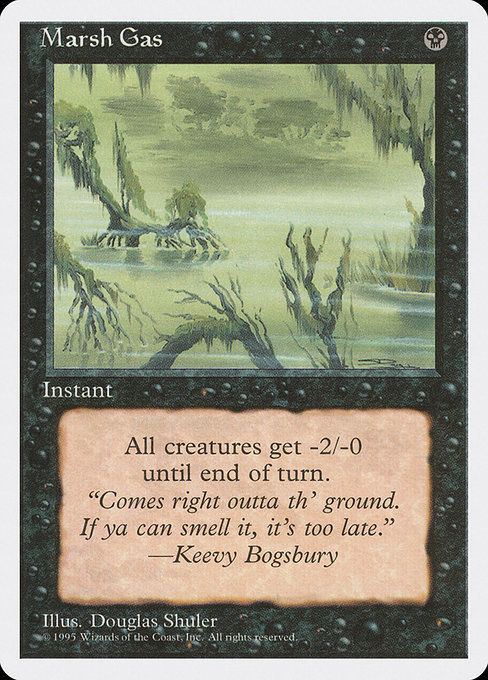
Magic: The Gathering has always walked a fine line between epic myth and sly wink. Some sets whisper grand destinies, while others cheerfully nudge players with a joke they didn’t know they needed. Marsh Gas, a humble common instant from Fourth Edition, embodies that playful spirit in a compact, gulpable moment 🧙🔥. With a single black mana and a simple but cheeky effect—“All creatures get -2/-0 until end of turn”—the card becomes a cultural artifact as much as a battlefield tool. It reminds us that humor in MTG isn’t filler; it’s a cultural signal, a wink from designers testing the boundaries of tone, pace, and feasibility in a trade-off-heavy game where big ambitions don’t always require big numbers 💎⚔️.
Marsh Gas: a snapshot of 1990s design and mood
Released in 1995, Marsh Gas sits squarely in Fourth Edition—the core set that helped standardize mechanics and flavor as the game leaned into its own mythic scape while inviting players to tell their own stories at the kitchen table. Its mana cost of {B} and its black-aligned effect fit the era’s appetite for dark playfulness: a tiny incantation that punishes the battlefield with a stinkier-than-usual breeze. The flavor text—“Comes right outta th' ground. If ya can smell it, it's too late.”—is a perfect microcosm of the period: gritty, folksy, and a touch roguish. Keevy Bogsbury’s line gives the card a vibe that blends rural bog lore with urban humor, a contrast that MTG fans still remember with a smile 🎲. And yes, the art by Douglas Shuler—rendered in the white-border, 1993 frame—conveys a swampy humor that’s part stink, part spectacle, and all charm.
How humor cards echo culture and community
Humor cards like Marsh Gas are not mere jokes; they reflect how players process conflict, scarcity, and power in a shared space. In a game where the most dramatic moments often hinge on a creature or a bomb, a tiny instant that nerfs every creature by two power whispers a broader truth: sometimes the tension is in the moment, not the numbers. The cultural symbolism is layered:
- Swamp identity: The black mana flavor and bog imagery resonate with the long-standing MTG lore of shadowy marshlands as sites of cunning, danger, and hidden potential. Marsh Gas personifies a swamp’s stubborn, practical humor—the stuff of gossip and tall tales told around campfires and card tables alike 🧙♀️.
- Means over spectacle: A negative-yet-universal effect (affecting all creatures) emphasizes communal stakes over individual glory—humor that bites because it levels the field in a way that isn’t flashy but feels right in a crowded game scenario.
- Dialect and flavor: The rustic aphorism in the flavor text anchors the card in a cultural voice that fans recognize, a nod to the shared storytelling around a kitchen table or a local gaming shop.
- Accessibility and nostalgia: Common rarity, a straightforward mechanic, and a widely print-run make Marsh Gas approachable for new players while still a nostalgic wink for veterans who remember the era’s bold art and bolder flavor.
Design and flavor: art, text, and the era’s voice
The card’s art and frame belong to a period that prized recognizability and a touch of humor amid the fantasy. The 1990s white-bordered frame, the illustration by Douglas Shuler, and the tongue-in-cheek flavor text work together like a well-timed punchline. In MTG design, humor often comes through two channels: textual quips and visual jokes. Marsh Gas leans into both. The text is short, precise, and punchy, while the art suggests a not-quite-typical safari into boggy territory where danger and levity share the same air. It’s a reminder that magic can be both awe-inspiring and a little ridiculous, which is a large part of why humor cards endure in fan conversation and deck-building lore 🎨⚔️.
“Comes right outta th' ground. If ya can smell it, it's too late.” — Keevy Bogsbury
The flavor line isn’t just a joke; it’s a cultural snapshot of a community that grew up with the card, learned its idiosyncrasies, and still quotes the dialect in casual conversation. That layering—mechanics, flavor, and community in a single line—helps explain why even a one-mana black instant can loom large in the collective MTG memory 🧙🔥.
Gameplay takeaways: when to reach for Marsh Gas
From a gameplay perspective, Marsh Gas is most meaningful in boards saturated with small, proliferating threats. The -2/-0 global swing can swing combat in a blink, turning a threatening alpha strike into a neutral exchange or enabling a few cheeky chump-blocks to grind out a win. In multiplayer formats, this kind of mass reduction often shifts the tempo more than a single-target removal ever could, producing those “everyone bleeds at once” moments players remember long after the game ends 🎲.
- Best used when you expect a wide field of little creatures rather than a few oversized threats.
- Especially effective in decks that favor denial or attrition, where your opponent’s board presence is the real obstacle to victory.
- Works best when you have a plan to capitalize on the temporary lull—think a plan that seals the game in the following turns rather than relying on the -2/-0 alone.
Legacy, rarity, and the collector’s lens
As a Fourth Edition common, Marsh Gas sits in a category that’s easy to acquire but historically beloved for its flavor and context. The set’s core status means it’s legality is broad in older formats like Legacy and Vintage, and in casual play across many tables. The market price, as tracked in recent data, sits modestly around a few dimes to a quarter for nonfoil prints, with the nostalgia factor often outweighing raw value for players who simply want a memory trigger on the battlefield or at the kitchen table. The fact that it remains a frequently cited example of humor in early MTG design only adds to its charm, making it a stubborn little badge of culture in the vast MTG archive 🧙💎.
Beyond the card: culture, humor, and community in the MTG multiverse
Marsh Gas isn’t just a card; it’s a cultural signpost. It marks a moment when designers were comfortable leaning into the everyday grotesque humor of bog gas, translating it into a strategic tool that also fuels storytelling at the table. The humor card tradition—where a one-mana instant can provoke a grin, a groan, and a reconsideration of board state—remains a vital thread in MTG’s design tapestry. It’s proof that the multiverse thrives on more than epic battles and legendary creatures: it thrives on the little jokes that give fans something to quote, debate, and cherish long after the last card lands on the battlefield 🧙🔥💎⚔️.
For readers who love this blend of lore, gameplay, and wit, there’s always more to explore. If you’re navigating casual formats or building a nostalgic mono-black list, Marsh Gas stands as a reminder that powerful moments can come from the most modest corners of the card pool.