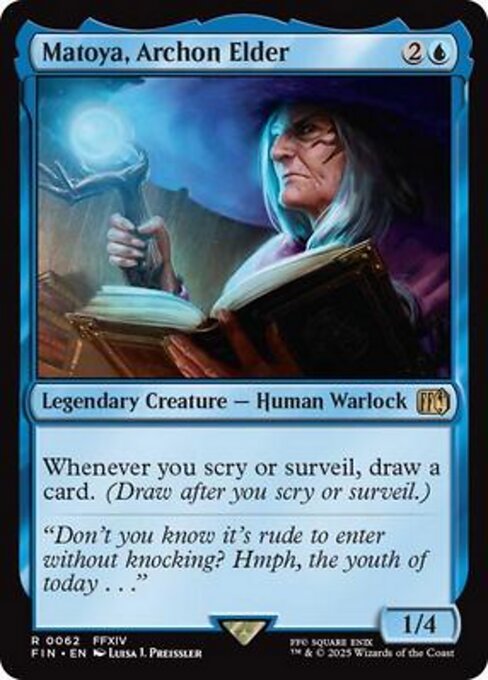
Image courtesy of Scryfall.com
Evolving illustration trends in modern MTG
Magic: The Gathering has always been as much a visual journey as a mechanical one, and the rise of crossover sets and Universes Beyond products has accelerated that evolution. When you look at a blue legendary creature like Matoya, Archon Elder, you’re not just seeing a mana cost of {2}{U} and a stat line of 1/4; you’re witnessing a deliberate conversation between lore, art, and play design. The Final Fantasy expansion Fin, with its distinct frame and cross-media ties, marks a pivot point where the gallery becomes a strategic tool as well as a storytelling device 🧙🔥💎. The image’s blue palette, the aura of arcane intelligence, and Matoya’s presence as an Archon Elder encode a narrative that invites both nostalgic collectors and new players to lean in and explore the card’s implications on the battlefield and in the lore labyrinth."
Artistic DNA: blue spells, storytelling, and a cross-cultural heartbeat
Blue has long been MTG’s channel for knowledge, control, and curiosity. Matoya’s ability—“Whenever you scry or surveil, draw a card (draw after you scry or surveil)”—is a perfect emblem of that identity: it rewards information-gathering and deck-filtering with card advantage. The Fin set’s artistic vocabulary embraces cool tones and crystalline atmospheres, spotlighting a mage whose stature and presence feel both timeless and relevant to modern players. The illustration by Luisa J. Preissler threads classic fantasy illustration with a contemporary flair, balancing detailed character work with a composition that reads clearly even at card size. This balance—narrative clarity plus technical polish—has become a hallmark of the current era of MTG art 🧙♂️🎨. The result is art that functions as a code for strategy and a beacon for lore fans who crave deeper universes beyond the card text."
From frame to figurine: how presentation guides perception
Matoya’s card sits in a 2015-era frame that still feels fresh in today’s highly polished market. It’s not a full-art spectacle, but the legendary crown and the subtle flourishes around the border signal grandeur without sacrificing readability. The set name, Fin, and the flavor text—“Don't you know it's rude to enter without knocking? Hmph, the youth of today...”—anchor the character in a playful, otherworldly universe while acknowledging the crossover’s tongue-in-cheek humor. This kind of flavor text, paired with a restrained but evocative illustration, helps players imagine a broader world where Final Fantasy personalities mingle with MTG’s mechanical ecosystems. The art direction demonstrates a growing confidence in letting crossovers feel both familiar to fans and distinct within MTG’s established aesthetic 🔮⚔️.
Mechanics as a lens: scry, surveil, and the value of information
The card’s core mechanic—triggering a draw whenever you scry or surveil—embeds information-gathering into the very engine of play. Scry and surveil are tools that reward careful planning and deck manipulation, and Matoya’s loyalty to card draw ensures those decisions carry momentum. In practice, you’ll weave scry effects into your turns to act as tempo accelerants while maintaining card quality. In a control or tempo shell, Matoya can serve as a reliable engine that keeps your options open while you’matically navigate counters and answers. It’s a design alignment that showcases how art and mechanics can reinforce a single, coherent strategic identity 🪄💎. This synergy is a microcosm of modern MTG: art that frames the strategy, and strategy that justifies the art’s mood and color.
Narrative density: lore, universes beyond, and market resonance
The Fin set carries more than fan service; it signals MTG’s willingness to braid genre storytelling with card design. The card’s cross-promotional tags—ffxiv and universes beyond—underscore a trend where players aren’t just collecting spells and creatures; they’re curating gateways to larger narratives. For collectors and lore-minded players, that means a richer reason to explore the card beyond its gameplay text. It also raises curiosity about future collaborations and how art direction will adapt to new mythologies. Matoya, as an Archon Elder, embodies both authority and curiosity—an emblem of a larger MTG ecosystem that respects tradition while inviting experimentation 🧙♀️🎲.
“Whenever you scry or surveil, draw a card.” That line feels almost nostalgic in its simplicity while staying aggressively modern in its payoff. It’s a reminder that blue’s love of information is timeless, even as the art and sets around it keep evolving.”
Collectibility, value, and the practical side of art-forward design
Beyond the story and style, there’s a practical economy at play. Matoya is a rare in the Fin set, printed in both nonfoil and foil finishes, with a price that fluctuates as set rotations shift and collectors chase specific crossovers. Current market data hints at modest but steady interest: a typical USD price in the low range with foil premiums higher, reflecting the card’s status as part of a beloved crossover rather than a powerhouse in a strictly competitive sense. For players designing blue-centric control or draw-based decks, Matoya offers a ready-made engine that rewards meticulous planning and deck filtering—the kind of synergy that keeps players coming back to refine their scry-surveil loops and dream up new lines of play 🧭💡.
From an art collector’s standpoint, the Final Fantasy crossover marks a notable milestone in MTG’s visual history. It demonstrates how a single card can embody a moment when narrative ambition, licensing strategy, and painterly craft align to create a piece that’s as much a motif as a mere card. The artist Luisa J. Preissler’s work, the 2015 frame, and the “legendary” treatment all contribute to a sense of enduring value—one that resonates not just when you shuffle, but when you pause to look, read, and hypothesize about the worlds those images hint at 🧙🔥🎨.
Practical deck-building tips for this card
- Pair with reliable scry and surveil effects to maximize card draw. Look for synergy with cards that add scry or surveil as a byproduct of casting blue spells.
- Consider a tempo control shell where Matoya acts as a card-advantage engine, offsetting countermagic with a steady stream of options.
- In commander formats, slot Matoya into blue-themed decks that prize card selection and incremental advantage—the Archon Elder’s aura fits neatly with political and midrange playstyles.
Whether you’re chasing the art history, the cross-media storytelling, or the crunchy deck-building nuance, Matoya, Archon Elder invites you to slow down, observe the library of possibilities, and then draw your next move. The card is a vivid reminder that MTG’s evolution isn’t only about bigger numbers or flashier frames—it’s about weaving culture, lore, and play into a single, living hobby 🧙♂️💎⚡.