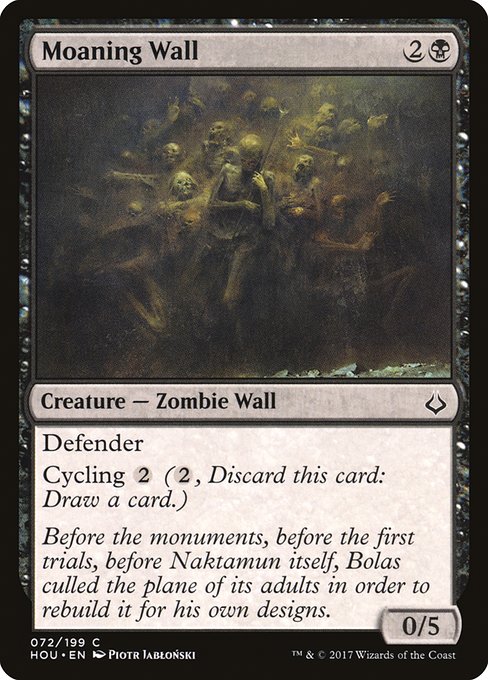
Image courtesy of Scryfall.com
Traditional vs Digital Illustration: A Case Study with Moaning Wall
If you’ve ever debated how MTG art bridges the centuries, Moaning Wall offers a surprisingly revealing lens. This common zombie Wall from Hour of Devastation blends a classic, almost relic-like vibe with the clean, crisp edges you often associate with modern digital painting. The result is a piece that feels both ancient and immediate—a perfect microcosm for how traditional and digital workflows contend for the soul of a card’s image. 🧙♂️🔥💎
On the table is a creature that wears its wall-ness on its sleeve: Defender, a stoic shield that keeps an opposing board at bay, with a sturdy 0/5 profile. Its mana cost is modest—2 generic and 1 black mana—yet its presence on the battlefield is anything but tiny. The card’s Cycling ability, {2}, offering a redraw at the cost of a card, invites a tidy strategic tension: when to strengthen the wall with a cycle, and when to keep it as a stubborn blocker. This duality—early defense vs late-game draw—serves as a micro-study in how an artist can translate a simple line of rules text into a vivid, almost tactile mood. 🧙♂️⚔️
Card in Focus: Moaning Wall at a Glance
- Set: Hour of Devastation (Hou)
- Rarity: Common
- Mana Cost: 2B
- Type: Creature — Zombie Wall
- Power/Toughness: 0/5
- Keywords: Defender, Cycling
- Flavor Text: “Before the monuments, before the first trials, before Naktamun itself, Bolas culled the plane of its adults in order to rebuild it for his own designs.”
Before the monuments, before the first trials, before Naktamun itself, Bolas culled the plane of its adults in order to rebuild it for his own designs.
The language of the card is minimalist, but it speaks volumes about the era and the design ethos behind Hour of Devastation. The set leans into a mythic, Egyptian-inspired aesthetic, and Moaning Wall sits at the intersection of occult mystery and stubborn resilience. The art—credited to Piotr Jabłoński—translates that theme into a composition where texture and shade convey the sense of an ancient barrier resisting the encroaching dark. In a market that often prizes flash and virtuosity, this piece leans into quiet power—the kind that invites players to plan a few turns ahead while the board slowly settles into a tense stalemate. 🎨🕯️
The Artwork: Traditional Techniques Through a Digital Lens
What makes traditional vs digital illustration a delightful debate in MTG is not just the toolset, but the emotional texture each method imparts. Traditional approaches—oil, acrylic, or pencil—toster the subtlety of light and grain in ways that feel tactile, a little rough around the edges in the best possible sense. Digital rendering, by contrast, can push contrast, sharpen lines, and render ghostly fog with a click, enabling a mood that’s at once crystalline and cinematic. Moaning Wall—though printed as a digital image—has a painterly gravity, with the wall’s stony surface and the ambient gloom captured in a way that nods to classical fantasy art while embracing modern polish. The Hour of Devastation frame itself—dark, textured, and monumental—benefits from digital workflows that allow artists to simulate natural media while delivering high-resolution, scalable art for card printings and digital previews. 🧙♂️💎
For collectors and players, the distinction matters not only in aesthetics but in how the card communicates its role in the game. The Defender ability is a nod to the old-school strategic mindset: a reliable shield against aggressive starts. The Cycling ability flips the script, offering card selection and momentum shifts that are more about tempo than pure power. In traditional art, you might chase the tactile sensation of a wall’s rough texture; in digital, you chase the moment the shadow moves just so, the way the light curls along the barrier’s edges. This piece manages to honor both impulses—an homage to craft and a nod to the speed of modern production. 🧲⚔️
Lore, Flavor, and the Cultural Pulse
The flavor text anchors the card in a broader saga—the Fall of Naktamun, Bolas’s ruthless redesign of the plane, and the way fear and power sculpt history. It’s a reminder that MTG art isn’t just pretty pictures; it’s a storyboard, a teaser for a world that’s as much about politics and myth as it is about mana and ratios. The wall’s presence—silent, patient, and inexorable—fits a larger pattern in many black-aligned cards: haunting inevitability, a slow burn that rewards patient planning over impulsive aggression. The oil-and-marble vibe of the artwork complements this narrative, even as the digital-era clarity keeps the image legible across screens and print. 🎲🎨
From a collector’s mindset, Moaning Wall sits in the common slot, yet its foil versions—when available—spark a surprising amount of interest given the set’s Egyptian motif and the card’s robust utility in some historical formats. The card’s power is in its endurance—a theme that resonates with many players who love a good late-game stall or a steady ramp toward cycling into a fresh draw. For modern players, the combination of Defender and Cycling makes it a surprisingly useful tool in controlling board state while keeping options open for redraws. The art, meanwhile, remains a quiet ambassador for the dual nature of the hobby: the artistry that endures and the mechanics that evolve. 🔥🧙♂️
- In Limited, Moaning Wall offers dependable defense while you develop other threats. Its 0/5 body buys time in a pinch.
- In Modern or Pioneer, it can stall an aggressive plan long enough to pivot into card advantage via cycling draws.
- The artwork’s traditional-vs-digital blend captures the spirit of an era in MTG’s visual evolution—honoring the painterly roots while embracing the clarity of contemporary digital workflows.
If you’re curious to dive deeper into the card’s ecosystem—how it interacts with cycling synergies, or how it stacks up in a casual cube—TCGPlayer and other marketplaces offer dynamic pricing and deck ideas. And if you’re in the mood to upgrade your desk with a little MTG-infused comfort, check out the product below. The crossover between hobby and everyday life is real, and it’s part of what makes the Magic community feel like a giant, glittery, game-night family. 🧙♂️🎲