Image courtesy of Scryfall.com
Traditional vs Digital Illustration in MTG: A Case Study
Magic: The Gathering has always traded in the currency of mood as much as mechanics. The moment you glimpse a card’s illustration, you’re stepping into a snapshot of the multiverse—the artist’s brushstroke becomes a portal that carries you into a creature’s heartbeat, a spell’s whisper, or a villain’s grin. When we compare traditional and digital approaches side by side, we’re not just debating mediums; we’re tracing how the game’s storytelling evolves with technology, culture, and the artists who translate rules into reverie 🧙♂️🔥.
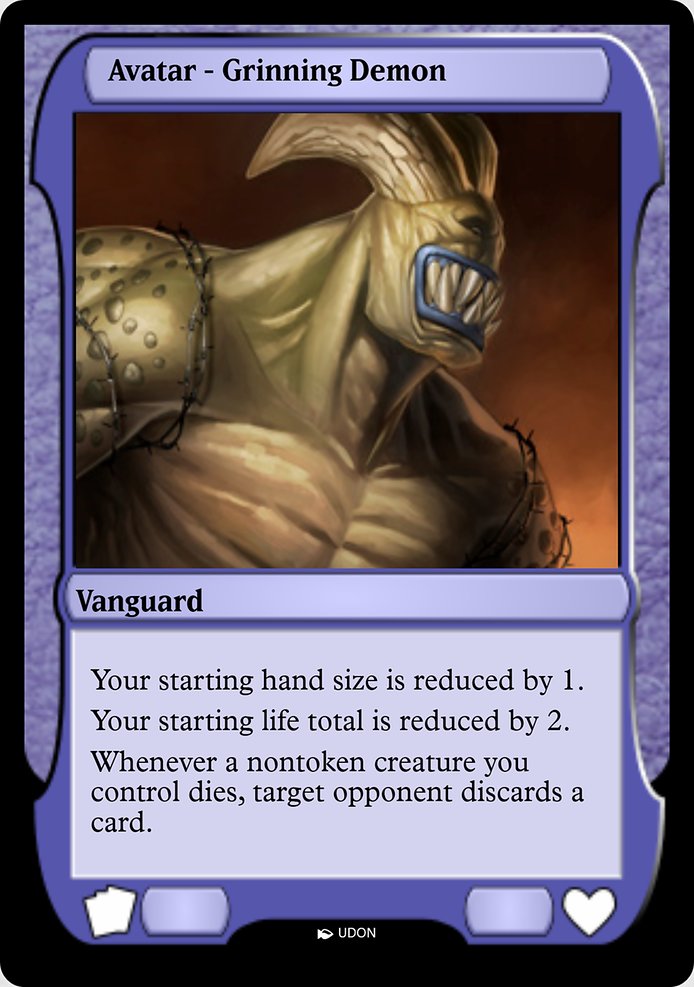
Our focus here is a Vanguard card that sits at an interesting crossroads: Grinning Demon Avatar, a rare digital artwork from the Magic Online Avatars set (pmoa). This card lives in a uniquely online space, bearing a colorless identity and a zero mana cost, with the artwork brought to life by UDON—the studio known for high-contrast lines, dynamic posing, and a kinetic energy that feels almost anime-adjacent. The piece was crafted with the Vanguard format in mind, a digital-first playground where avatars represent players and where art often leans toward bold, instantly legible imagery. The result is a piece that reads as both demon and avatar—a perfect ambassador for a format built for online identity and quick, readable storytelling ⚔️🎨.
The art speaks the game's language
The card’s effect—“Whenever a nontoken creature you control dies, target opponent discards a card”—isn’t just a line of rules text; it’s a moment that wants to be captured visually. The Grinning Demon Avatar image channels a mischievous, almost theatrical menace: a demon’s grin that promises consequences, paired with a stylized silhouette that reads clearly even on a small MTGO window. In traditional illustration, you’d expect a slower, more deliberate build: multiple cycles of concept sketches, color studies, and approved proofs. In this case, the digital path allows UDON to push contrast, sharpen highlights, and compress the composition for legibility in online play—an advantage digital artists often tout: fidelity and impact at a glance 🧙♂️.
The fastest way to signal a card’s intent in a crowded battlefield is through bold shape language and high-contrast lighting—the kind of clarity digital tools excel at delivering.
Colorwise, the Vanguard art leans into stark presentation. The absence of a color identity on the card itself foregrounds the demon avatar as a symbol, not a faction. In traditional print, you might see subtler palettes woven through brushwork; in digital practice, the emphasis shifts toward a confident silhouette, crisp edges, and a dramatic pose that telegraphs the card’s online persona. That shift matters because MTG’s online spaces prize readability: players must interpret a card’s function within seconds, and art plays a big role in shaping that initial read 🧙♂️💎.
Traditional vs digital: a behind-the-scenes glance
- Traditional illustration: A lead artist might begin with pencil thumbnails, develop a color study on separate sheets, and refine on canvas or board. The texture, brushwork, and material grain add a tactile depth that reminds us of the hand’s imprint on the legend.
- Digital illustration: Layered workflows, intense shading, and crisp linework are common. Digital can accelerate revisions, support rapid testing of color combos, and ensure the final image scales cleanly for online displays and various card sizes. The result often feels more graphic and cinematic, which suits a format where players skim art during a fast-paced game or while navigating a crowded card shop.
In Grinning Demon Avatar, UDON’s stylization aligns well with digital sensibilities—edgy lines, bold shapes, and high-contrast lighting that pop on a screen. The same energy, however, isn’t limited to MTGO: the card’s aura translates into fan art, memes, and cosplay designs with a contemporary edge. That cross-pollination—where digital art informs fan culture and paper art borrows from online aesthetics—is a modern MTG phenomenon you can feel in every gallery, subreddit, and deck-building corner of the community 🧙♂️🎲.
Collectors, value, and the digital artifact
One of the most interesting consequences of digital-only or digital-forward sets is how collectors approach value. Grinning Demon Avatar is a Vanguard card from the Magic Online Avatars line, a set_type designed for online identity rather than paper-promo lore. It’s listed as a rare foil and nonfoil piece, with a distinct frame and a 0 mana cost that immediately signals its role as a meta-shaper in an online space. For collectors, that combination of rarity, digital origin, and an artist with a recognizable style adds a layer of desirability that’s separate from traditional print cycles. The card’s ability to disrupt your opponent’s hand while you’re navigating the resources of a Vanguard game gives it a thematic aura that translates well into a collector’s moodboard of MTG moments ⚔️💎.
For players, this story isn’t just about value—it’s about how art communicates function. The absence of color identity makes the visual emphasis on the demon avatar even more pronounced, and the Vanguard environment rewards clear, graphic design. This intersection—a digital artist’s bold interpretation, a clean online-friendly presentation, and a mechanically distinctive card text—illustrates why digital illustration is not merely an alternative to traditional methods but a vibrant partner in MTG’s evolving aesthetics 🧙♂️🔥.
Design choices that endure
Art directors at MTG—and the artists who collaborate with them—must balance brand consistency with the freedom that each card’s identity demands. UDON’s involvement here ensures a recognizable line style, while the Vanguard frame and digital-first production keep the piece accessible to online players who crave immediacy and energy. The ongoing dialogue between traditional craft and digital execution is what keeps MTG visually dynamic: you can appreciate the brushwork in older releases and still feel the charge of contemporary, screen-first design in newer avatars 🎨🎲.
As players and fans, we’re invited to savor both sides of this coin: the tactile romance of a painted, textured piece and the crisp, luminous authority of a digitally rendered image. And if you’re feeling inspired to celebrate the hobby with a touch of modern flair in your everyday gear, there’s a friendly nudge from a fellow fantasy enthusiast—the chance to blend MTG’s artful worlds with everyday tech accessories. Speaking of which, a little accessory inspiration can go a long way in keeping your game-night vibe on-point 🔥.