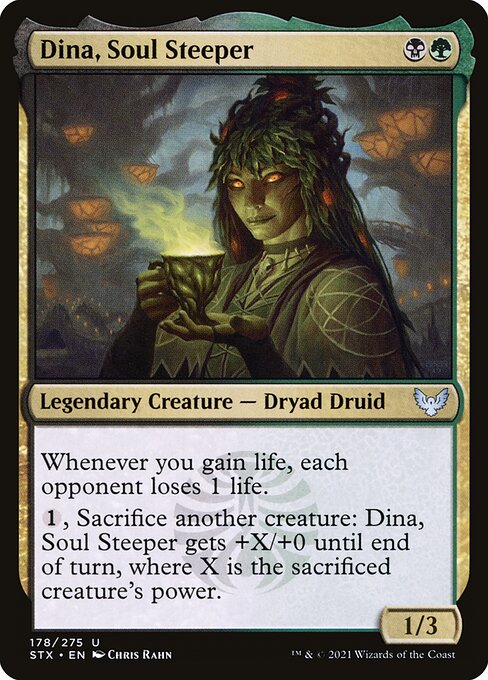
Image courtesy of Scryfall.com
Investment Potential of Parody Cards for Dina, Soul Steeper
Parody cards sit at an intriguing crossroads in the MTG hobby: they’re playful, collectible, and sometimes surprisingly strategic—yet they exist in a gray area outside Wizards of the Coast’s official print runs. Dina, Soul Steeper, a real card from Strixhaven: School of Mages with the Witherbloom watermark, has inspired a swirl of fan-made jokers and homage prints that riff on her lifedrain flavor. 🧙🔥💎 For collectors who enjoy a healthy dose of nostalgia alongside a pinch of risk, these parody items offer a unique kind of entertainment value that can occasionally flirt with real-world price dynamics—without ever promising the same liquidity as a sanctioned set piece. ⚔️
Dina’s real-world frame of reference matters when you weigh parody potential. In STX, Dina is a legendary Dryad Druid with a compact 2-mana cost: {B}{G}. She’s a 1/3 with a striking ability: “Whenever you gain life, each opponent loses 1 life.” That lifedrain twist lines up nicely with lifegain or aristocrat-style decks in multiplayer formats, while her secondary ability—“{1}, Sacrifice another creature: Dina gets +X/+0 until end of turn, where X is the sacrificed creature’s power”—rewards clever self-sacrifice and token generation. This kind of payoff makes Dina memorable beyond her stat line, and it helps explain why parody cards often lean into her lifegain theme or turn her into a punchline that still nods to her core mechanic. 🎨
From a design perspective, the real Dina’s foil worth is modest: the Scryfall data shows an entry price hovering around a few dimes to a couple of quarters for non-foil, with foil variants only a touch higher. In collector culture, that means parody prints tied to Dina are less about raw financial upside and more about cultural cachet, playability in fan-devised formats, and the thrill of owning a cheeky, well-executed homage. The charm often lies in a strong artistic take, timely memes, or a limited print run that captures a specific moment in MTG’s ongoing conversation. 🎲
What makes parody cards resonate, and when do they become “investable”?
- Print run and availability: Limited or exclusive releases drive early demand. A parody card that only appears at a local convention or on a small online drop can become a sought-after novelty due to scarcity rather than power. 🧵
- Artistic merit and theme alignment: Parodies that honor Dina’s Witherbloom vibe or that riff on her lifegain/lose-life mechanic in clever ways tend to travel better in MTG circles. A well-executed, funny rework of the flavor text or a playful alternate art can boost appeal. 🎨
- Community context: The memes and conversations around Strixhaven-era cards, especially those tied to schools and houses, give parody prints a living, meme-driven lifespan. If the humor hits the right target, the card becomes a talking point at Leagues, tables, and EDH nights. 🗣️
- Quality of materials: Even fan-made pieces that mimic premium finishes (foil-like gloss, card stock feel, or premium printing) can feel more collectible than simple paper proxies. A genuine sense of craft translates into perceived value. 💎
Risks and realities for the thoughtful collector
Parody prints are delightful, but they aren’t backed by Wizards’ official set licensing. That reality creates a few practical cautions:
- Valuation is highly speculative. Price trajectories can spike on novelty going viral and then just as quickly collapse when the meme wanes. 🧙♂️
- Legality and ethics vary by jurisdiction and print method. It’s wise to stick to reputable, clearly fan-made channels and avoid anything that could blur lines with counterfeit or misrepresented official cards. ⚖️
- Liquidity is limited. If you’re hoping to cash out quickly, parody cards (even Dina-inspired ones) rarely match the speed of a staple real card in a popular format. ⏳
“The joy of a parody card isn’t just what it does in a deck—it’s how it makes a table grin.”
For Dina, Soul Steeper specifically, the real card is a neat discovery for players chasing life-gain themes and those who enjoy the back-and-forth of draining opponents while curating a survivable board state. A parody print that amplifies that flavor—perhaps by tightening the lifegain-to-damage loop or by pairing art with a tongue-in-cheek flavor text—has intrinsic charm, especially for players who built meme-friendly commanders around Witherbloom’s ethos. The key is authenticity of the joke and fidelity to the source vibe, not misrepresenting power or rarity. 🧙🔥
Practical takeaways for savvy collectors
- Focus on narrative value: Parody prints that tell a story or fit a tabletop joke will endure longer in memory and display value. 🎭
- Prefer well-made prints: Good cardstock feel, stable color accuracy, and professional presentation increase collectibility beyond sheer joke value. 🎨
- Pair with real-world data: Keep an eye on the market for Strixhaven-era cards and Witherbloom-themed pieces to gauge how the broader interest in Dina and friends is behaving. 📈
- Nest the item in a broader collection: Parodies shine when they sit alongside other Strixhaven and meme-era cards, forming a narrative mini-gallery rather than a single oddity. 🗂️
While you weigh whether a particular Dina parody print belongs in your display case, you can also think about practical ways to support your MTG hobby beyond cards alone. If you’re shopping for desk gear that complements your gaming setup, this product line offers a tasteful blend of utility and style that many fans appreciate. For a different kind of desk upgrade, consider this option below and keep your gaming space as legendary as Dina herself. 🧙💻