Image courtesy of Scryfall.com
Rarity and Mana Cost: The Subtle Equation
In Magic: The Gathering, rarity often signals a creature’s expected impact, yet the real magic happens when you read the mana cost and the texture of the card’s text. Orcish Settlers, a Weatherlight-era piece from 1997, clings to a two-mana starter cost with a highly scalable threat. At first glance it’s a modest 1/1 for a modest price: {1}{R} and a tepid power/toughness of 1/1. But look a little closer, and the design philosophy gleams. The card’s true payoff is not just the stats on the battlefield; it’s the ability to scale through X and R, with a built-in trade-off that embodies red’s famous “pay to affect the world” ethos. 🧙♂️🔥💎
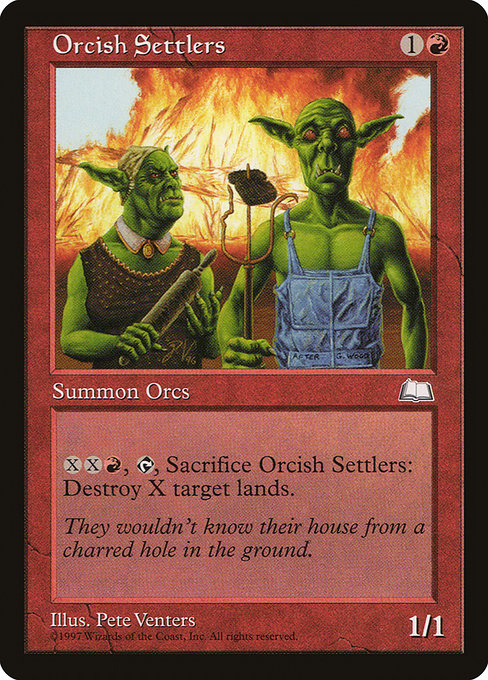
Meet Orcish Settlers
- Mana cost: {1}{R} (CMC 2)
- Type: Creature — Orc
- Rarity: Uncommon
- Set: Weatherlight (wth), released in 1997
- Oracle text: {X}{X}{R}, {T}, Sacrifice this creature: Destroy X target lands.
- Power/Toughness: 1/1
- Flavor text: "They wouldn't know their house from a charred hole in the ground."
Designed as an uncommon, Orcish Settlers embodies a curious blend: a low-cost body that can pivot into a high-impact late-game play via mana investment. The card’s rarity signals collection value and playability in casual formats, while the X in the activation text invites players to consider how far red’s explosions can reach when you’re willing to pay for them. ⚔️🎨
The Math Behind the Mayhem: Why the X matters
Cast at a base cost of 2 mana, Orcish Settlers’ real power unfolds when you ramp into its potential. The activation cost is {X}{X}{R} and the effect is to destroy X lands. This means you can trade a fragile 1/1 body for a land-destruction engine that scales with your mana investment. The rarity provides a design guardrail: you’re not getting a broad, unconditional board wipe—you're getting a programmable tool that can take out a handful of lands or, if you’ve got the mana to spare, a devastating strip-mining field clear. That tension—low initial cost, high ceiling—sits at the heart of rarity-versus-mana-cost discussions. 🧙♂️🔥
Where It Shines: Casual, Cube, and Vintage Legacies
In casual play, Orcish Settlers can shine as a spicy commander or teammate-friendly card that punishes overextension. In cube, it becomes a classic “ramp into big-X” card that rewards players who build around efficient mana acceleration. Its uncommon status helps keep it accessible in a wide card pool, while the X-based payoff preserves that thrilling “one more mana and the world tilts” moment. In formats where land destruction is legal and thematic—Legacy and Vintage, to an extent—the card can make a cameo as a flavorful, grindy option, though it won’t be a staple. Its EDHREC ranking around the mid-teens of thousands underscores its status as a niche pick that fans adore for flavor and swingy plays rather than tier-1 competitiveness. 🧲🎲
Flavor, Art, and Design: Why the Card Still Speaks
Pete Venters’ art captures the rugged crunch of orcish labor and the rough-edged expansion ethos of Weatherlight. The flavor text lands a wry note about orcish life—survival, stubbornness, and a house that’s as likely to be a charred ruin as a home. The rarity choice aligns with early Magic design: uncommon cards often housed bold, unusual effects that could swing in a single, memorable moment. Orcish Settlers is a textbook example of how a seemingly tiny investment at casting time can unlock a colossal effect later on, a core principle that still fuels debates about power curves today. 🎨⚔️
Collectibility and Market Lens
As an uncommon from Weatherlight, Orcish Settlers sits in a sweet spot for collectors who chase nostalgic design spaces and retro mechanics. It isn’t a chase-card like a mythic, but the combination of its art, flavor, and the “X” mechanic keeps it interesting for card connoisseurs. Its market price has hovered in a modest range, with foil variants often commanding higher premiums in the right condition. The lesson here mirrors the broader MTG truth: rarity gives you a baseline, but the mana-cost architecture and the activation text create lasting intrigue that endures beyond a card’s initial print run. 🧙♂️💎
Design Takeaways for Modern Set Designers
Orcish Settlers shows how a designer can:
- Use a simple mana-cost frame to hide a scalable, high-impact ability.
- Balance risk and reward by requiring a sacrifice to unlock the effect.
- Anchor a potentially powerful mechanic (X) to a color’s archetype — red’s impulsive, tempo-driven edge — while tying that to rarity to shape how players value the card in different formats.
For players drafting new sets or tuning cubes, the card is a reminder that value isn’t just about raw stats; it’s about how a card invites you to invest, plan, and time your maneuvers. And yes, sometimes you want to destroy lands just to watch a plan come together—especially when the payoff scales with your mana strategy. 🧭🔥
If you’re crafting your collection or curating a retro-styled deck, consider how Orcish Settlers fits into broader themes: red aggression, land-control narratives, and the enduring charm of Weatherlight’s era. And if you’re browsing for a little real-world inspiration between rounds, you can keep the vibe going with gear that protects your everyday life as fiercely as your mana investments protect your board state. Speaking of which, while you study mana costs and card synergies, you might want to shield your tech with style—check out this neon, clear silicone phone case designed for modern pilots of the multiverse. 🔥🧙♂️