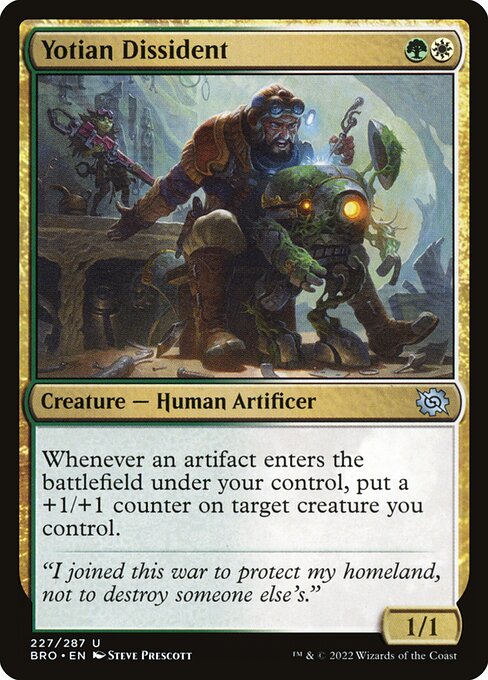
Image courtesy of Scryfall.com
Reprint Economics in the MTG Market
When we talk about the economics of Magic: The Gathering, the focus often lands on the big-ticket reprints that flood shelves and reset price baselines for years. But the truth lies in the microcosms—cards like Yotian Dissident, a GW artifact creature from The Brothers’ War (BRO). This uncommon 2-mana 1/1 pairs green and white to fuel artifact-heavy boards, offering a straightforward trigger: whenever an artifact you control enters the battlefield, you get to put a +1/+1 counter on a creature you control. Simple on the surface, but it’s precisely that simplicity that makes it a useful case study for understanding how reprints, supply chains, and format demand interact over time 🧙🔥💎⚔️🎨🎲.
Card snapshot: Yotian Dissident
- Set: The Brothers' War (BRO)
- Rarity: Uncommon
- Mana Cost: {G}{W}
- Types: Creature — Human Artificer
- Power/Toughness: 1/1
- Oracle Text: Whenever an artifact you control enters, put a +1/+1 counter on target creature you control.
- Flavor Text: "I joined this war to protect my homeland, not to destroy someone else's."
- Artist: Steve Prescott
- Foil: Yes; nonfoil and foil finishes available
- Prices (as listed): USD 0.12; USD foil 0.37; EUR 0.13; EUR foil 0.27; TIX 0.03
In terms of design, Yotian Dissident embodies the elegant efficiency of mid-range artifact support. Its two-mana cost aligns with tempo-friendly starts, while the +1/+1 counter mechanic scales with artifact cadence on the battlefield. It’s a card that rewards players who lean into artifact synergies—think vehicles, thopters, treasures, and modular toolkits that keep an entrance cadence flowing each turn. The flavor of a conflicted artificer who fights for homeland rather than conquest adds a narrative layer to the mechanics, making the card feel like more than just a number on a cardboard rectangle 🧙🔥.
Gameplay implications and synergy
From a strategic standpoint, Yotian Dissident acts as both a glue and a nudge for artifact-heavy decks. In Commander or casual formats, you can leverage multiple artifact enters to stack value on your board. Every time an artifact you control enters, you grow a creature’s battlefield presence by popping a +1/+1 counter onto a creature you already own, which can snowball into meaningful pressure over several turns. The trigger rewards efficient artifact deployment—equipment, clue tokens, mana rocks, or even deck-enriching enchantments that produce artifacts—so your build becomes less about raw card advantage and more about tactical tempo and incremental growth. It’s a small cog that can turn a midrange plan into a tangible victory path in formats where artifact synergy is king ⚔️🎨.
Because the card resides in The Brothers’ War, its future reprint prospects are intertwined with broader demand. BRO featured a lot of nostalgia-pumping reprint cycles and showcases for classic pieces, but Yotian Dissident itself was not reprinted in a subsequent modern set on the data we have here. That means the card sits in a position where supply is relatively fixed for the near term, with price nudges driven primarily by ongoing Commander demand, casual play interest, and foil collectors who chase a gleaming finish for a favorite build 🧙🔥.
“I joined this war to protect my homeland, not to destroy someone else’s.”
The economics here hinge on a few classic principles: limited print waves, steady conversion of speculators into long-term holders, and the evergreen appeal of commander formats that support colorful, interactive creature strategies. The nonfoil card tends to hover around a few dimes to a few quarters for many players, while foil versions attract a modest premium—primarily due to foil fans who want the tactile feel of a glossy, collectible artifact on their battlefields 💎. The presence of a TIX market price, while nominal here, also illustrates how MTG economics isn’t just about dollars and centavos; it’s about liquidity in a living ecosystem where players buy, trade, and cast in real time 🎲.
Economic lifecycle: a macro lens
When we analyze the lifecycle of a card’s value, several stages emerge, and Yotian Dissident offers a clean lens to examine them:
Release in a set that emphasizes artifact synergy can obscure an uncommon’s value if the deck archetype isn’t widely adopted. Early demand is typically modest for uncommons, especially those that aren’t staples in competitive formats. As players discover synergy opportunities (artifact enter triggers, ETBs, and token strategies), demand grows among collectors and deck builders. This is where foil variants often gain traction despite a low base price for nonfoils. A reprint in a major set or anthology line would typically drive a price drop across foil and nonfoil copies, reshaping the market for budget players and altering the long-tail collector value. In the long run, the card’s utility in Commander and casual play tends to stabilize around a modest baseline, with foils and etched foils sometimes generating a secondary spike during special set rotations or reprint rotations.
For Yotian Dissident, the numbers—USD 0.12 nonfoil, USD 0.37 foil, EUR 0.13 nonfoil, EUR 0.27 foil, and TIX around 0.03—paint a picture of a budget-friendly pick for budget setups, with foil versions offering a glint of collector appeal. The intangible value lies in its flavor, its role in artifact-centric shells, and the nostalgia attached to The Brothers’ War era that continues to resonate with players who adore revisiting MTG’s history 🧙🔥.
Takeaways for players and collectors
- Look for synergy opportunities: if your deck leans on artifacts entering the battlefield, Dissident’s trigger can be a reliable engine for growing threats over time 🎲.
- Foil seekers might find a modest premium worth chasing, especially for players who want a visually striking addition to a GW artifact theme ⚔️.
- Monitor reprint cycles: a future reprint would alter the price baseline, but ongoing Commander demand can sustain interest even after a reprint wave.
- Flavor and lore matter: a character fighting for homeland adds depth to a battlefield where tools and artifacts are the real protagonists 🎨.
Whether you’re a seasoned collector, a commander connoisseur, or a casual player who loves seeing artifacts weave into your battlefield narrative, Yotian Dissident helps illuminate how the MTG economy breathes—one artifact entry at a time 🧙🔥💎.