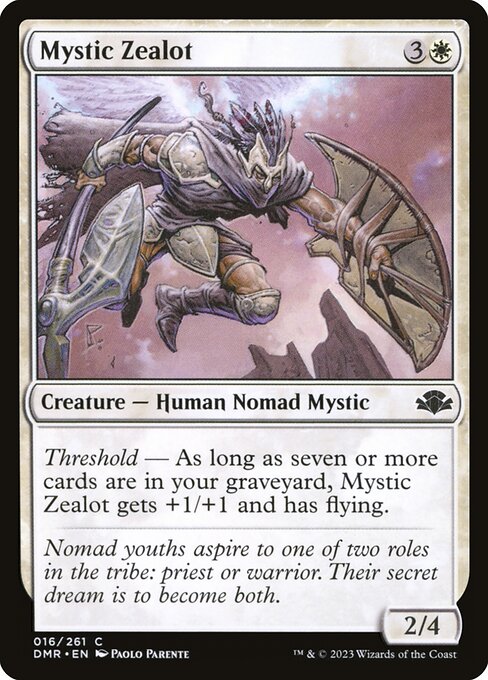
Image courtesy of Scryfall.com
Mystic Zealot and White Aggro: A Hidden Riser in Dominaria Remastered
White aggression has always thrived on the edge of efficiency and tempo, skittering in to land early damage, spark victories, and keep opponents in a perpetual race to keep up. Mystic Zealot slides into that space with a quiet, stubborn charm. A four-mana, white creature—{3}{W}—it starts as a sturdy 2/4, a respectable body for the cost, but it hides a subtle, game-shifting trick: Threshold. When your graveyard swells to seven or more cards, this nomad mystic becomes a (3/5) flyer. That upgrade isn’t just numbers on a card; it represents a strategic pivot—turning a reliable late-game threat into an unexpected air assault that can overwhelm slower boards or close out a race when most expect a lull. 🧙♂️🔥💎
What makes Mystic Zealot tick?
At its core, Mystic Zealot is a resilient pressure piece. The base 2/4 body provides a solid blocker-turned-attacker profile in the early stages of a game. In a typical white aggressive shell, you’re aiming to push damage quickly while keeping a tight curve. Zealot’s true value surfaces once you’ve built a graveyard that hits seven, triggering flying and the +1/+1 boost. That dual upgrade—reach and evasion—lets you punch through a stalled board, threaten a race you were told you couldn’t win, and keep up the aggression even when your opponent starts to stabilize. The flavor text reminds us that Nomad youths dream of a dual role—priest and warrior—and in practice, Zealot embodies that tension: pious purpose meets battlefield prowess. 🎨⚔️
Let’s talk numbers in plain language: as a 2/4 for four mana, Zealot is not a glass cannon; it’s a sturdy workhorse that scales with your graveyard. The threshold condition rewards deck-building imagination—how can you reliably generate seven cards in your own graveyard by midgame without compromising your early plan? This is where the strategic beauty lies: you’re not simply playing a creature; you’re piloting a small, deliberate plan to unlock a bigger threat when the moment is ripe. In this sense, Mystic Zealot isn’t a one-note beater but a strategic pivot that rewards thoughtful sequencing and board awareness. 🧠🪄
How to weave Mystic Zealot into an aggressive white deck
- Plan the graveyard build: In an aggressive white shell, you typically want to maximize early damage while keeping the door open for threshold to spark. Deliberately engineering seven cards in the graveyard—through self-milling, looting, or choosing cards that cycle—lets Zealot flip into a flying threat with +1/+1. It’s a calculated gamble that pays off when tempo becomes a weapon. 🧭
- Protect and pressure: Use efficient removal and evasive threats to pressure life totals while you feather in your graveyard strategy. Zealot’s flying ability helps it bypass ground blockers, turning even a modest 3/5 into a menacing clock in the air. Pair it with other white creatures that can keep the board tight, and you create a two-pronged assault that’s hard for opponents to answer in time. ⚔️
- Bridge to the midgame: The moment Zealot flips, you’re entering a midgame where a single well-timed attack can swing the game. Treat threshold as a temporary upgrade—don’t lock into waiting for the trigger if you’re already ahead; instead, cleverly convert your pressure into a resilient flyer that demands answer on multiple fronts. 🧙♂️
- Synergy picks for white aggro: Support cards that smooth out your curve or help you maintain momentum—early creatures, efficient pump, or cheap cantrips that cycle your hand while advancing your graveyard plan. Think in terms of tempo and reach: the Zealot is your insurance policy that can deliver surprise damage from the skies. 💎
“Nomad youths aspire to be both priest and warrior; the dream is to be both.” The flavor of Mystic Zealot hints at a larger tribal rhythm in Dominaria Remastered, but in a practical sense it translates to a white strategy that values adaptability as much as aggression. Keep your eye on the board and your graveyard tally—when seven lines up, the Zealot takes off. 🎨
Deckbuilding considerations and practical tips
Dominaria Remastered brings Mystic Zealot into a curious space for players who love white aggro with a twist. Since the card is a common in a set that emphasizes thematic reprints, it’s accessible for budget-conscious builds while still offering a genuine strategic payoff. The dual-faced value—solid on the ground, then spry in the air—means you don’t need perfect synergy to get value. A well-timed Zealot can close a game that looks like a grind, and that moment feels especially satisfying in a red-white or white-centric plan. Carry-over value matters here: even if you never fully flip the threshold, a 2/4 early is a credible tempo play that can force trades and keep you ahead. 🧙♂️🔥
For players chasing collector vibes or casual reenactments, the card’s artwork by Paolo Parente and its reprint in Dominaria Remastered add flavor to your binder—an anchor for color identity and a reminder of the set’s nostalgia arc. The card’s rarity is common, with foil and non-foil finishes available in the product line, and even with a modest price tag, its ceiling in terms of play value is pleasantly surprising for a common. It’s the kind of piece that can spark conversations about threshold, tempo, and the joy of pushing a niche mechanic into the mainstream. 💎
Seeing it in the wild: formats and accessibility
Mystic Zealot is legal in formats that welcome its threshold shenanigans, including many historical and fringe builds where white aggressive strategies flourish. In Modern or Pioneer, you’d typically opt for different, more consistently aggressive threats, but in formats that respect older sets and reprints—including Commander and certain Legacy-adjacent spheres—the Zealot can shine as a flexible piece that rewards deckbuilding nuance. And yes, in casual play it’s a fantastic talking point about how a card’s ceiling can hinge on your graveyard plan and timing. 🧙♂️
Pricing notes—don’t scroll past the thrill of seeing a card land on the battlefield and realize your plan wasn’t just about haste, but about the subtle threshold that makes preparation worthwhile. The numbers in the market reflect a modest footprint, with foil variants offering a touch of splashy appeal for display and collection. For deck builders, that means you can experiment without breaking the bank, which is precisely the kind of accessibility modern MTG players crave. 🔥
If you’re a fan who loves blending nostalgia with playability, this dynamic gives you a reason to revisit Dominaria Remastered and reimagine how a midrange tempo plan can coexist with a throwback threshold trick. The Shadow of the Zealot isn’t merely a single card; it’s a philosophy—a reminder that white aggro can be as cunning as it is direct. 🎲