Image courtesy of Scryfall.com
Naga Eternal Sealed Product Scarcity in MTG Markets
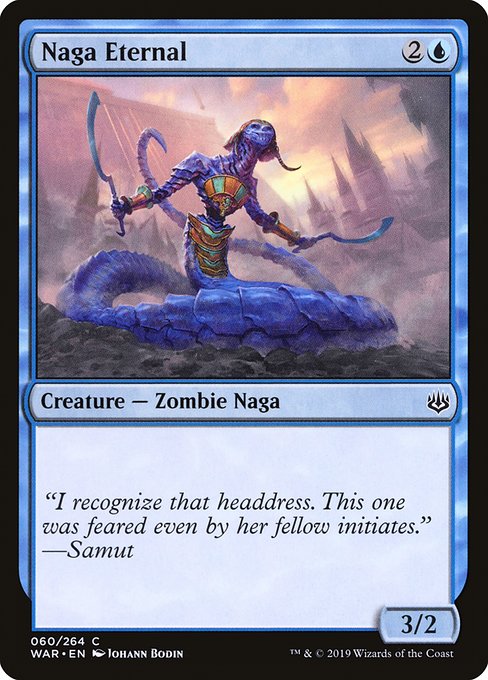
In the grand theater of Magic: The Gathering economics, sealed product scarcity is a living, breathing creature that rarely behaves the way new players expect. War of the Spark arrived amid a perfect storm: a mechanically rich set, a sprawling story, and a wave of booster displays, bundles, and special editions that flooded shelves—and yet, even common cards are not immune to the market’s tug-of-war between supply and demand. 🧙🔥 The blue, 2U creature Naga Eternal—a Zombie Snake sporting a 3/2 body—serves as a telling case study. Its card data reads like a snapshot of modern MTG: a common rarity, printed in War of the Spark (set name often abbreviated as War), released in 2019, with a mana cost of {2}{U} and flavor that nods to Samut’s remembered fear and reverence. The realities of sealed product scarcity, however, aren’t driven by a single card’s popularity; they’re shaped by how a set is printed, how products move through distribution channels, and how collectors and players value sealed boxes years after release. ⚔️
The Card in Context: War of the Spark and a Scarcity Narrative
Naga Eternal hails from War of the Spark, a set built around a climactic magical conflict. Its artwork by Johann Bodin captures that crisp, cinematic edge the set is known for. With a mana cost of {2}{U}, blue mana’s hallmark of tempo and evasion is evident, even if the creature’s raw stats (3/2) don’t scream top-tier power. The rarity is listed as common, meaning it’s widely available as a foil and nonfoil in booster displays and packs. While these attributes would suggest “low value” in the singles market, sealed product markets tell a more nuanced story. The card’s price might sit at a few cents to a couple of dimes depending on foil status and regional demand, but the sealed product ecosystem—boxes, packs, and bundles—carries its own gravity. Current numbers in markets often reflect a low-cost snapshot for the individual card (USD around $0.04 nonfoil, $0.12 foil), yet the broader sealed market reveals a different kind of scarcity—one that’s about distribution, storage life, and the risk of future reprints. 💎
Sealed Product Scarcity: What Drives the Curve?
- Print volume and distribution: War of the Spark was a high-visibility era for MTG. The supply chain delivered mass quantities of booster boxes, bundles, and special edition products. However, as collectors and players chase sealed product for the long haul, even sets with generous print runs can show pockets of scarcity due to regional demand, store allocations, and the natural attrition of products kept in closets and warehouses for years. 🎲
- Reprint risk and product lifecycles: The moment a set enters rotation or gets a reprint in a later product line, the perceived scarcity can shrink quickly. Naga Eternal itself isn’t a marquee chase card, but sealed boxes of War of the Spark still carry the aura of a complete, finite bundle. The market’s memory extends beyond the card’s rarity; it extends to the entire product’s risk profile. 🧙♂️
- Foil versus nonfoil dynamics: Foil products tend to hold value longer, even when the nonfoil cards in the same set don’t, simply because foils are more physically scarce in critical printings. The price delta for foil versions—USD around $0.12 for Naga Eternal, versus $0.04 nonfoil—reflects this supply-demand friction. Collectors who sought the shimmer of foil cards helped maintain some premium in sealed products years after the original release. ✨
- Channel constraints and retail behavior: Local game stores, online marketplaces, and distributor allocations determine how quickly sealed stock moves. Pandemics, shipping bottlenecks, and even the cadence of events like Friday Night Magic influence how much sealed stock sits on shelves versus being shuffled into display cases and subscription bundles. The end result is a narrative where scarcity can appear in microbursts, even within a broad-set release. 🧭
- Investor sentiment and nostalgia: As players age into commander formats and nostalgia becomes a selling point, sealed War of the Spark boxes can gain a reputation as a “safe” or “timely” purchase for future liquidity, even if individual cards remain inexpensive. That sentiment adds a whisper of value to the entire product line, not just to the rares and mythics that capture the spotlight. 💬
Strategic Takeaways for Collectors and Players
If you’re weighing whether to buy sealed War of the Spark today, balance the math with the mood of the market. The economics aren’t about chasing the flashy creatures or the big-studio mythics; it’s about understanding how supply chains, reprint risk, and long-tail demand shape today’s prices and tomorrow’s liquidity. For players who enjoy building sets or diving into draft experiences, sealed product offers a hedge against single-card volatility, even if the individual card prices for Naga Eternal are modest. In practice, that means evaluating your storage capabilities, your long-term horizon, and your appetite for risk. 🧙♀️
The emotional pull of a set’s lore—the way flavor text such as “I recognize that headdress. This one was feared even by her fellow initiates.” —Samut helps connect players to a broader story—also adds intangible value to the sealed product’s narrative. And even when you’re not chasing a $5 to $10 spike for a single foil, you’re buying into a piece of the set’s history, its distribution decisions, and the community’s ongoing conversation about what’s valuable, playable, or merely collectible. The War of the Spark era didn’t just deliver battles on the battlefield of Ravnica; it created a market dynamic where scarcity is less about scarcity in a vacuum and more about scarcity relative to what collectors and players want, when they want it. ⚔️
Practical Tips for Navigating the Market
- Track regional distributor allocations and local store stock to gauge real supply instead of relying solely on online sticker prices. 🗺️
- Consider foil-focused bundles if you’re chasing sealed product liquidity or potential future resale value. Foils tend to preserve some premium, even for commons. 🔎
- Balance the appeal of the set with the likelihood of a reprint or a shift in the meta that changes demand for sealed boxes. Knowledge is your best shield against volatility. 🧭
- Store product in a climate-controlled environment and label storage by set and edition to minimize wear and maintain resale value over years. 🎨
As you navigate the multiverse of sealed product, the lesson from Naga Eternal is clear: even a humble common from a crowded set can illuminate a broader market truth. The magic isn’t just in the cards you hold, but in the stories you tell about how products travel from the factory to your shelf—and how the market decides which stories endure. 🧙♂️💎